30 Jan 2025 - {{hitsCtrl.values.hits}}
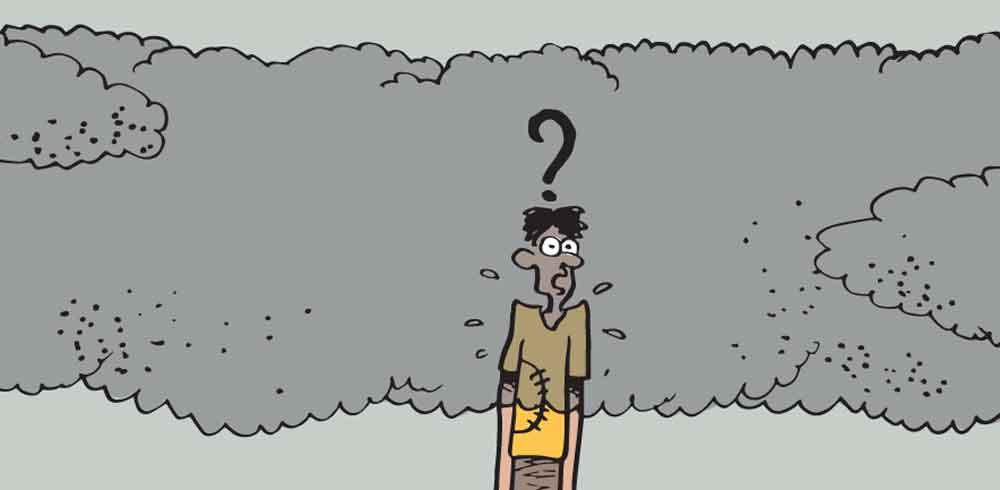
Colombo is once again covered in a thick smog and it seems to be a phenomenon that we may have to deal with more often. Commonly known as ‘transboundary air pollution’, climate scientists describe it as ‘particulate matter pollution’ which is observed every time the Bay of Bengal experiences a depression, resulting in cyclonic conditions followed by heavy rainfall. The National Building Research Organisation announced that the air quality in areas such as Kilinochchi, Trincomalee, Chilaw, Mullaitivu, Puttalam, Dambulla, Matale, Negombo, Kandy, Colombo, Ratnapura, Batticaloa, Kurunegala, Mahiyanganaya, Gampaha, Ambalantota, Galle, Bandarawela, Monaragala, and Polonnaruwa has dropped to unhealthy levels.
The United States Environmental Protection Agency (US EPA) defines ‘particulate matter’ or particle pollution as a mixture of solid particles and liquid droplets found in the air. According to US EPA particle pollution includes PM10 and PM2.5 particles where the former comprise inhalable particles, with diameters that are generally 10 micrometers and smaller while the latter comprise fine inhalable particles, with diameters that are generally 2.5 micrometers and smaller. According to the U.S. Air Quality Index, the smallest particulate material, PM 2.5, has a value of between 100 and 150, a condition that can have a profound effect on sensitive groups.
According to a World Bank study on transboundary air pollution in South Asia, over 50 percent of air pollution is not local but transboundary in nature, travelling from a neighbouring city, state, or even country. Studies reveal that 31% of PM2.5 in the South Asian region comes from residential sources, including the use of solid fuels for heating and cooking. Additionally, a growing fleet of personal vehicles and continued reliance on coal for energy production poses the challenge of increasing levels of nitrogen dioxide and PM2.5.
In a recent article published by the Daily Mirror, experts believe that this phenomenon had been happening since the 1990s primarily due to the long-range transport of air pollutants from the Indian sub-continent - sometimes from South East Asia and occasionally from the Arabian Peninsula. One climate researcher observed how Sri Lanka is impacted by air pollution due to agricultural burning in India. The researcher claims that small time farmers have to burn their harvests but that laws against burning crops cannot be enforced at the village level.
But when the writer questioned an Indian climate scientist regarding the possible link between Delhi’s smog and Sri Lanka’s lower air quality levels, the scientist not only refuted these claims but said that the origins of the winds can be traced to Europe or Africa over a 7-10 day period.
Back in the 1960s, when scientists across Europe were investigating high levels of acid deposits in lakes and rivers, which led to volumes of fish dying, they concluded that air pollutants emitted thousands of miles away were causing the harm. This scientific evidence that air pollutants travel long distances set the stage for the United Nations Economic Commission for Europe Convention on Long-range Transboundary Air Pollution (CLRTAP) in 1979— the first and the oldest multilateral agreement on clean air signed by 51 partners.
One of the concerns raised by climate researchers is with regards to the lower emission standards maintained by Sri Lankan environmental authorities. But several ‘airshed management approaches’ have been taken across the region to tackle air pollution. In 2020, India implemented the vehicle tailpipe emission standards. With these new standards, India has introduced stricter limits for on-road and non-road vehicles. In Kathmandu, Nepal following the earthquake in 2015, brick kilns were rebuilt using the cleaner zig-zag technology. This new type of kiln led to reductions in fuel use and lower emissions. In Pakistan, legislators and clean air advocates developed a National Clean Air Plan.
While climate change has now become a growing concern across all regions in the world, the impact of global greenhouse gas emitters on countries such as Sri Lanka is worsening by the day. Therefore it is high time that the new government looks at implementing stricter emission standards and moving towards renewable energy in order to tackle the prolonged impact of air pollution on Sri Lanka.
09 Jul 2026 8 hours ago
09 Jul 2026 9 hours ago
09 Jul 2026 09 Jul 2026
09 Jul 2026 09 Jul 2026
09 Jul 2026 09 Jul 2026