Reply To:
Name - Reply Comment

|
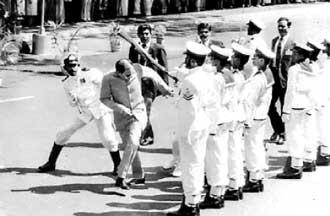
Indian PM Rajiv Gandhi being attacked by a Sri Lankan Navy sailor |
The Indo-Lanka Peace Accord, signed in Colombo on July 29 1987 by Indian Prime Minister Rajiv Gandhi and Sri Lankan President J.R. Jayewardene, remains one of the most consequential—and controversial—agreements in Sri Lanka’s modern political history.
Conceived as a framework to end the ethnic conflict, the accord sought to devolve power to the provinces through the Thirteenth Amendment to the Constitution and the Provincial Councils Act of 1987, while requiring Sri Lankan troops to withdraw to barracks in the North and Tamil militant groups to surrender their arms. Crucially, the agreement also provided for Indian military assistance at Sri Lanka’s request, a provision that led to the deployment of the Indian Peacekeeping Force (IPKF) in the North and East.
Nearly four decades later, the agreement continues to divide opinion. It was an externally imposed settlement that failed to address the underlying causes of the conflict and instead triggered new waves of violence.
One of the most memorable moments following the signing came during the joint press conference held by Jayewardene and Gandhi. Responding to a question about why he had not reached an agreement with Tamil leaders earlier, Jayewardene candidly admitted: “It is a lack of courage on my part, a lack of intelligence on my part, a lack of foresight on my part.” The unusual public acknowledgement, later reported by the Sunday Observer (August 16 1987), surprised many observers, as Jayewardene was rarely known for openly admitting political mistakes.
Regional pressure and India’s strategic interests
The accord was signed after months of increasing pressure from India. By mid-1987, Sri Lanka’s military campaign in the North had drawn regional attention, while India was grappling with the arrival of approximately 125,000 Tamil refugees following the anti-Tamil violence of Black July in 1983.
Relations between Colombo and New Delhi had deteriorated significantly after the return of Prime Minister Indira Gandhi to power in 1980. Strategic concerns also complicated bilateral ties. India’s security establishment viewed Sri Lanka’s growing cooperation with Western powers, including expanded facilities for the Voice of America transmission station and commercial proposals involving the Trincomalee oil tank farm, with considerable suspicion during the Cold War.
Preventing external powers, particularly the United States, from establishing a stronger strategic presence in Sri Lanka was widely viewed as an important consideration in New Delhi’s regional policy. The situation reached a turning point in June 1987 when the Indian Air Force conducted a humanitarian airdrop over Jaffna, popularly remembered as the “Parippu Drop.” The operation demonstrated India’s willingness to intervene directly. Contemporary accounts also record Indian High Commissioner J.N. Dixit’s firm message urging Colombo to “act now,” reinforcing the perception that Sri Lanka had little room to resist Indian pressure.
A divided nation
Political opposition quickly intensified. The Janatha Vimukthi Peramuna (JVP), sections of the Sri Lanka Freedom Party (SLFP), the Buddhist clergy, and nationalist organisations mobilised widespread protests. Prime Minister Ranasinghe Premadasa and National Security Minister Lalith Athulathmudali were both regarded as skeptical of the agreement, although the government ultimately proceeded with the signing. As Rajiv Gandhi arrived in Colombo on July 29 1987, curfews had already been imposed amid escalating unrest.
Reports from the period indicate that India dispatched naval vessels near Colombo and remained prepared to assist the Sri Lankan government should the situation deteriorate further. By the time the accord was signed that afternoon, Colombo remained largely deserted under curfew. However, in the city’s suburbs and across many outstation areas, widespread violent demonstrations, arson, and destruction of public and private property continued as security forces struggled to restore order. The violence surrounding the accord nearly claimed the lives of both signatories. Immediately after the signing ceremony, Rajiv Gandhi inspected a ceremonial guard of honour. During the parade, a Sri Lankan naval rating struck Gandhi with the butt of his rifle. Gandhi instinctively moved, avoiding what could have been a far more serious injury. The incident instantly became one of the defining images associated with the accord and illustrated the depth of hostility it had generated among sections of the security forces and the public.
Jayewardene himself narrowly escaped death less than three weeks later. On 18 August 1987, a suspected JVP supporter threw two hand grenades into a government parliamentary group meeting attended by the President, Prime Minister Premadasa and senior cabinet ministers. One minister was killed, and Lalith Athulathmudali suffered serious injuries. Had both grenades exploded as intended, much of Sri Lanka’s political leadership could have been wiped out in a single attack.
A central weakness of the accord was that the Liberation Tigers of Tamil Eelam (LTTE) had not been a party to the negotiations. Although the organisation initially agreed to surrender some weapons, disarmament proved only partial.
Within months, relations between the LTTE and the IPKF collapsed into open warfare. The force, originally deployed as a peacekeeping mission, became engaged in an intense counter-insurgency campaign that lasted from 1987 to 1990. More than 1,200 Indian soldiers lost their lives during the conflict, while civilians and combatants on all sides suffered heavy casualties.
The conflict was further complicated by disagreements over implementing the accord. Some commentators alleged that India sought to expand the LTTE’s political role within the proposed North-Eastern Provincial administration. Other allegations, including claims published by journalists regarding secret understandings between Indian officials and the LTTE, have remained disputed and have never been conclusively established.
Internationally, the agreement received widespread praise. United States Congressman Stephen Solarz even announced his intention to nominate Jayewardene and Gandhi for the Nobel Peace Prize, describing the accord as an act of statesmanship. Domestically, however, implementation faltered. Although the accord resulted in the creation of Provincial Councils and the temporary merger of the Northern and Eastern Provinces, it failed to achieve its principal objective of ending the civil war. Political changes in both countries further weakened their momentum. Premadasa, who succeeded Jayewardene, sought the withdrawal of the IPKF, while India’s changing leadership also altered New Delhi’s priorities.
In 1990, India and Sri Lanka agreed on the phased withdrawal of the IPKF, which was completed later that year. The LTTE subsequently reoccupied many areas vacated by Indian troops, and the civil war resumed with renewed intensity. Years later, the legality of the North-East merger was successfully challenged before Sri Lanka’s Supreme Court. In October 2006, the Court ruled that the emergency regulations used to merge the provinces had not complied with the law, effectively ending the merger.
The accord’s legacy was further overshadowed by tragedy. In 1991, former Indian Prime Minister Rajiv Gandhi was assassinated in Tamil Nadu by an LTTE suicide bomber. This act permanently altered India’s relationship with the organisation and remains one of the defining events of South Asian political history. The Indo-Lanka Peace Accord endures as one of the boldest yet most contentious diplomatic initiatives in Sri Lanka’s post-independence history. While it introduced constitutional reforms that remain in force today through the Thirteenth Amendment, it failed to secure lasting peace. Instead, it became a turning point that reshaped Sri Lankan politics, transformed Indo-Lanka relations, and demonstrated the immense challenges of resolving deeply rooted ethnic conflict through political agreements alone.