01 Mar 2025 - {{hitsCtrl.values.hits}}
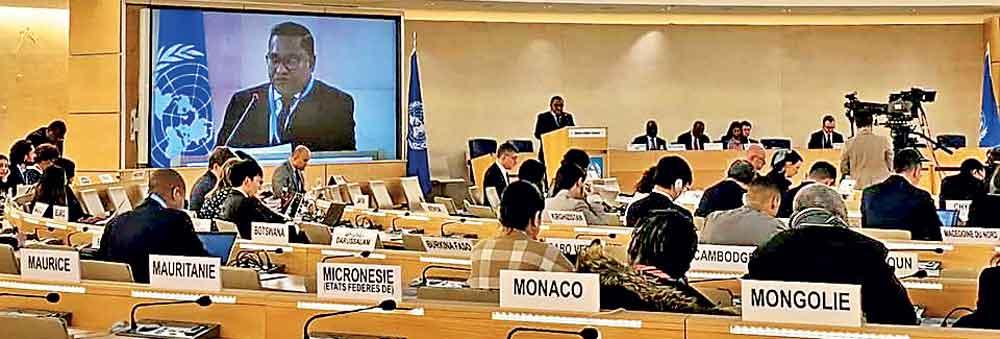
Foreign Minister Vijitha Herath addressing the 58th Regular Session of the United Nations Human Rights Council
Even if the president accepted the UNHRC’s accountability process, with him having been elected only by 42 percent of the valid voters, he should be a political extremist by Sri Lankan standards, if he antagonizes the majority Sinhalese at a time when another countrywide election is at the corner
While Foreign Affairs Minister Vijitha Herath was in Geneva delivering his speech at the 58th Regular Session of the United Nations Human Rights Council (UNHRC) on Tuesday, former President Ranil Wickremesinghe had addressed a group of youth whom he met at his office where he advised the government and the main political parties in the country to take the double standard of the UNHRC seriously.
“This matter has to be taken seriously as the UNHRC is expected to take up a resolution on Sri Lanka in September this year,” Wickremesinghe stated, according to the Daily Mirror.
What he expects the government to do in respect of the UNHRC resolution in September is not clear. The most the National People’s Power (NPP) government could do is to reject the resolution, as it did last October. What else does Wickremesinghe expect?
Criticising Many European nations for their silence on Ukranian President Volodymyr Zelensky not holding the Presidential election in his country, Wickresinghe also said, “In Sri Lanka we held elections at times when the LTTE was fighting in the North and JVP in the South. Sri Lanka has held elections on time. We held elections in 2024 and a JVP led government is in power currently.”
This is a fascinating statement as to how a Sri Lankan politician should be. He seems to be of the view that people have forgotten last year’s Supreme Court ruling that he as the Minister of Finance, and the then members of the Election Commission have violated the fundamental rights of the people through the postponement of the 2023 Local Government Elections. And there was a fear among the Opposition parties that he might postpone the Presidential Election as well, as he attempted to bring in an amendment to the Constitution on the term of the President.
Going back to the UNHRC issues, it also must be noted that except for the first resolution presented by Sri Lanka eight days after the end of the war in Sri Lanka in 2009 and the resolutions passed during the Yahapalana government when Wickremesinghe was the Prime Minister, all other resolutions on the country have been rejected by successive governments. Would the NPP government accept or co-sponsor the next resolution as the Yahapalana government did?
There was a doubt about the action the NPP government might take with regard to the last year’s resolution before they rejected it, since the NPP or its core constituent party, the Janatha Vimukthi Peramuna (JVP) had never expressed its stance on UNHRC resolutions since 2009. Yet, they rejected it.
Subsequently, Babu Ram Pant, Deputy Regional Director for South Asia at Amnesty International, said “As the country is undergoing a period of political transition following recent presidential elections and with general elections scheduled for next month, it is critical that the new Sri Lankan government breaks from the past and fully engages with the UN Human Rights Council and OHCHR’s Sri Lanka Accountability Project. It was disappointing therefore that the government instead chose to continue past policy and express opposition to evidence gathering by the UN.”
In fact, the very “period of transition” prevented the NPP from breaking from the past. Even if the president accepted the UNHRC’s accountability process, with him having been elected only by 42 percent of the valid voters, he should be a political extremist by Sri Lankan standards, if he antagonizes the majority Sinhalese at a time when another countrywide election is at the corner. A political party that had waited nearly sixty years and sacrificed lives of tens of thousands of its members before it partially got hold of the reins of power might have reasonably thought it justifiable to compromise one or two policy matters for the sake of total power.
Minister Herath told the UNHRC on Tuesday, “Our aim is to make the domestic mechanisms credible and sound within the constitutional framework. This will include strengthening the work towards a truth and reconciliation commission empowered to investigate acts of violence caused by racism and religious extremism that give rise to tensions within Sri Lankan society.”
The UNHRC officials have been insisting on a process that would make those who violated international human rights and humanitarian laws during the war in Sri Lanka accountable. It is not clear whether they would be satisfied with the truth and reconciliation commission proposed by minister Herath.
Sri Lanka has gone back on its words to the international community on truth seeking issue several times. On September 14, 2015, the then foreign Minister Mangala Samaraweera told the UNHRC that his country was launching a truth and reconciliation commission after its decades-long civil war. Again, 17 months later, on February 28, 2017, he told the 34th Session of the UNHRC that the Sri Lankan Government expected a draft legislation on a Truth-Seeking Commission to be presented to the Cabinet within the next two months.
However, not within two months but after about 20 months, on October 16, 2018, a conceptual framework was submitted to the cabinet which said the Truth Commission will look into the grievances suffered by the people during past conflicts.
Yet, nothing on the matter was heard for over four years till January 2023 when the Cabinet approved another concept of a Truth and Reconciliation mechanism proposed by the Cabinet Sub-Committee on Reconciliation, chaired by Wickremesinghe who was this time the President of the country. Meanwhile, the recommendations of a commission headed by Supreme Court Judge Dilip Nawaz also referred to a Truth and Reconciliation Commission whose contours were yet to be set out.
As a follow up step of this concept paper, Foreign Minister Ali Sabri and Justice Minister Wijeyadaa Rajapakshe took a five-day visit to South Africa in March 2013, to further study the subject. Another nine months later, on December 8, 2023, the President’s Media Division had announced that the government has decided to establish an independent “Commission for Truth, Unity and Reconciliation.” It took another 14 months for us to hear about the truth-seeking mechanism from Minister Herath.
Minister Mangala Samaraweera while assuring the creation of a truth-seeking mechanism told the UNHRC in 2015 “Don’t judge us by the broken promises, experiences and u-turns of the past” and ironically Minister Herath has to repeat the same assurance to the same international community after ten years.
09 Jul 2026 9 hours ago
09 Jul 2026 09 Jul 2026
09 Jul 2026 09 Jul 2026
09 Jul 2026 09 Jul 2026
09 Jul 2026 09 Jul 2026