01 Feb 2025 - {{hitsCtrl.values.hits}}
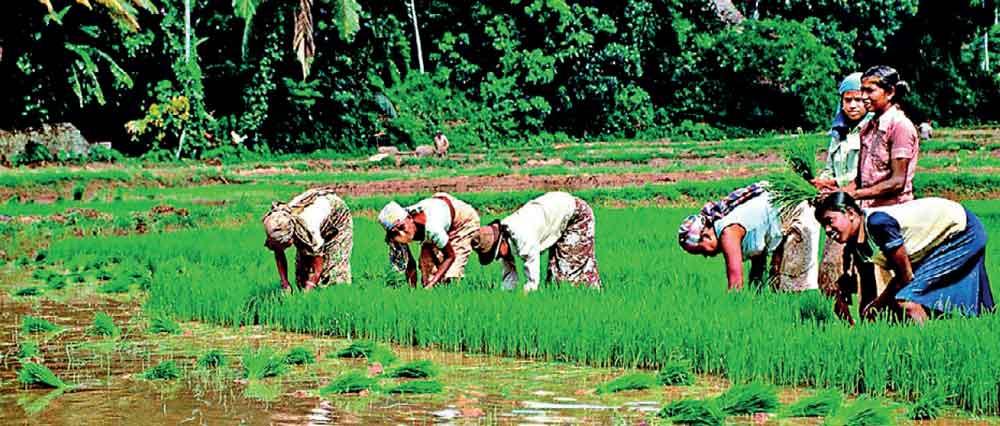
Former Agriculture Minister Mahinda Amaraweera told media that paddy production in 2024 was 4.5 million metric tonnes which could yield about 3 million metric tonnes of rice. File photo
The claims by the leaders of the ruling National People’s Power (NPP) that they are not responsible for the current rice muddle are true. It must be recalled that the rice mill owners had been arguing over a shortage of Nadu rice and their inability to sell rice at the controlled price just after the last Presidential election at which Anura Kumara Dissanayake rose to power.
However, it is the incumbent government that has to find solutions to the problems faced by the country and the people, no matter who is responsible for them. The NPP leaders must be reminded of their decades-long pledges that they would bring in solutions to the issues that were created by the past governments affecting the lives of the people. People now expect those solutions and not excuses - direct or indirect – from the government.
President Anura Kumara Dissanayake met the rice mill owners – large-scale as well as small and medium-scale - thrice between October and December last year to resolve the rice shortage and price hike but to no avail. The very meetings had stemmed from the popular belief that mill owners are hoarding paddy or rice which has resulted in the shortage and soaring prices.
For a few days following these discussions the rice market showed signs of stability but soon the situation was back to square one. Nevertheless, President Dissanayake during an interview with a private television channel on January 21 refuted hoarding theory while making a startling revelation to the effect that no state institution, even the Agriculture Ministry has reliable data on production, milling or distribution of rice. He questioned how a government can address an issue without relevant data. Interestingly, no group or political party that had thus far been accusing the government for not raiding the large-scale rice mills criticised the President’s denial of hoarding by mill owners.
The government allowed the traders to import rice in December to meet the rising demand. Despite announcement that 70,000 metric tons of rice would be imported, the amount rose to 168,000 metric tonnes at the end of the period fixed for rice imports. With an import tax of Rs. 65 per kilo having been imposed, the imported rice was expected to be sold at Rs. 220. However, the traders increased the prices at will. Opposition politicians accused the government for not reducing the price of imported rice by reducing the import tax, but Media Minister Dr. Nalinda Jayatissa argued that any price reduction of imported rice would affect the local farmer.
However, it could be observed that 90 percent of rice has been imported by the private traders while the State Trading Corporation accounted only for 10 percent. The government seems to have let the private sector to have the upper hand considering the import tax factor.
The rice consumption in Sri Lanka is about 2.4 million metric tonnes. Former Agriculture Minister Mahinda Amaraweera told media that paddy production in 2024 was 4.5 million metric tonnes which could yield about 3 million metric tonnes of rice, as the paddy-to-rice ratio is 5:3, according to the Agriculture Ministry. The NPP leaders were also agreeable initially that there is a surplus in rice production.
Yet, now it has been transpired that these statistics in respect of year 2024 do not reflect the true situation. Proving the point presented by President Dissanayake on absence of reliable data on rice production, officials of the Agriculture Ministry presented conflicting figures on paddy production on January 21 at the Committee on Public Finance (COPF) chaired by Samagi Jana Balawegaya MP Dr. Harsha De Silva. It was against this backdrop the former leaders had waxed eloquent on food security during the height of the bankruptcy two years ago.
The government is planning to strengthen the Paddy Marketing Board (PMB) to prevent the large-scale rice millers from manipulating the rice market. The Maha season paddy harvest has commenced in some areas of the country and it is expected that the PMB would jump into action to purchase paddy. However, neither it moved in that direction nor the government announced a certified price for paddy. Deputy Minister for Agriculture Namal Karunaratne who is also a trade union leader in the agricultural sector stated that the government was intentionally delaying the announcement of a certified price since such an announcement would negatively affect the farmers who are currently selling their paddy at a price higher than the proposed certified price which is Rs. 130.
Karunaratne’s claim that the traders pay a price higher than the certified price is yet to be verified. A farmer’s organization in the South had stated that they would not even sell a single grain of paddy to the PMB as private traders pay them Rs. 170 per kilo. However, traders would do so only if the market conditions dictated, and it has nothing to do with the government’s announcement of certified price. Such an announcement would not prohibit traders from purchasing paddy at a higher price.
On the other hand, television channels showed farmers in some other area pleading the government to announce the certified price as the traders in their areas purchase paddy at a meagre price of Rs.80 or Rs.90 per kilo.
If traders purchase paddy at a price of Rs. 170 as the above farmer organization claim, the rice yield from that paddy alone would cost Rs. 283 per kilo and with processing and transport costs apart from the profit of the trader the rice price would exceed Rs. 300. Would any trader take such a risk? Also, refusing to sell paddy to the state-owned PMB would be immoral and ultimately self-defeating. It is the public coffers that maintains the irrigation system for the paddy lands, bears the burden of providing fertilizer subsidy for farmers, and provides compensation for them in case of drought or floods or any other crop damages. And the PMB is a mechanism that serves as a buffer against the exploitation of farmers by the traders. The farmers have a responsibility to strengthen it.
Yet, they might ignore this fact and hence there must be a mechanism that persuades them in this regard and prevent the officials of the PMB from working hand in glove with the traders. However, nothing is heard about the implementation of President’s plan to maintain a comprehensive database for the agricultural sector or the registration of traders and farmers involved in buying and selling of paddy/rice, despite the Maha Season’s rice flow into the market which had commenced.
09 Jul 2026 8 hours ago
09 Jul 2026 9 hours ago
09 Jul 2026 09 Jul 2026
09 Jul 2026 09 Jul 2026
09 Jul 2026 09 Jul 2026