12 Feb 2025 - {{hitsCtrl.values.hits}}
 Students of realism, the dominant school of thought in international politics, consider the Melian Dialogue a good starting point for studying the discipline. In the conversation, as recorded by Thucydides in ‘The History of the Peloponnesian War,’ the Athenians demand that the neutral state of Melos submit to them. The Melians plead to reason and justice, arguing they have the right to neutrality and sovereignty. To which the Athenians reply, “Right, as the world goes, is only in question between equals in power, while the strong do what they can and the weak suffer what they must.”
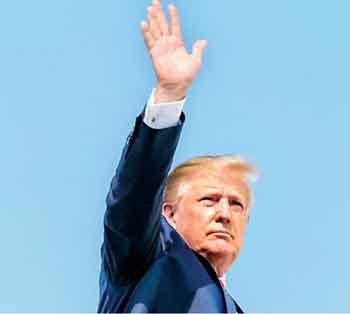 |
| 75 years into the US-led global order, the 47th President of the United States, Donald Trump, has begun dismantling the international world order established post World War II |
This has been the essence of realist thought in international politics, which deemed power the highest manifestation of the force of nature and the source of self-preservation. From the warring states of ancient China to Mongols and the Concert of Europe, international politics is dictated by the stronger states or great powers, enforcing their will on the weaker states, carving out their own sphere of influence at the expense of the smaller states that cohabitate in the system.
After two hegemonic wars, the post-World War II international order built by the United States greatly diminished the anarchy in the international system. The institutions it cultivated alongside, such as the United Nations, Bretton Wood institutions, and free markets, provided alternative avenues for states to settle their differences short of recourse to military actions and incentives to work within the normative global order. In this global order, the sovereignty of smaller states was given—and no smaller state had ceased to exist due to being swallowed up by a larger state—unlike in the 19th-century global order when the great powers carved out smaller states among themselves.
America itself is the greatest beneficiary of the post-war global order. Pax Americana spread across the world, much less through the use of arms, but through free markets and institutions it had created. It emerged as the richest and most powerful country on the planet by a great margin, and its superpower adversary, the Soviet Union, collapsed without fighting a war.
However, 75 years into the US-led global order, the 47th President of the United States, Donald Trump, has begun dismantling it. He says the other countries have taken America for a sucker through the system which, ironically, had established the American primacy in the international system. His Secretary of State Marco Rubio declared in his Senate confirmation hearing: “The postwar global order is not just obsolete… It is now a weapon being used against us”.
Trump has thrown a wrecking ball into the global economic order, announcing tariffs on its friends and foes alike. However, beyond the trade, Trump’s rhetorics echo a return of naked power politics in the 19th century when the might was considered right. He has mused about taking over Greenland from Denmark, a key NATO ally, and seizing Panama Canal from Panama, both without ruling out the use of military and converting Canada into the 51st state of the United States. He has vouched to buy Gaza to turn it the Riviera of the Middle East while offering to forcefully relocate 2 million Gazans to neighbouring countries, which, if undertaken, would amount to a brazen act of war crime and a crime against humanity.
Much of his rhetoric, announced in impromptu press interviews, may be designed to cater to his constituency back home. Others claim they were meant to be bargaining tools in Trump’s trademark transactional diplomacy. Yet they have delivered a fatal blow to the normative principles of the global order which the United States had painstakingly nurtured and institutionalised.
However, the world that Trump envisages is not one in which the United States has its primacy. He has little interest beyond the Western Hemisphere, a throwback to the Monroe Doctrine and is especially disinclined to compete in places where equally equipped authoritarian leaders come into contact. The world order that would emerge should Trump deliver on his threats would broadly echo the 19th Century Concert of Europe, where five great powers, the United Kingdom, Austria, Russia, France, Prussia, and Italy, set the rules of conduct and curved out their sphere of influence in the world.
Except for the fact that the concert would not take place in Europe but across the world. President Putin would have his way over Ukraine. While the end of the war would save millions of lives, it would end on Putin’s terms and pave the groundwork for assertive Russian diplomacy in its near abroad, effectively establishing its writ in Georgia, Moldova, the Baltic States and even some of Nato and EU members.
Faced with permissive conditions and growing security challenges, China would establish its sphere of influence more assertively, enforce its expansive claims for the South China Sea and become belligerent over Taiwan.
Elsewhere, other expansionist states, such as Erdogan’s Turkey, which has already brought Islamist rebels controlled Syria under its sphere of influence, would expand its writ beyond its traditional boundaries.
The Trump world order would seriously compromise the normative guarantees of the smaller states, whose survival was granted under the post-war world order. Smaller states in the vicinity of the great powers would be compelled to barter a good deal of their sovereignty in exchange for their survival.
This brings us to the fate of Sri Lanka in the Trumpian world order. One great power that would be compelled to assert its sphere of influence, more aggressively as its rivals jockey for influence would be India, which considers South Asia and a good part of the Indian Ocean as its sphere of influence, a heritage from the British Raj foreign policy. India’s economic opening and greater integration into the international system greatly mellowed Indian power politics and its treatment of the smaller states. One should ponder how India would behave when these normative principles are compromised or delegitimised by the United States itself. One does not look further than the Indian treatment of Sri Lanka in the 80s, culminating in the arrival of the IPKF. One might even believe that rather than restraining, Trump’s America may encourage India towards a more assertive exercise of power politics in its neighbourhood to deter China’s advent. Narendra Modi, who is expected to visit America in the coming weeks, is one of the first global leaders to meet Trump. One might also find a greater ideological inclination for power politics in the Hindutva BJP than its Congress rivals. And in a world order where normative principles of sovereign equality are in tatters, ugliness would come into play. The primary Indian concern in Sri Lanka is the growing Chinese geo-economic footprint. The exceeding power asymmetries between the two competing powers, China being five times India’s GDP, amplifies these anxieties, especially in a system of might is right- as Trump is remaking the world order.
These are not some academic conjectures. Conflicts in international politics do not erupt overnight, like the Indian Ocean tsunami. Fissures appear for a long time and also provide time and space for the leaders to find solutions. Sri Lankan political leaders and policymakers should take note of this eventuality and have solutions in hand or try to avert them before they emerge. One thing is for sure: Sri Lanka should not sacrifice its economic partnership with China, considering China’s deep pockets and historical partnership. Instead, Sri Lanka should be able to integrate itself more deeply with Indian economic interests, court Indian investment aggressively, lease land for Indian-run industrial parks, and provide free mobility for skilled labour between the two countries.
Probably in the Trumpian world order, the survival of the smaller states may not be decided by the treaty of Westphalia or not even by the UN, but by how deeply integrated they are into the international economic order so that their travails would trouble the international system.
10 Jul 2026 18 minute ago
10 Jul 2026 26 minute ago
10 Jul 2026 35 minute ago
10 Jul 2026 1 hours ago
10 Jul 2026 1 hours ago