07 Jun 2025 - {{hitsCtrl.values.hits}}
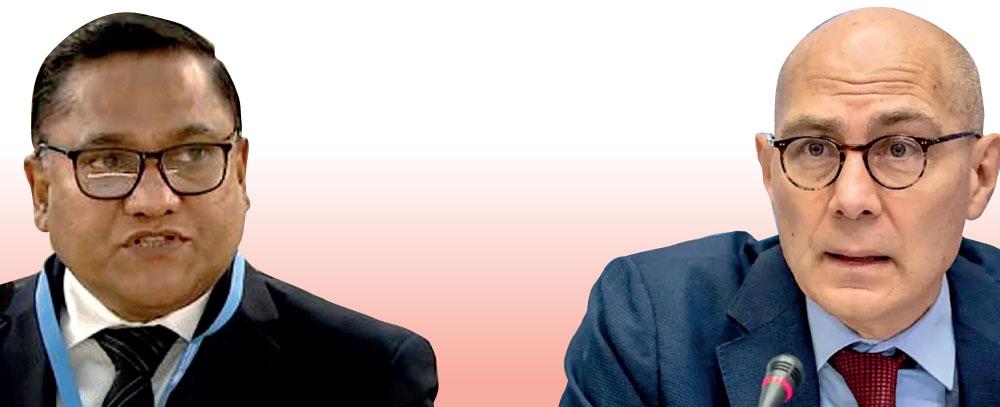
Volker Türk’s visit, announced by Vijitha Herath, could significantly impact Sri Lanka’s human rights policies going forward and the government’s approach to reconciliation and accountability, shaping the future political landscape
Foreign Affairs, Foreign Employment, and Tourism Minister Vijitha Herath, during an interview, stated that the UN High Commissioner for Human Rights, Volker Türk, is expected to visit Sri Lanka on June 26.
This marks the first official visit to Sri Lanka by a UN High Commissioner for Human Rights in nine years. The last such visit was by Zeid Ra’ad Al Hussein in February 2016, during the so-called Yahapalana Government.
Al Hussein’s predecessor, Navanethem Pillay also visited Sri Lanka in 2013, at a time when the Sri Lankan government headed by President Mahinda Rajapaksa was strongly at loggerheads with the United Nations Human Rights Council (UNHRC), with Sri Lanka repeatedly rejecting the resolutions on the country’s human rights situation adopted by the council. Mervin Silva, a minister in the Rajapaksa Cabinet, made a public marriage proposal to Pillay, apparently to humiliate her, prompting another minister, Dullas Allahapperuma, to extend an apology to the visiting UN human rights head for Silva’s uncivilised comments.
The relationship between Sri Lanka and the UNHRC at the time when Al Hussein paid his visit to the country was somewhat different from now, the time the current UNHRC head is planning his visit. The so-called Yahapalana Government did not follow a hard line in respect of the country’s ethnic problem. It co-sponsored the UNHRC resolution passed in 2015, which provided for initiating an accountability mechanism with the participation of judges from the Commonwealth countries.
The report of an investigation into the violations of international human rights and humanitarian law by both the armed forces and the LTTE during the war between them had been presented to the UNHRC in the same year. The investigation was conducted by 12 investigators appointed by the previous UN human rights chief, Navanethem Pillay, in 2014. The report alleged that both the armed forces and the LTTE have violated the law alike.
Hence, the visit by Al Hussein took place in a cordial environment, despite President Maithripala Sirisena having gone back on his government’s commitment to include judges from the Commonwealth countries in Sri Lanka’s proposed accountability mechanism, within two months. Prince Hussein, when journalists questioned about the President’s backtracking during his stay in Sri Lanka stated “though the Office of the High Commissioner for Human Rights (OHCHR) makes a recommendation on the judicial process into alleged war crimes or on the involvement of foreign judges, it was the sovereign right of Sri Lanka to decide.”
However, the visit by Volker Türk this time comes about in a different environment, with, on the one hand, the OHCHR having initiated the Sri Lanka Accountability Project—a mechanism for gathering evidence related to alleged human rights violations in Sri Lanka. The OHCHR has also established a central database where information and evidence of human rights abuses in Sri Lanka can be stored and analysed.
Former UN Human Rights Chief, Michelle Bachelet, who initiated this programme under a resolution passed in 2021, recommended to the member countries to “explore possible targeted sanctions such as asset freezes and travel bans against credibly alleged perpetrators of grave human rights violations and abuses.” When another resolution was passed in the UNHRC last October, in line with the 2021 resolution, the National People’s Power (NPP) government rejected it. It is against this backdrop that Volker Türk is visiting Sri Lanka.
The NPP government seems to be more serious than the previous governments in bringing in reconciliation in the country, due to which it also seems to be in a dilemma in handling the ethnic problem and dealing with the UNHRC. Unlike the other parties in the country, the Janatha Vimukthi Peramuna (JVP), the core party in the NPP coalition cannot morally ignore the allegations of human rights violations since it has been the prime victim of large-scale rights violations during two state repressions, where in one of them over 60,000 people have been killed, according to unconfirmed reports.
The moral obligation apart, human rights are an inseparable element in the process of reconciliation, especially after civil strife. With an apparent understanding of it, the NPP government, unlike the previous governments, has taken several healing steps in the recent past. It has opened several roads in the north, which had been closed for decades, starting from the days of war. The commemoration of those Tamils killed in the war was allowed this time, unlike what the regimes of the Rajapaksas did. The National War Heroes Commemoration was also held with a reconciliatory note, though it stirred controversy.
Nevertheless, the ethnic issue and the issues pertaining to accountability have a tremendous impact on the very political survival of the NPP since human rights have been heavily politicised. Hence, these issues always cause a dilemma for the party. It is in this context that the NPP government rejected the UNHRC resolution in October. Importantly, the resolution came in the run-up to the Parliamentary election. Similarly, President Anura Kumara Dissanayake was in two minds whether or not to take part in the National War Heroes Commemoration.
However, the NPP government did not seem to be vacillating between choices when Patrick Brown, the Mayor of the Canadian city of Brampton, inaugurated a “Tamil Genocide Monument” in his city. Foreign Affairs Minister summoned the Canadian Ambassador to convey Sri Lanka’s “strong objections” to the opening of this monument.”
It is not only an action by the NPP government towards political survival, rather the successive governments have argued against the notion of genocide in Sri Lanka on a strong footing. The panel appointed by the then United Nations Secretary General Ban Ki-Moon to advise him on Sri Lanka in 2010 had concluded that some 40,000 civilians were killed in the last phase of Sri Lanka’s ethnic war, but stopped short of calling it a genocide.
Also, the report compiled by a group of investigators appointed by the former UN human rights chief, Navanethem Pillay, in 2014 to look into the allegations of human rights violations in Sri Lanka never used the term genocide, despite the laws pertaining to genocide being considered during the investigation. An enumeration conducted in the Northern Province by the Census and Statistics Department in 2011 concluded that the number of deaths that occurred due to “other causes” than natural causes in the province in 2009 stood at little over 7000, and no Tamil party has thus far contested its report.
Yet, it would be difficult, if not impossible, for the NPP to sell these facts to the Tamil people as their leaders claim various numbers ranging from 40,000 to 300,000 as the civilian death toll in the final war between the armed forces and the LTTE. Reconciling such different viewpoints and perceptions between various communities in the country would be a gigantic task for any political party in general and particularly for a party that mainly relied on southern votes.
10 Jul 2026 53 minute ago
10 Jul 2026 1 hours ago
10 Jul 2026 2 hours ago
10 Jul 2026 2 hours ago
10 Jul 2026 4 hours ago