12 Dec 2016 - {{hitsCtrl.values.hits}}
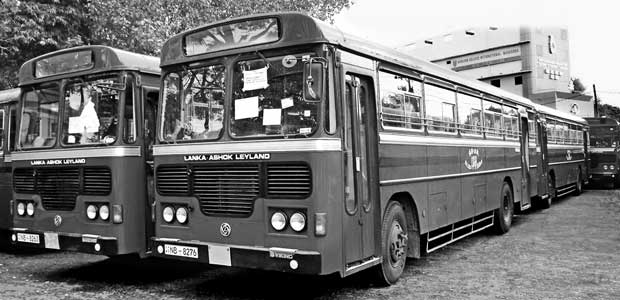
December 8 commemorates the 14th death anniversary of Anil Moonesinghe.
Ramal Siriwardane, Chairman Sri Lanka Transport Board [SLTB] issued a statement saying the Board had recorded a Rs.120 million income on the day of the strike, against the normal income per day of Rs.72 million, a 66 percent increase: and on Saturday they recorded a Rs.99 million income which on a normal Saturday was Rs.68 million- a 45 percent increase. It further said the long-distance buses that hadn’t yet reached their destinations expected an even higher overall income. They had taken measures to arrange an additional 1,000 buses supported by the running of extra trains. Most employees were either on leave or allowed to leave office earlier. The record income on  Friday was due to the increase in the volume of passengers as well as additional buses on the roads. “When we acquire these new buses, we will be able to provide a better service to the public in times of need,” the Chairman added.
The Chairman had commended the SLTB staff for their dedicated services of the bus crew who took a particular interest in their performance, providing maximum transport facilities even at their peril. Of course it is praiseworthy and they deserve the gratitude of the public and the Government. Introduction of more SLTB buses will be more praiseworthy, as private buses have become a menace. Whose
money would be spent to repair the 128 SLTB buses that had been damaged by the hooligans?
On Friday, due to the pelting of stones at buses by the striking private bus drivers as per information, 23 SLTB employees and eight passengers were injured and hospitalized. The critically injured included a soldier on holiday. He is still lying unconscious at the Anuradhapura hospital. Instead of using public funds to repair the buses, the Ministry could file action against the culprits who are in police custody and the organizers of the protests, the private bus unions, to recover the costs of repairs.
Thousands of commuters have been largely inconvenienced due to the bus strike which came into effect at midnight on December 1. A number of incidents of violence in support of the strike action have been reported from across the country. A group of unruly three-wheeler drivers have also joined in the strike action in protest against the proposed Rs.25,000 fines for traffic offences. Railway trade unions however had discussions with the President the previous afternoon and dropped their intention to join the strike. The public have been severely inconvenienced as a result of the situation. Stones have been pelted at SLTB buses in Gampaha, Warakapola, Radawatunna,Waralawatta and Thalaramba area in Matara, by groups of unidentified persons. The Chairman of the SLTB Ramal Siriwardena made arrangements for buses to continue to operate under the protection of the police.
In 1964, the Lanka Samasamaja Party, the oldest political party, faced an ideological policy crises on the issue of whether or not to enter into a Coalition with Sirimavo Bandaranaike’s ‘capitalist’ Government. Anil Moonasinghe, MP for Agalawatte, aligned with his leader Dr. N.M. Perera who proposed the unity and won the majority. Anil accepted the portfolio of Transport when two of the most seniors, Lesley Goonawardene and Colvin R. de Silva, though not against the coalition, declined to join the cabinet. Anil formed the Employees’ Councils to help run the ailing Ceylon Transport Board. Obtaining a large allocation of land in the heart of Colombo, he established a Central Bus Station close to the Fort Railway Station. He began negotiating an agreement with the FIAT company to set up a plant to build buses in the island, however, the Government was defeated shortly thereafter and he was unable to complete his work – the 1965 UNP government did not sign the agreement with FIAT.
At the 1970 elections, the SLFP/LSSP coalition won a landslide victory and Anil Moonesinghe was back as Chairman of the CTB, with Lesley as his Minister. Anil revived the workers’ committees and took over the running of the institution. This was the beginning of the flourishing of the CTB as an establishment. The CTB became a profit-earning corporation, while providing an efficient and disciplined service to public transport which was never experienced previously.
Older generations will remember the CTB under Moonesinghe, who would operate a one-man flying squad in his blue Volkswagen car to catch misbehaving bus crews in the act. To prove a point that seven buses could be serviced in a day, he personally attended and remained at Central Workshops, Werahera service station.
Tata and Ashok Leyland, the main suppliers, combined in to cartel dictating prices of bus chassis; Moonasinghe ordered chassis from the Isuzu Company of Japan, to offset effects of any cartelization and purchased Ikarus from Hungary. He solicited the assistance from Elections Commissioner in conducting elections to worker committees, which were later transformed into Employees’ Councils with additional powers and responsibilities in management. Commuter organisations were set up in an advisory role. As services expanded, efficiency improvement measures were taken in consultation with committees. Several new depots and bus stands were established. His final dream of a modern, multi-storied central bus station complete with cinema, hotel and lodging for long distance travellers never saw the light of day. Another vital arm of a central workshop well-equipped with foundries and other needs was built up at Werahera, which was adjudged the largest in South Asia. Assembling of bus chassis commenced in 1974.
Going a step further in 1975, Minister Leslie Gunawardena and Moonasinghe proposed a major shift in the management structure of the CTB: the senior members of Employees’ Councils were absorbed in to the Board on a 50-50 basis. The historic UF government of SLFP-LSSP came to an end in September 1975; the three LSSP Ministers, Dr. N.M. Perera Finance, Dr. Colvin R. de Silva Plantations and Leslie, Transport, along with CTB Chairman Anil Moonasinghe having to leave the government, marking the beginning of the end of Sri Lanka Transport Board.
It was S.W.R.D. Bandaranaike, who as PM in 1958, studied the survey reports of Ratnam-1948, the Sansoni report in 1954 and the Jayaratna Perera Survey in 1956, all of which recommended nationalisation of public transport for a better service. Since 1977, JRJ and Premadasa governments introduced private buses to compete with SLTB on the same routes. SLTB was split into several ‘peoplised’ smaller units called regional boards. Later in 1991, these small enterprises were grouped in to 11 ‘cluster’ companies.
The Werahera Central Workshops, several regional workshops along with 123 brand new bus chassis valued at 400 million approximately by government value were ‘sold’ to a private company for less than 40 million in controversial circumstances in the early 1990s. Since then successive governments and their henchmen vandalized this state property.
The unity government can resurrect it on ‘Anil Moonasinghe lines’, to fix the private bus hooligans!
28 Jun 2026 28 minute ago
28 Jun 2026 55 minute ago
28 Jun 2026 1 hours ago
28 Jun 2026 1 hours ago