Reply To:
Name - Reply Comment
The tourism potential of this line should be used to save it

It’s six months since Ditwah hit. It will be another six or seven months before it will be possible to take the train to Kandy, according to the government. How long will it take for the Uva Railway from Peradeniya to Badulla to be fully operational again?
The express train from Badulla to Colombo took 11 hours to complete its journey of 292 km before Ditwah. That is an average speed of 26.5 kmph. By road, the distance is 331 km and the time taken would be less than six hours, using the southern expressway. Trains are not good at traversing steep gradients, so they tend to meander, keeping to contour lines on the map. Also, the purpose of the Uva Railway was transportation of tea. So, it made sense to cover as much of the tea country as possible.
But still, 26.5 kmph is pathetic. It must have declined since the track to Badulla was completed in 1924. On the Northern Line, the Intercity Express covers the 413 km from Kankesanthurai to Colombo in six hours at an average speed of 68 kmph, 2.5 times the average on the Upcountry Line. The distance by road is slightly lower at 407 km but the time taken by road is longer than by train (7:30 hours to Jaffna for a fast bus; could be a tad lower by car). The reason for the slow speed on the Uva Railway is the condition of the track. It’s curvy and it’s expensive to maintain (thus it is not maintained to international standards).
I took the Uva Railway almost to its terminus a few years back. The many hours spent on the train gave me more than enough time to reflect on the sad state of our railway network. It also made me realise I was not designed to travel happily at 26.5 kmph.
Railway losses
It was estimated that LKR 300 billion would be needed to repair the damage to the railway network caused by Ditwah, primarily in the central hills. The government is fiscally constrained. Loans, if taken, must be repaid. And will the restored railway yield a return? Or create additional demand for infusions to cover losses, as was the case in the past?
According to Central Bank Reports, the government railway is a peculiar beast. In 2014, the year that rail connectivity was restored to the Jaffna peninsula, it operated more kilometers, carried more passengers and freight, and even increased its revenue by about LKR 500 million, relative to 2013. But most stunning was the increase in operating expenditure and operating losses: LKR 16,943 million expenditure from LKR 10,586 million in 2013; and an LKR 11,034 million loss compared to LKR 5,163 million in 2013.
More recently in 2025, the government railways operated more kilometers, carried more passengers but less freight, and its revenue decreased by about LKR 1,690 million, relative to 2024. Operating expenses increased from LKR 27,908 million in 2024 to LKR 35,749 million in 2025. Operating losses increased from LKR 9,052 million in 2024 to LKR 18,584 million in 2025. Operating losses in 2025 were nearly double the losses made in 2024.
Generally, passenger railways cannot be operated without subsidy. Freight transport alone can make money (e.g., USA), as can freight and passenger transport when efficiently combined (e.g., India). Sri Lanka’s railways carry minuscule amounts of freight, around two percent of the total, so we have a problem.
I have previously written about how the Northern Line (Ragama-KKS) and its spurs could be carved out and made viable as a public-private partnership focusing on freight and fast passenger transportation. But what could be done with the Uva Railway?
Freight from the declining tea plantations will not return to the railway. Freight carried by the railway is declining overall. It is difficult to imagine how the money could be found to improve the track to enable greater speeds, let alone double tracking. So, the alternatives are to shut down the Uva Railway or embrace its slowness.
Embrace the slowness
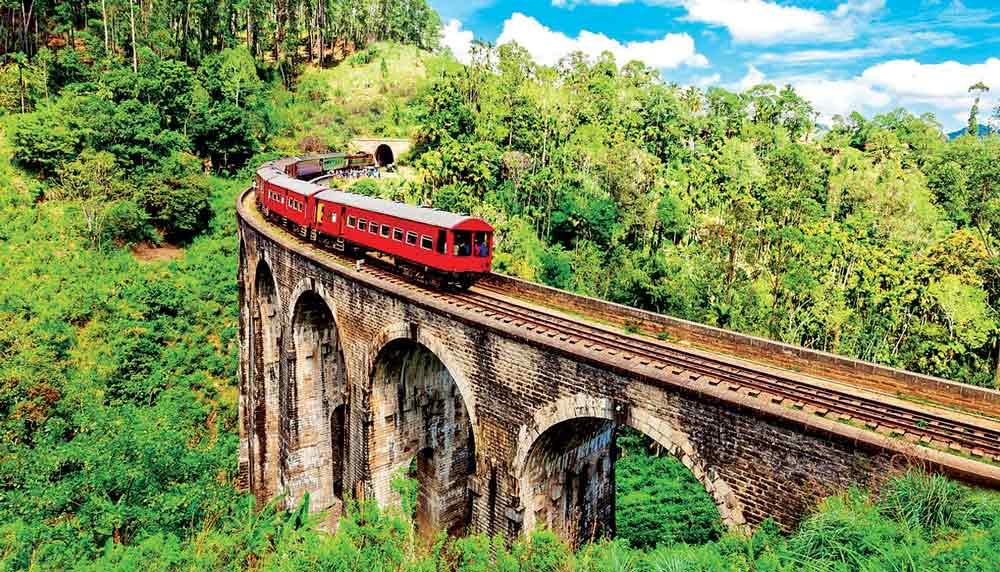
The value proposition of the Uva Railway is its beauty. It attracts a significant number of tourists. When it was running, the Observation Car was fully booked. The private carriages that made up, in some cases, half the train, did well too. If the objective is not that of efficiently getting from Point A to Point B but of savouring the journey and the scenery, speed becomes irrelevant. In fact, speed is inimical to the main purpose. The TGV and the Shinkansen trains are so fast that what you see out the window is a blur, not scenery.
So, redefine the primary purpose of the Uva Railway to that of serving domestic and foreign tourists. Redesign the carriages, making some/all of them moving hotels. Cruise tourism works; why not train tourism?
Develop attractive and secure sidings in locations like Nanu Oya and Ella, so that carriages can be kept overnight for tourists to sleep in. Tourists pay good money to sleep on kettuvallam in the Kerala backwaters. Why not on trains?
They come in the train; the carriage is shunted into a siding; vans, taxis and tuk tuks provide excursions, they return to the carriage for dinner or sleep. Then the carriage is attached to another train and the process repeats. Same model as cruise-ship tourism.
If the service is redefined as scenery, good accommodation, gourmet food, and romantic transportation, appropriate prices can be charged. The significantly higher revenues can be used to maintain the track and rolling stock at appropriate levels so that the ridiculous 15 kmph speed limits that apply to significant stretches of track can be lifted, and even perhaps to cross-subsidise some carriages for people travelling between upcountry stations.
Considerable new investment will be required to upgrade the rolling stock, bring the track up to international safety requirements, build the secure sidings, and conduct an international marketing campaign. Obviously, this is not an activity that can be undertaken by the Sri Lanka Railway, which somehow managed to increase operating expenditures by 60 percent and operating losses by 114 percent in one year.
For this, it will be necessary to carve out the Uva Railway from Peradeniya as a public-private partnership. The track will continue to be owned by the government, but maintenance and train operations will be handed over to the train operator. The concession contract could specify the terms of general passenger transportation among upcountry towns and for the occasional tanker train. The tourist carriages will be owned by different operators. There need not be a limit on how many. Given the power asymmetry between the many carriage operators and the train operator, some form of regulatory oversight may be needed.
As said above, this is simply a distillation of the public-private partnership that has emerged organically over the past few years. It’s nothing radical. The train I travelled in had six carriages, of which three were private, one was a reservation-only observation car and only two were for general carriage.
But it is the only alternative to closing down what many consider a national treasure, even if they never use it. If something creative is not done, the shoveling of increasing amounts of taxpayer money down a second-rate and bottomless railway pit will not end. The national treasure will continue to be a drain on the national treasury.