Reply To:
Name - Reply Comment
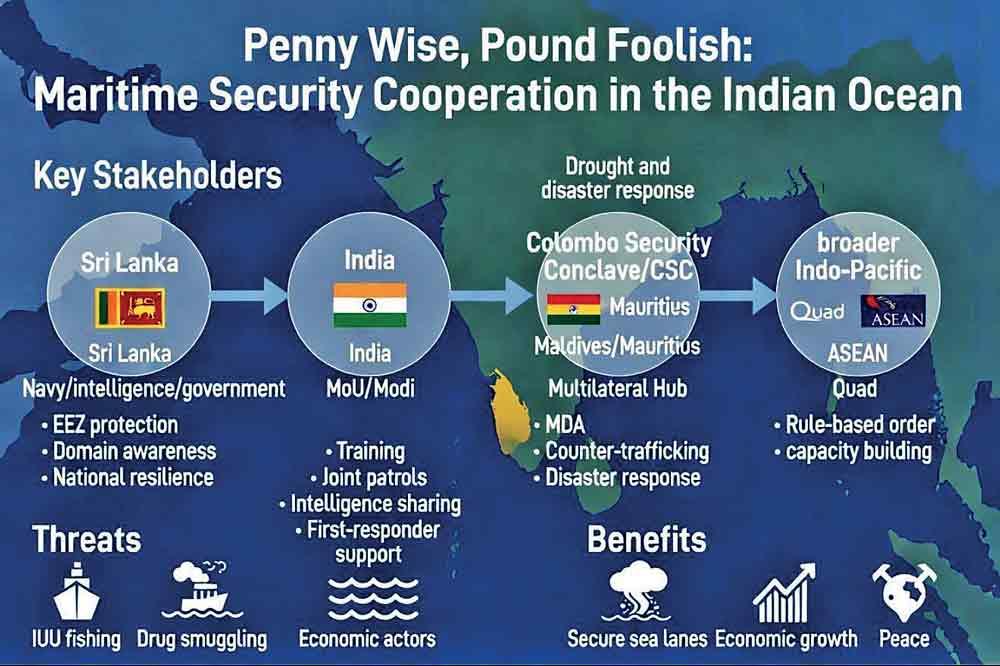
 From an intelligence practitioner’s lens, honed at the State Intelligence Service Counter Terrorism Desk and during high-profile event security for CHOGM and World Cups, this cooperation amplifies our HUMINT and technical capabilities without

As a retired Senior Superintendent of Police with decades of experience in intelligence, counter-terrorism, and strategic security coordination, I have repeatedly seen how short-sighted decisions undermine long-term national resilience. The adage “penny wise, pound foolish” perfectly encapsulates Sri Lanka’s vulnerabilities exposed during the 2022 economic collapse.
Austerity measures, delayed reforms, and isolationist tendencies conserved minor resources in the moment but inflicted catastrophic costs in stability, public trust, and security capacity. Today, as we consolidate recovery under the National People’s Power government, embracing deeper maritime security cooperation with India stands as a wise counter to such false economies, investing prudently now to safeguard our sovereignty, economy, and peace for generations.
Hybrid threats
Post-2009, with no active internal armed conflict, our security focus has evolved to hybrid and transnational threats, drug trafficking, IUU fishing, arms smuggling, terrorist financing, and great-power manoeuvring in the Indian Ocean. The 2022 crisis, however, tested this peace. Fuel shortages, power blackouts, and protest strains diverted naval and police resources, highlighting how economic fragility directly erodes maritime domain awareness and operational readiness.
India’s role as the indispensable first responder during that crisis, extending nearly USD 4 billion in credit lines, currency swaps, and essential supplies, prevented total collapse and laid the groundwork for today’s elevated partnership. What began as economic solidarity has matured into structured defence cooperation.
The landmark April 2025 MoU on Defence Cooperation, signed during Prime Minister Narendra Modi’s visit to Colombo, represents a pivotal shift. This five-year framework, the first comprehensive bilateral defence pact in decades, building on the 1987 Indo-Sri Lanka Accord, institutionalises training, equipment support, joint exercises, intelligence sharing, and maritime operations. It directly counters the “pound foolish” risks of under-investment that plagued our 2022 response.
Maritime security is the linchpin. Sri Lanka’s vast Exclusive Economic Zone (EEZ) and position astride critical sea lanes make it a natural hub, and a potential chokepoint, for regional stability. Threats like narcotics smuggling through porous sea routes, illegal fishing by foreign vessels, and potential infiltration demand robust monitoring.
From an intelligence practitioner’s lens, honed at the State Intelligence Service Counter Terrorism Desk and during high-profile event security for CHOGM and World Cups, this cooperation amplifies our HUMINT and technical capabilities without sacrificing autonomy. Shared information through platforms like the Information Fusion Centre-Indian Ocean Region (IFC-IOR) closes gaps that economic crises widen. It echoes our defeat of the LTTE: proactive, collaborative disruption of threats before they escalate. Post-Easter Sunday 2019 lessons on inter-agency coordination find new expression in these bilateral mechanisms, reducing vulnerabilities to hybrid warfare, disinformation, and economic espionage.
Critics may invoke sovereignty concerns or past sensitivities, but pragmatism demands we reject penny-wise isolation. The 2025 MoU includes termination clauses for flexibility, ensuring decisions remain Colombo-driven. Diversification is key: balancing ties with India alongside China (via BRI projects), Japan (drones and hydrography), the US, UK, and Gulf partners prevents over-dependence while maximising gains. The CSC framework exemplifies inclusive, non-exclusionary regionalism, precisely the model needed to navigate Indo-Pacific dynamics. Economically, maritime security underpins recovery. Secure sea lanes boost tourism, fisheries, and trade, sectors devastated in 2022. Joint capacity building (over 1,200 annual training slots for Sri Lankan forces) and blue economy initiatives create jobs and resilience, averting future “pound foolish” collapses. In a climate-vulnerable nation, cooperation on sustainable fisheries and disaster response further mitigates risks.
In conclusion, Sri Lanka must assertively embrace and lead multilateral Indo-Pacific cooperation as the indispensable driver of its long-term progress, security, and sovereignty. The hard lessons of the 2022 crisis leave no room for hesitation: penny-wise short-termism must give way to pound-wise strategic vision. We should fully operationalse the Indiadefence MoU through sustained joint and intelligence fusion, while elevating the Colombo Security Conclave into a robust, action-oriented Indo-Pacific platform for maritime domain awareness, counter-trafficking, cyber resilience, and humanitarian response. Sri Lanka is uniquely positioned to play a bridging leadership role, convening island nations, advancing inclusive initiatives under frameworks like the Indo-Pacific Oceans Initiative, and fostering minilateral and multilateral ties that include India, the Quad partners, ASEAN, and other responsible actors, without compromising our traditional non-alignment.
Bipartisan political consensus on these pillars, insulated from electoral politics, is urgent and non-negotiable. Isolationism invites exploitation and repeats past failures; assertive multilateral leadership in the Indo-Pacific secures our sea lanes, rebuilds economic vitality, strengthens interfaith harmony, and honours the sacrifices that delivered victory over terrorism in 2009. By championing such cooperative architectures, Sri Lanka transforms its strategic geography from vulnerability into enduring strength. The moment demands bold action, our nation’s destiny, regional stability, and future generations require nothing less.
(This opinion draws on public records and professional experience. The views expressed are personal).
Mahil Dole, SSP (Retired), is the former Head of the Counter-Terrorism Division of the State Intelligence Service of Sri Lanka, and has served as Head of the Sri Lankan Delegation at three BIMSTEC Security Conferences. With over 40 years of experience in policing and intelligence, he writes on regional security, interfaith relations, and geopolitical strategy.