18 Mar 2026 - {{hitsCtrl.values.hits}}
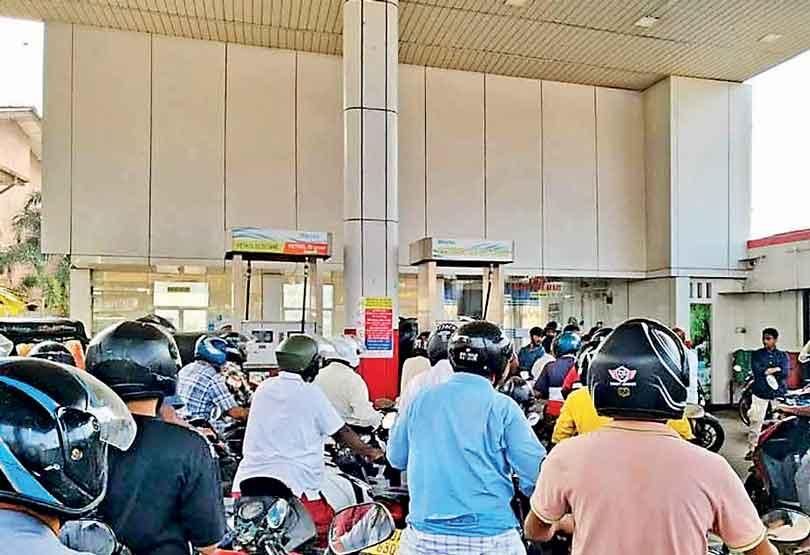
 The very notion of energy security in this country has been reduced to a campaign slogan. A succession of political agitators sabotaged every measure to upgrade energy infrastructure
As the country struggle under oil shock, the Government should expedite the development of the Trinco oil farm, and the tri-party agreement for its development as an energy hub, expedite the Sinopec Oil refinery in Hambantota, and make dedicated policy measures
 For years, political agitators have opposed the joint development of the World War II British oil tank farm in Trincomalee. The pretext has always been defending energy security, although irony should not be lost on the discerning onlooker.
Now, as the country lingers in long fuel queues, here are a few issues deserving their somber reflection under the scorching heat.
The Trincomalee tank farm deserves a special mention because, had the Sri Lankan authorities developed a fraction of the total capacity there (99 tanks at 12,000 metric tonnes each), Sri Lanka would have been insulated of the energy shocks associated with the Iran war.
In the 1930s, the British built a 101-tank storage facility in China Bay to service the colonial fleet, and later, during World War II, the Allied fleet. Two tanks were destroyed in a Japanese bombing raid, and the rest fell into disrepair after Sri Lanka, then Ceylon, took over the Trincomalee Harbour from the Royal Navy.
Sri Lanka’s independent leaders lacked a grand economic vision or a design beyond mouthing slogans of the time - sovereignty and anti-imperialism, while presiding over a population that multiplied at the rate of modern-day Niger. The tank farm, which could have been turned into a bunkering facility, rivalling Singapore, which emerged much later, rusted and was encroached by the jungles.
In 2002, the Ranil Wickremesinghe administration leased the tank farm to Lanka IOC. The deal did not proceed as envisaged; instead, it trapped Colombo in an agreement without an exit clause. Wickremesinghe’s intention was to induct India as a security provider and a partner of the brief peace process. However, the resumption of the conflict and the lack of Indian economic interest commensurate to its geostrategic emphasis on the place made the project a nonstarter. Lanka OIC (LOIC) used only 14 tanks.
Twenty years later, in January 2022, Sri Lanka and India agreed to jointly develop the Trincomalee oil tank. Under the deal, a new company, the Trinco Petroleum Terminal (Private) Company, was set up with 51 percent stake held by Ceylon Petroleum Corporation (CPC) and 49 per cent by LIOC. The new company was expected to develop 61 tanks out of 99 tanks at an initial investment of $ 70 million. Of the remainder (38), LOIC would continue to operate 14 tanks, and CPC would develop and run 24 tanks. The agreement envisaged developing Trincomalee into a regional energy hub. Among the most vocal opponents of the deal was Janatha Vimukthi Peramuna. In January 2022, Anura Kumara Dissanayake, at a protest march against the agreement organised by the JVP-allied trade unions, vowed to ‘revert’ the agreement.
However, once in power, saner sense has prevailed and the Government announced that it would proceed with the agreement for the joint development of the Trinco Tank facility.
April, last year, during the state visit by Prime Minister Narendra Modi, Sri Lanka signed a tri-party Memorandum of Understanding (MoU) with India and the United Arab Emirates for the development of Trincomalee as a regional energy hub. The agreement envisaged building a multi-product pipeline between Trincomalee and South India and the refurbishing and development of the tank farm. In addition, President Anura Kumara Dissanayake has mooted plans for an oil refinery in Trincomalee.
However, much of the grand promises have not moved from their blueprints, from the early 2000s onwards. The tri-party MoU itself leaves much of the unknown and guess works, and little tangible action on the ground. Every analyst on Trincomalee Port harp on its strategic value, and Indian security interest, tacitly acknowledged in the annex of Indo-Sri Lanka Peace accord. However, Sri Lanka has continuously failed to convert geostrategic interest into a geo-economics advantage, in part owning to the lack of consistency of the state policies, that changes with every government. Parasitic trade union activism is a part of the problem, but they are being amplified by successive governments lacking initiative and conviction for economic modernisation.
Now, as Sri Lankans languish in fuel queues, the Government has declared a four-day week. Calls are being made to close schools, which, if undertaken, would be a folly.
While the Government is yet to concede, Sri Lanka is heading for a major fuel shortage in the coming weeks, unless fresh stocks are secured, with is a tall order as the Strait of Homuz is severely restricted for tankers. On the admission of Power and Energy Minister Kumara Jayakody in Parliament on Monday, Sri Lanka has diesel stocks sufficient until April 12, Petrol 92 stocks until April 23, Super diesel and Petrol 95 until May 10, including supplies, confirmed, yet to be arrived.
Contrast the emergency fuel stocks maintained by many countries. Japan has fuel stocks for 254 days, South Korea 110 days, France 90-100 days, Germany 90 days, China 80-90 days and India 74 days.
In contrast, Sri Lanka’s initially announced stocks to last 40 days, in fact, included supplies that had not yet received. Sri Lanka does not have storage capacity for stocks of two months.
The 99 tanks with each 12,000 metric tonne (MT) capacity has storage capacity for 1.2 million metric tonnes. In contrast, combined storage capacity of Kolonnawa and Muthurajawela facilities is 150,000 metric tonnes. The daily demand for petrol and diesel in the country is between 8,600 and 8,800 MT. The full storage capacity of the Trinco oil farm along could have a capacity for six months of oil.
The current crisis should be a moment of learning. The very notion of energy security in this country has been reduced to a campaign slogan. A succession of political agitators sabotaged every measure to upgrade energy infrastructure. And mundane political leadership is often neglected, either out of dogma. Aka, fear of losing energy security to India or China, while the energy infrastructure in the country had rotted.
An aggravated fuel crisis could get bad enough to topple a government. As the country struggle under oil shock, the Government should expedite the development of the Trinco oil farm, and the tri-party agreement for its development as an energy hub, expedite the Sinopec Oil refinery in Hambantota, and make dedicated policy measures to secure the repetition does not happen.
08 Jul 2026 19 minute ago
08 Jul 2026 29 minute ago
08 Jul 2026 34 minute ago
08 Jul 2026 41 minute ago
08 Jul 2026 43 minute ago