Reply To:
Name - Reply Comment
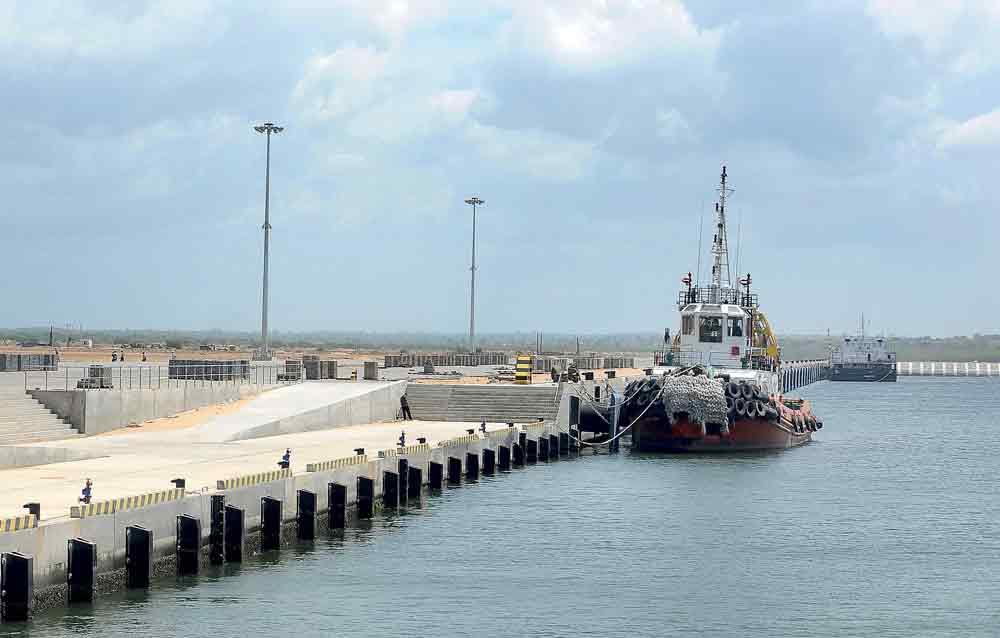
Sri Lanka lies close to sea lanes carrying a substantial proportion of global energy supplies and container traffic. The photograph shows the new port in Hambantota
 The US–Iran– Israel confrontation shows how regional conflicts now send global shockwaves, disrupting energy markets, contesting maritime chokepoints, and drawing in Washington, Moscow, and Beijing. For Sri Lanka, these are not distant headlines but living realities

The international system is undergoing its deepest transformation since the Cold War; the U.S.-led unipolar moment has ended, replaced by a fragmented multipolar order marked by great-power rivalry, technological competition, and the rise of the Global South. The US–Iran– Israel confrontation shows how regional conflicts now send global shockwaves, disrupting energy markets, contesting maritime chokepoints, and drawing in Washington, Moscow, and Beijing. For Sri Lanka, these are not distant headlines but living realities. Sitting at the heart of the Indian Ocean’s busiest trade routes, the island holds enviable geography, yet economic fragility and strategic ambiguity have too often left it an arena for external competition rather than a consequential actor in its own right.
The strategic imperative
Middle Eastern instability sharpens Sri Lanka’s vulnerabilities and opportunities alike: Energy security: As a net importer, Sri Lanka is exposed to oil price shocks triggered by Gulf tensions. Maritime relevance: Disruptions in Gulf shipping elevate Colombo and Hambantota as alternative hubs for logistics and trade. Diplomatic leverage: Sri Lanka can position itself as a neutral convener in Indian Ocean dialogues, emphasizing stability and freedom of navigation.
Four pillars for relevance
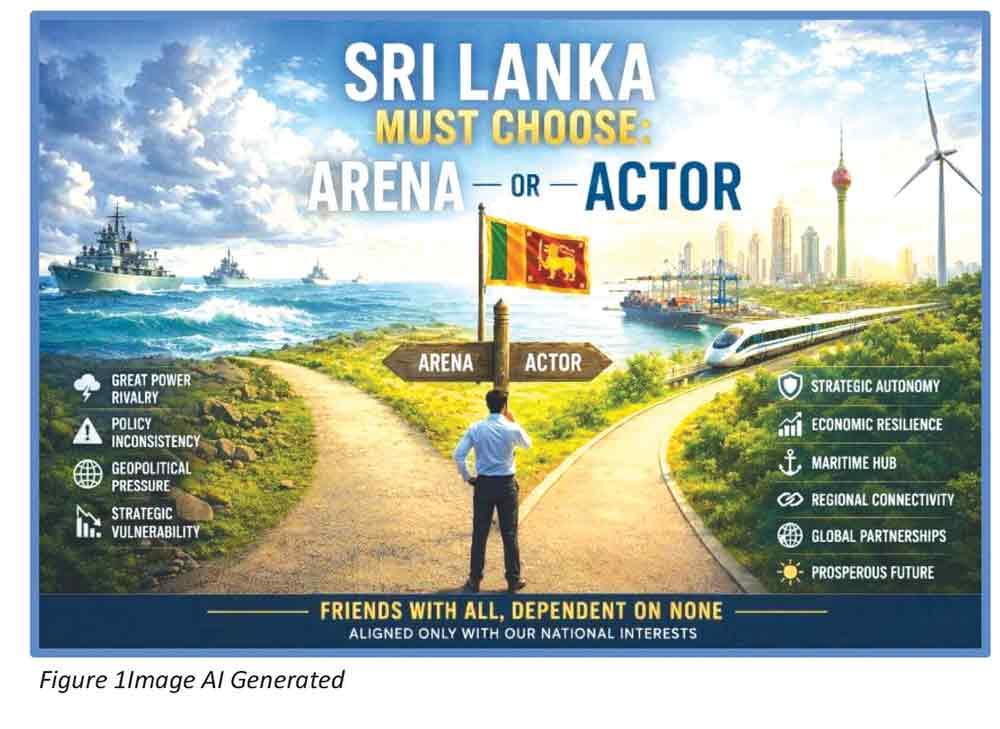
Economic resilience diversifies dependencies, strengthen fiscal discipline, and leverage Port City and Free trade zones as hubs for logistics, finance, and renewable energy. Balanced diplomacy pursues “Non-alignment 2.0,” cultivating pragmatic ties with all major powers while acting as a bridge-builder for Global South concerns. Maritime leadership assert stewardship in Indian Ocean security dialogues, develop the blue economy, and balance naval partnerships Figure 1Image AI Generated 2 without surrendering autonomy. Global South engagement build coalitions with Africa, ASEAN, and Latin America, partner on technology and renewable energy, and project Sri Lanka as a case study in resilience and reform.
Non-Alignment 2.0: Friends with All, Dependent on None
Sri Lanka’s foreign policy in the coming decades cannot rest on the passive neutrality of the twentieth century. The emerging international order demands a modern, agile approach—a doctrine of strategic non-alignment often described as Non-Alignment 2.0.
This is not equidistance between rival powers, nor a return to Cold War neutrality. It is strategic autonomy: the freedom to engage all major powers while becoming dependent on none.
In a multipolar world, smaller states maximise influence not by choosing sides, but by preserving freedom of action and pursuing partnerships that serve national interests. Pragmatism must outweigh ideology; priorities at home must outweigh pressures from abroad.
For Sri Lanka, this means; India: sustaining strong ties with its closest neighbour. China: expanding economic engagement. United States & Europe: strengthening trade and investment links. Emerging middle powers: deepening partnerships across Asia, the Middle East, and Africa.
Sri Lanka must seek cooperation without alignment, partnership without dependency, and engagement without entanglement. In the emerging multipolar order, its greatest strategic asset will not be geography alone, but the ability to preserve autonomy while confidently advancing national interests.
A legacy to revive
Sri Lanka has walked this path before. During the Cold War, it was an active voice in the Non-Aligned Movement, championing sovereignty and South–South solidarity. Today, as multipolarity takes shape, the island can revive that legacy not as nostalgia, but as a pragmatic framework for navigating energy shocks, technological divides, and maritime insecurity.
The country should invest in logistics, shipping, and renewable energy ventures that align with global sustainability trends and forge regional partnerships with ASEAN, Africa, and Latin America to diversify markets. It should also strengthen public–private collaboration in technology, finance, and infrastructure to attract foreign investment and develop innovation clusters around Colombo Port City to integrate Sri Lanka into global value chains.
The Indo-Pacific and the return of geopolitics
The Indo-Pacific has become the principal theatre of strategic competition between the United States and China. China’s expanding economic footprint, military modernization, and political influence increasingly challenge the established regional order supported by the United States and its allies.
This competition extends beyond military considerations to encompass trade, infrastructure development, digital technologies, supply chains, and maritime governance. Flashpoints such as the Taiwan Strait and the South China Sea carry implications not only for regional security but also for global commerce and economic stability.
For smaller states located along major maritime routes, the consequences of this rivalry are profound. Their strategic relevance is increasing precisely as their room for manoeuvre becomes more constrained.
Sri Lanka’s strategic geography
Few countries possess a geographic advantage comparable to Sri Lanka’s. Located near the center of the Indian Ocean and adjacent to one of the world’s busiest East-West shipping corridors, Sri Lanka occupies a position of considerable strategic importance.
The island lies close to sea lanes carrying a substantial proportion of global energy supplies and container traffic. In an era where maritime security and supply chain resilience have become central strategic concerns, geography itself has become a source of national power.
Consequently, Sri Lanka occupies an important place in the strategic calculations of all major powers. For India, stability in Sri Lanka is integral to security in its immediate neighbourhood and to its broader Indian Ocean ambitions. For China, Sri Lanka represents an important component of the Belt and Road Initiative and the Maritime Silk Route. For the United States, Sri Lanka contributes to wider Indo-Pacific objectives centered on freedom of navigation and open sea lanes.
A range of middle powers, including Japan, Saudi Arabia, the United Arab Emirates, South Korea, and Turkey have similarly increased their engagement across the Indian Ocean region, recognizing Sri Lanka’s potential role as a logistical and commercial hub.
The strategic deficit
Despite these advantages, Sri Lanka has struggled to convert strategic geography into geopolitical influence. Frequent political transitions, policy reversals, and short-term decision-making have undermined investor confidence and weakened 4 the country’s international credibility. Strategic ambiguity has often translated into indecision rather than flexibility.
As a consequence, Sri Lanka has too frequently become a reactive rather than proactive actor in international affairs, accommodating the interests of larger powers instead of advancing clearly defined national objectives. Geography creates opportunity, but institutions, policy coherence, and economic strength convert opportunity into influence. Economic Strength as Strategic Power
The economic crisis of 2022 demonstrated a fundamental principle of international relations: foreign policy ultimately rests upon economic foundations.
Financial collapse does not formally diminish sovereignty, but it significantly constrains strategic autonomy. Dependence upon international lenders, bilateral creditors, and external investment reduces negotiating leverage and narrows policy options.
Sri Lanka’s vulnerability to external economic decisions was further illustrated by trade restrictions affecting exports to key markets, particularly in sectors such as garments that remain central to employment and foreign exchange earnings. Economic resilience is therefore not merely an economic objective but a national security imperative.
The rise of the global south
Perhaps the most important geopolitical development of the twenty-first century is the growing influence of middle powers from the Global South.
Countries such as India, Brazil, Saudi Arabia, Indonesia, South Africa, Turkey, Mexico, and Nigeria increasingly shape global discussions on trade, finance, climate policy, and international governance.
These states possess the demographic scale, economic strength, and diplomatic confidence necessary to challenge the traditional dominance of Western institutions and to advocate for a more representative international order. New coalitions such as BRICS+ and an expanded G20 reflect this redistribution of influence.
Sri Lanka shares many historical and developmental experiences with the Global South, yet it remains largely absent from strategic debates shaping the future international system.
Opportunities for Sri Lanka
Periods of international transition often create opportunities for smaller states capable of strategic adaptation. Singapore transformed itself into a global 5 logistics and financial hub despite limited natural resources. Qatar leveraged diplomacy and mediation to exercise influence disproportionate to its size. The United Arab Emirates utilized strategic investment and connectivity to become a global commercial center. Sri Lanka can pursue similar pathways.
First, the country can establish itself as a neutral maritime and logistics hub serving all major economic blocs. Second, Sri Lanka can emerge as a diplomatic platform for dialogue on maritime security, climate adaptation, and regional cooperation in the Indian Ocean. Third, the country’s significant renewable energy potential offers opportunities for partnerships in green energy investment and technology transfer. Finally, Sri Lanka can contribute constructively to efforts aimed at reforming global institutions and improving representation for smaller developing nations.
Conclusion
Sri Lanka stands at a crossroads in an era of strategic competition and shifting power. Its geography, maritime relevance, and proximity to dynamic economies are enviable assets, but they guarantee nothing. The real question is not where Sri Lanka stands today, but where it chooses to stand tomorrow.
It can remain reactive to external pressures, or it can pursue resilience, clarity, and confident diplomacy. In a multipolar world, Sri Lanka’s role should be that of a purposeful small power, neutral, connected, stable, and regionally influential.
Our geography is fixed, but relevance must be earned. By embedding resilience and maritime leadership into its national strategy, and by mobilizing government, business, and civil society around shared goals, Sri Lanka can rise above fragmentation and become a pivotal player in the emerging global order.
Regional conflicts, such as the U.S.–Iran–Israel confrontation, show how quickly global trade and security can shift. For Sri Lanka, the stakes are existential: it must transform from a vulnerable arena into a confident actor. The world is fragmenting the choice is whether Sri Lanka fragments with it or rises above it.
(The writer is Director Khen Energy, Senior Fellow South Asia Foresight Network Formerly Commander Sri Lanka Air Force, Ambassador to Afghanistan and President Association of Retired Flag Rank Officers)