11 Jul 2026 - {{hitsCtrl.values.hits}}
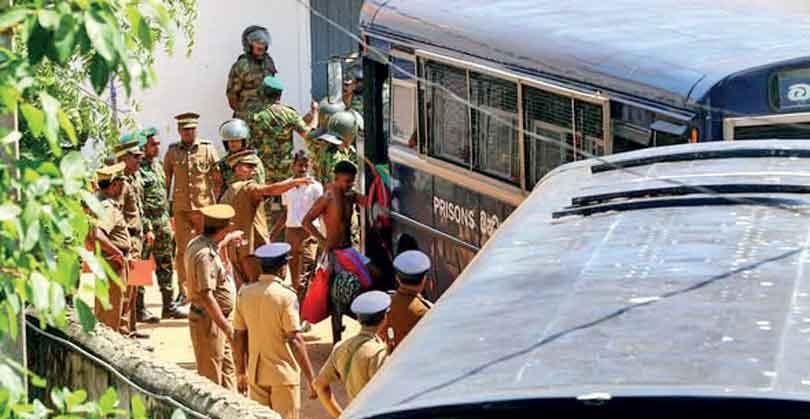
Prisoners being escorted to buses after the riot
- Despite the motto “Prisoners are Human Beings,” the reality within Sri Lanka’s prisons tells a different story, one of immense suffering and systemic failure
 The cause of the Negombo prison riot, which left 25 dead, is yet to be ascertained. But, as in the case of previous prison riots, it could be traced to certain chronic deficiencies in the Sri Lankan prison system. These deficiencies were identified by the Committee for Protecting Rights of Prisoners (PRP), a civil society organisation dedicated to advocating for prisoners’ rights.
In its Status of Prisoners in Sri Lanka 2025 Annual Report, it pointed to a range of issues within Sri Lanka’s prison system, primarily concerning inadequate infrastructure and the lack of justice-centred treatment for prisoners. In many prisons, the number of inmates exceeds the designed capacity by four times, forcing detainees to endure harsh living conditions with sanitation facilities that fail to meet basic human needs. These conditions have had a detrimental impact on the physical and mental health of the inmates.
Despite the motto “Prisoners are Human Beings,” the reality within Sri Lanka’s prisons tells a different story, one of immense suffering and systemic failure. It would not be an exaggeration to say that the prison system is on the verge of collapse.
Most prison infrastructure dates back to the colonial era. And due to years of neglect, there is a lack of essential maintenance. The buildings are dilapidated and the lighting dim. Due to resource shortages and administrative inefficiencies, essential maintenance and renovation efforts are hindered, creating an unsafe environment for both inmates and prison staff.
Prison overcrowding remains a severe issue within Sri Lanka’s prison system. According to the 2023 Annual Report of the Department of Prisons, the overcrowding rate in 2022 was identified at 111%. The UN Special Rapporteur on Torture, Inhumane, Degrading Treatment, and Punishment reported during its 2016 mission to Sri Lanka that overcrowding levels in some prisons, such as the Vavuniya Remand Prison, exceeded capacity by 200% to 300%.
This extreme overcrowding has contributed to severe consequences, including increased death rates, riots, and significant health problems among inmates.
Overcrowded wards force many new remanded persons to stand all night due to a lack of space to sleep. Some are even compelled to sleep near or inside toilet areas, highlighting the dire conditions.
In addition to infrastructure issues, there is also a severe shortage of prison staff. According to the 2021–2025 Prison Reform Implementation Plan, by 2025, approximately 1,800 staff vacancies will be reported. This shortage has led to challenges in ensuring prisoner safety, providing healthcare, distributing food, and managing other essential maintenance operations.
The national legal framework governing Sri Lanka’s prisons is largely based on the Prisons Ordinance of 1877 and its related regulations. These outdated laws are inadequate to meet modern human rights standards, which Sri Lanka has undertaken to maintain. Sri Lanka has ratified the International Covenant on Civil and Political Rights (ICCPR), the United Nations Convention Against Torture (UNCAT), and the Standard Minimum Rules for the Treatment of Prisoners (the Mandela Rules). But in practice, these international standards are disregarded in matters concerning prisoners.
The continuous application of the Prevention of Terrorism Act (PTA) has subjected detainees and those held under its provisions to distressing and precarious living conditions. These laws, which lack adherence to fundamental international legal standards, have led to prolonged detention without charge or trial, restricted access to legal remedies, and an increased risk of torture and abuse.
The failure of the prison system is further evident in the rising number of prison-related deaths. From January 2024 to May 2025, at least 173 prison deaths have been reported due to neglect of illnesses, suicides, assaults, and other hazards.
Most of these deaths highlight the severe lack of healthcare facilities within the prisons. The death of an inmate at Boossa Prison in April 2025, along with incidents involving the forced consumption of harmful substances and other related deaths, underscores the urgent need for proper medical care and supervision for prisoners.
Neglecting vulnerable categories of inmates within the prison system exposes them to various forms of abuse. In the women’s prison section, overcrowding, lack of sanitation facilities, compromised privacy, and limited access to maternal healthcare are among the challenges faced by female inmates.
Inmates with disabilities often rely on assistance from other prisoners due to inadequate accessibility and the lack of trained care staff. Transgender inmates face a heightened risk of systemic discrimination and harassment due to the absence of policies addressing gender identity. Elderly inmates also face a lack of age-appropriate medical care and support.
Justice has not been served for the Mahara riot (November 2020, in which 11 died) and the Welikada prison killings (November 2012, when 27 were killed by firing). Legal proceedings related to the Mahara Prison killing have been suspended, making it impossible to identify those responsible. Former Prisons Commissioner Emil Ranjan Lamahewa was sentenced to death by the Colombo Permanent High Court Trial-at-Bar over the Welikada prison massacre on the charge of murdering 8 prisoners. But he was acquitted by the Supreme Court in 2024.
The Sri Lankan prison system is in urgent need of comprehensive reform. It is essential to consider formalising the Department of Prisons by establishing a dedicated service, such as the Sri Lanka Correctional Service.
This initiative would ensure compliance with international norms and enhance the administration of prisons. Key international regulations and standards for prison administration include: The UN Standard Minimum Rules for the Treatment of Prisoners (Nelson Mandela Rules); The UN Rules for the Treatment of Women Prisoners and Non-Custodial Measures for Men Offenders (Bangkok Rules) ; The UN Standard Minimum Rules for the Administration of Juvenile Justice (Beijing Rules)
By adopting and adhering to these frameworks, Sri Lanka can promote a more humane, effective, and modern correctional system. This report will explore the priority areas for prison reform in Sri Lanka, emphasising the importance of aligning national policies with these international standards.
Sri Lanka must establish separate Centres for Convicted Narcotics Offenders. There has been a gradual increase in convictions for narcotic drug offences. In 2019, 51.9% of convicted prisoners were incarcerated for dangerous drug offences. Among these, 40.6% were first-time offenders, 33.3% were repeat offenders, and 26.1% were recidivists.
Additionally, around 77% of narcotic offenders in 2019 were imprisoned for periods ranging from less than one month to six months, which is insufficient for conducting proper drug rehabilitation programmes.
Creating dedicated facilities for these individuals would not only provide better rehabilitation opportunities but also serve as an effective solution to reduce prison overcrowding. Immediate action must be taken to implement this initiative.
The delays by the Government Analyst Department in furnishing reports, particularly drug-related reports, also contribute to the growing prison population. As a result, prison overcrowding is significantly exacerbated by the number of inmates convicted of drug-related offences.
Sri Lanka’s Prison Ordinance Act includes a four-year review mechanism that can be enhanced to address the needs of inmates serving long term sentences. This mechanism is particularly relevant for individuals serving life sentences, long-term punishments, or even those sentenced to death.
By prioritising such cases, this system allows for early release, typically around 13.5 years, based on an inmate’s behaviour and rehabilitation progress during incarceration. The system can ensure that deserving individuals are granted a second chance, thereby reducing the strain on the prison system. The home leave process should also be reinforced as part of this initiative. Additionally, it is crucial to review.
Alternative punishment methods should also be explored to address prison overcrowding. For instance, introducing house arrest for prisoners with shorter sentences and selected offenses could be a practical solution. Prisoners could be engaged in community service projects as a form of alternative punishment, contributing to society while serving their sentences.
Prisoners granted bail should be released on the same day and the effective use of the Remand Prisoners Released Act. The effective implementation of the Remand Prisoners Release Act is crucial for reducing the prison population.
Delays in granting bail, late submission of analyst reports, delays in advice from the Attorney General, and the lack of translators are common factors that prolong the imprisonment of remand prisoners unnecessarily. To address this, it is vital to expedite these processes and ensure smooth coordination among all stakeholders. Prompt action and increased attention to these issues will contribute significantly to reducing prison overcrowding and improving the efficiency of the justice system.
The time spent during the appeals process should be taken into the calculation of the sentence. Under the current system, the time spent on appeals is often disregarded when determining the final sentence duration. By deducting the duration of the appeals process from the overall sentence, the total time spent in prison can be effectively reduced.
This adjustment not only shortens the incarceration period for eligible inmates but also contributes significantly to alleviating overcrowding within the prison system.
Streamlining the appeals process and ensuring its duration is accounted for can improve the efficiency of the justice system while maintaining fairness.
The primary purpose of imprisonment is twofold: to ensure public safety by isolating offenders and to rehabilitate them for reintegration into society as responsible citizens. Rehabilitation focuses on reforming inmates’ behaviour and equipping them with the skills necessary for a productive life.
To achieve this, inmates should spend a significant portion of their time participating in programmes that promote personal and spiritual development. For prisoners dealing with drug addiction, it is essential to provide specialised counselling and treatment programmes.
Vocational training should play a central role in prison rehabilitation programmes, offering inmates practical skills in trades that are both useful and income-generating, aligned with current market demands. A wide range of training programmes should be made available, allowing inmates to choose fields that match their interests and aptitudes.
To further support this effort, mechanisms should be introduced to market and sell products made by inmates during their training, especially to state entities.
Programmes such as yoga, meditation, and mindfulness, tailored to Sri Lanka’s cultural context, should be implemented to enhance inmates’ mental and emotional well-being. These programmes can help transform their mindset, instil positive thinking, and encourage personal growth.
11 Jul 2026 11 minute ago
11 Jul 2026 2 hours ago
11 Jul 2026 3 hours ago
11 Jul 2026 3 hours ago
11 Jul 2026 3 hours ago