31 May 2025 - {{hitsCtrl.values.hits}}
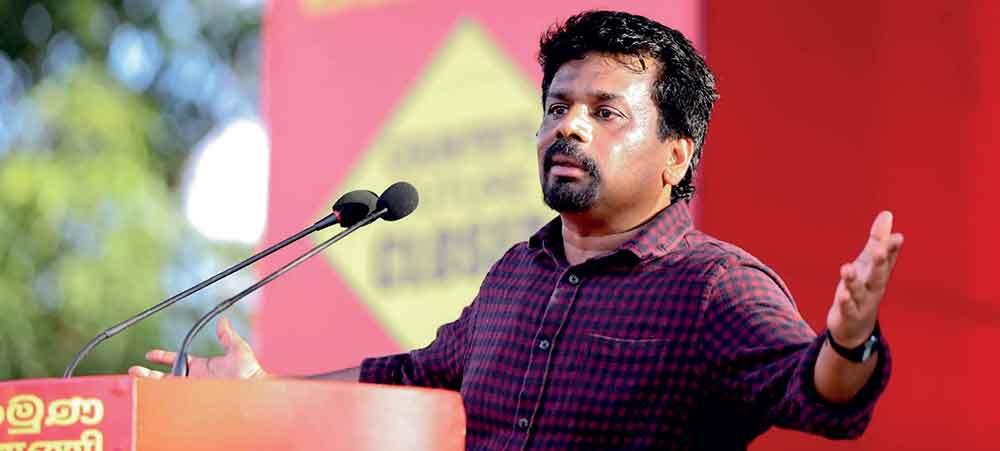
The current leadership under the NPP have to watch out for the fact that Opposition parties have succeeded to some extent in creating a negative public opinion of the government with blunders like the recent war commemoration day miscommunciation. (FILE PHOTO)
 Historical governments started with high enthusiasm but waned due to policy decisions taken by those governments, including Mahinda Rajapaksa’s second time being president and Maitripala Sirisena’s Yahapalana Government
The NPP government has had real progress, such as the tourism and export revenues continually increasing, but they are overshadowed by miscommunication and blunders like the recent war heroes commemoration debacle
At a time when the National People’s Power (NPP) government is being accused of inaction, it is pertinent for the leaders of the government to revisit the collapse of the past few governments.
The Mahinda Rajapaksa government, which was voted into power in 2010 with a near two-thirds majority in Parliament, had somewhat distanced itself from their voters by 2014 with its highhanded activities including suspected extrajudicial killings and high-profile corruption. It failed to prevent itself from being toppled by its own Health Minister, Maithripala Sirisena, at the 2015 Presidential election.
Sirisena did not have a vote bank of his own, it was mainly the voters of the United National Party (UNP) who backed him. He appointed UNP leader Ranil Wickremesinghe as his Prime Minister and the duo named their administration “Yahapalana Government” or government of good governance.
However, within a month after the government assumed office, it proved to be an entity undeserving of that title as its leaders apparently had paved the way for the infamous Central Bank bond scam, one of the largest scandals in Sri Lanka’s history. They were so shameless that they allowed a second scam of similar magnitude at the same bank in another two months.
The Yahapalana government also earned disrepute for its rhetoric and inaction. By 2018, when the first local government election under the mixed electoral system approached, they were accused of not providing at least a single job for the previous three years. Only the bickering between the two top leaders of the government, President Sirisena and Premier Wickremesinghe, proved that there was a government in the country.
Against this backdrop, a new party, Sri Lanka Podujana Peramuna (SLPP), led by former President Mahinda Rajapaksa, swept the electorate by winning 231 out of 340 local councils. In fact, the SLPP was not a new party, but a rechristening of the majority group of the bifurcated Sri Lanka Freedom Party (SLFP) led by Maithripala Sirisena.
The 2018 LG elections became a trendsetter in the face of inaction on the part of the So-called Yahapalana government and Gotabaya Rajapaksa of the SLPP won the Presidential election in 2019, but this led to another round of inaction, corruption and failures, which later transformed into anarchy. Gotabaya Rajapaksa started his blunders with a huge tax cut, which deprived the state of nearly one third of its revenue and it was followed by another imprudent decision to impose an overnight ban on imports of chemical fertiliser and agrochemicals.
He attempted to stop the rupee from diving below Rs. 203 against the dollar, which had cost $ 5.5 billion—an amount equivalent to the total cost of annual fuel imports—for the Central Bank, according to the officials of the Bank. He was prevented from approaching the IMF, the last resort to avert a crisis situation, by his advisors. All these created a situation where there was a time when the foreign reserves were left with an unprecedented $ 50 million. It was after the country went bankrupt; he replaced his advisors with a set of new officials who advised him to approach the IMF.
Yet, it was too late, he had to flee amidst a huge public uprising against his government in 2022 and Ranil Wickremesinghe took charge. Within months, Gotabaya’s approach to the IMF came to fruition with foreign exchange starting to flow by way of loans from the IMF, World Bank and the Asian Development Bank, ending queues for fuel and gas. Normalcy gradually returned despite warnings by the experts continuing and Wickremesinghe grabbed all the credit.
The loss of trust in the traditional parties catapulted the NPP into power last year and the last six months under the new rulers were another period of inaction. In spite of the negative claims by the Opposition parties and the media backed by them, the economy is improving under the NPP as well, thanks to the IMF-sponsored programme. The country’s tourism and export revenues are continually experiencing a surge. Corruption at the highest and political level has been stopped and political patronage for corruption is no longer an issue, at least for now.
Nevertheless, although a production-based economy had been a mantra on NPP platforms prior to the Presidential and Parliamentary elections, realisation of it does not seem to be in the government’s agenda. No new projects are being executed under any of the ministries and no new legislation is forthcoming under the NPP government.
However, it is too early to conclude that the government has failed the people, as the ministers complain about rigidity in bureaucratic controls, which cannot be ruled out. They accuse the officials who worked hand in glove with the corrupt politicians of the past governments are not being prepared to take the government’s programmes forward. President Anura Kumara Dissanayake, also inaugurating the National Anti-Corruption Programme last month, warned that if the officialdom is not prepared to change before the end of May, the government would change them.
The government’s communication blunders in the meantime give more ammunition to the Opposition than the real issues. In fact, Opposition parties are also hanging on to these blunders rather than on real issues. The best point in case was the confusion in the honour awarded to veteran film star Malini Fonseka. First, the government announced she would be given state honours and then it was changed to a state funeral. When journalists questioned this, Foreign Affairs Minister Vijitha Herath struggled to find answers.
Similarly, the government created controversy by first declaring that the National War Heroes Commemoration would be held under the aegis of Deputy Minister of Defence Aruna Jayasekara and later the deputy minister was replaced by President Anura Kumara Dissanayake. Herath stated that the first announcement was a communication error.
The President, during the local government elections, stated that funds for those local councils won by the Opposition would be issued after a thorough scrutiny. The Opposition politicians distorted it as the President having said that the councils under the Opposition would be denied funding.
Again, Dissanayake last month stated that investigators would be able to make some new revelations in respect of the Easter Sunday terrorist attacks, before April 21, which was also distorted as him having stated that the mastermind of the terrorist attacks would be exposed before April 21. In both occasions, ministers seem to be clueless as to what their leader really said, given their embarrassment in the face of questions posed by the journalists based on the distorted version of the President’s statements.
What the leaders of the government have not realised is that the Opposition parties have succeeded to some extent in creating a negative public opinion of the government with these blunders, albeit the government still seems to be on the right track, in respect of real issues.
10 Jul 2026 51 minute ago
10 Jul 2026 1 hours ago
10 Jul 2026 2 hours ago
10 Jul 2026 2 hours ago
10 Jul 2026 4 hours ago