03 Nov 2025 - {{hitsCtrl.values.hits}}
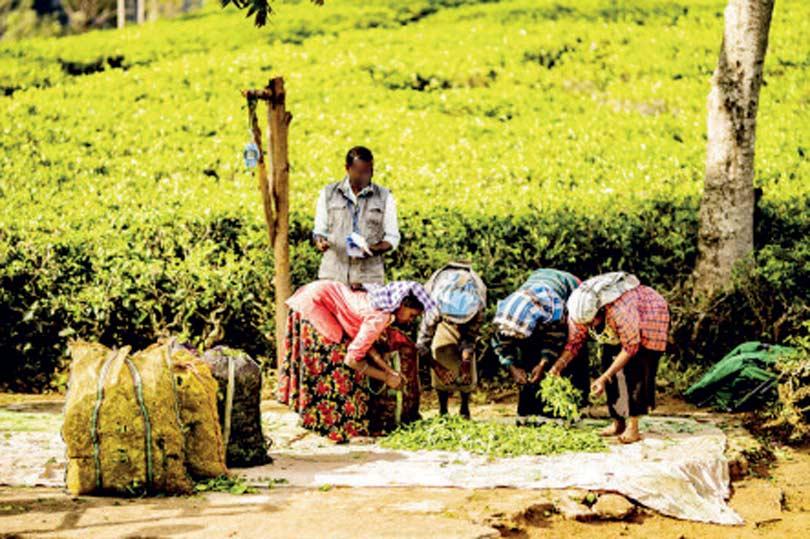
Tea plantation work has been called a form of modern slavery
 Every crisis forces us as a people, and for that matter as a country, to rethink our future. The failed post-war reconstruction in the North a decade ago made many of us approach rural development with a focus on rebuilding co-operatives.
Similarly, the worst economic crisis ravaging our country since the 1930s has now put forward the challenge of how we think about our economic future. This great challenge before the Government is also for the people and its movements; teachers’ associations, trade unions, co-operatives, and many other social institutions have to rethink their demands and their way forward.
 The national budget will be announced in a few days, and hopefully it will provide some direction for a way out of this long crisis. However, we cannot expect much in terms of allocations until the IMF programme with its austerity measures ends. We should also be clear and aware of the scale of this crisis. Sri Lanka has lost a decade in terms of economic growth and two decades in terms of bringing people out of poverty; Sri Lanka’s GDP is expected to return to 2018 levels only in 2026, and poverty levels to pre-crisis levels only in 2034. In effect we have lost an entire generation!
This great economic depression devastating our economy has disrupted livelihoods, drastically reduced income streams and affected our food system. The situation would not have been this bad if successive governments had not abandoned the rural economy, and not taken the path of trade liberalisation in agriculture. Furthermore, the state institutions responsible for the rural sectors – whether it be agricultural extension, rural development departments or agencies supporting co-operatives – were cut down only to exist in name with little resources.
It is amidst this state of affairs that the government has now announced a major drive to create one thousand producer co-operatives to revive and strengthen the agricultural and food systems. Further, given the broader crisis in the plantations, there is also a move to form five hundred producer co-operatives in the plantation regions. In this column, I address the challenges facing this vast co-operative plan.
Political economy of labour
I begin with the theoretical challenge, and draw on ideas of Karl Marx. Only a few leftists today know about Marx’s views on co-operatives. Marx, in guiding the formation of the First International in 1864, reflected on the long crisis that confronted the working people of Europe following the suppression of the great revolutionary uprising of 1848. Marx claimed that despite this major setback, there were two great victories for the working people following the counter-revolution. A decade and a half after this setback to workers, the first victory, he says, is the broad acceptance of the ten-hour working day and then the formation of co-operatives:
“Hence the Ten Hour Bill was not only a great practical success; it was the victory of a principle; it was the first time that in broad daylight the political economy of the middle class succumbed to the political economy of the working class. But there was in store a still greater victory for the political economy of labour over the political economy of property. We speak of the cooperative movement, especially the cooperative factories raised by the unassisted efforts of a few bold ‘hands’. The value of these great social experiments cannot be overrated.”
The ten-hour working day mentioned by Marx had over the next century been brought down to an eight-hour working day in most countries. But as we know from our situation today, the low wages inadequate for survival have led to workers working twelve hours or even more, with their dependence on overtime work for survival. This mockery of the working day needs to be addressed with an eight-hour working day, a forty-hour work week and two days of rest. And the minimum wage needs to be adjusted to address the increased cost-of-living.
Here, I focus on the great victory of the co-operative movement mentioned by Marx. For co-operative production entails the workers producing on their own, avoiding the dominance of capital. With the extraction by traders and companies not only exploiting our working people in the countryside to a state of pauperisation, but also undermining agricultural production, can co-operatives create an autonomous system to provide decent work, incomes and food to our working people?
Subsequently in 1867, Marx’s Instructions for the Delegates of the Geneva Congress articulated the significance of the co-operative as one based on class struggle:
“We acknowledge the cooperative movement as one of the transforming forces of the present society based upon class antagonism. Its great merit is to practically show that the present pauperising and despotic system of the subordination of labour to capital can be superseded by the republican and beneficent system of the association of free and equal producers.”
The challenge today before us amidst the economic crisis is to consider the class implications of the crisis; it is the working people who are devastated by both the debt restructuring and the austerity-driven IMF programme. And it is demands for decent wages and a bearable working day as much as autonomous production by workers in producer co-operatives that can bring the much needed victories for our working people.
State institutions and plantations
The vision of one thousand producers co-operatives by the Government I would argue is a once in a half-century shift. There is now an unprecedented opportunity to redirect the rural economy and the food system in the country. State institutions long abandoned and even considered for liquidation with neoliberal policies in recent years are now being revived; the National Institute of Co-operative Development and the Co-operative Wholesale Establishment are two such important examples.
In the plantation regions with harrowing social conditions for Malayaha Tamils, which a UN Special Rapporteur recently called a contemporary form of slavery, the emergence of producer co-operatives could signal a major advance. However, two hundred years of such extreme exploitation and social exclusion, poses many other challenges and at the heart of it is the right to land. Thus if the Government is serious about forming vibrant co-operatives, land reforms would be critical; land to the tiller and land to the co-operative have to be coupled with the vision of initiating producer co-operatives in the Hill Country.
While the Government programme of producer co-operatives is welcome, its success or its failure will depend for the most part on social mobilisation and social will to create such co-operatives. The revival of the agriculture and food system through co-operatives can also address poverty and malnutrition depriving communities. Furthermore, the state cannot lead the co-operative movement which should remain autonomous. In this context, federations born out of the co-operatives themselves must address the challenges and shocks that come from capitalist exploitation and crises, which are bound to affect the co-operatives that have to survive within the capitalist market. While co-operatives alone are insufficient to address the inequalities and exploitative nature of the capitalist system, they can create the ground for a good life. The long road ahead for the co-operative movement is bound to be fraught with challenges, but the co-operative alternative, if it succeeds, can become a foundation for equality and freedom.
11 Jul 2026 18 minute ago
11 Jul 2026 2 hours ago
11 Jul 2026 3 hours ago
11 Jul 2026 3 hours ago
11 Jul 2026 3 hours ago