28 Jun 2025 - {{hitsCtrl.values.hits}}
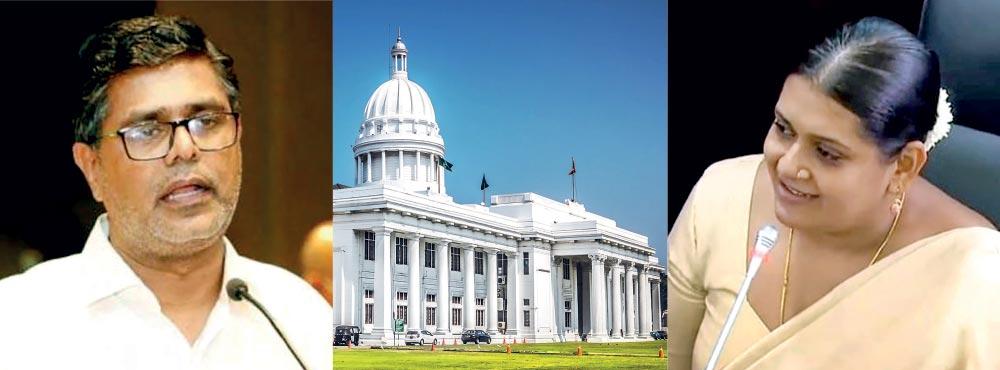
While SJB’s Mujibur Rahman backs different ballot methods based on his party’s wavering interests, this contrasts with NPP’s Vraie Balthazaar, who secured the Colombo mayoralty through the controversial secret ballot process. Middle photo courtesy Colombo Municipal Council (File photo)
The procedure for the election of the chairman and mayors in local government bodies where no party has secured an absolute majority is something amusing. The election would be held by secret ballot or open ballot, which is decided by another poll in the councils again by secret ballot or by open ballot.
That means you have to take a vote first in the council to decide the mode of ballot that would be used in the vote for the election of the chairman or the mayor, as the case may be. Then the vote for the election of the chairman would be taken. However, the law is silent on the method of the first vote – whether it should be a secret ballot or an open ballot. It is left to the concerned provincial local government commissioners.
Pandemonium reigned recently due to this lapse in the law in many local government councils, including the Colombo Municipal Council (CMC), where the National People’s Power (NPP) had won the largest number of seats, but not an absolute majority at the May 6 elections. The strength of the NPP was less than the collective strength of all other parties in these councils.
Hence, the NPP members insisted on a secret ballot for both votes, expecting defections from other parties, while all other parties that had fielded a common candidate against the NPP candidate preferred an open ballot, fearing such defections.
In a secret ballot, there is ample opportunity for duplicity or double dealings by the LG members. If that method is employed during the first vote and if there are sufficient defections to the NPP, the same method would prevail at the second vote as well. The process would end up in the victory of NPP candidates, as happened in the CMC and some other councils. On the other hand, since defections are unlikely in an open ballot at the first vote, the same method would be chosen for the second vote as well, which would be favourable to the anti-NPP collective.
If the secret ballot or the open ballot at the first vote leads to the same method being employed at the second vote, it is pointless to conduct two votes. The whole process for the election of the mayors and chairmen of LG bodies, therefore, has to be re-evaluated. There should be an incontrovertible method for the election of the heads of LG bodies.
In the Colombo Municipal Council, where NPP has only 48 members, the mayoral candidate of the party, Vraie Cally Balthazaar, obtained 61 votes, two votes more than the absolute majority. The reason for the 13 non-NPP members who voted in support of her is yet to be revealed. The Opposition parties, without presenting any credible evidence, claim that the NPP is buying votes, while Deputy Minister of Transport Dr. Prasanna Gunasena stated days ago that members of other parties vote for NPP candidates, approving the actions of the party. The majority of NPP leaders seem to prefer not to comment on it. At a time when politics has become a money-making business, the NPP leaders who vowed to bring morality into politics have an inseparable obligation to convince the people in this regard.
Whatever that pushed them to do so, the 13 non-NPP members in the CMC were able to vote according to their conscience due to the secret ballot method that was applied. If they had done so at an open ballot, the secretary of their party or parties or independent groups could expel them from the party or the group, on disciplinary grounds, ultimately depriving them of their membership of the council. Sometimes the safety of the defective member would also be jeopardised.
When a party brings in or supports a Bill or a motion that is clearly inimical to the interests of the people in the Parliament or a provincial council or an LG council, individual members should have an obligation to oppose it. They would easily be able to do so without being prejudicial to their membership if the vote on it is taken by a secret ballot. At the same time, it is also fittingly argued that the people who voted for a member of parliament or a provincial council or an LG council have the right to know what their representative does in the respective council. But the secret ballot prevents it.
Colombo District Samagi Jana Balawegaya Parliamentarian Mujibur Rahman, during an interview with a Sinhala newspaper last week, had said that he first preferred the secret ballot for the CMC mayoral election and later, when it seemed to be inapt to the interests of his party, he pressed for an open ballot. This is a totally wrong approach. Systems cannot be introduced or employed in line with the interests of individual political parties. They must be evaluated in light of the pros and cons of them, including the conscience of members and the rights of the people who
voted for them.
No party has won an absolute majority in 187 out of 339 LG councils for which elections were held on May 6. This is a systemic failure as it constitutes more than half of the total number of councils. As we have pointed out in previous articles, this is a direct upshot of the current mixed electoral system, which has done away with the cut-off point system for the weakest contenders and the bonus
seats for the winners.
This messy situation was witnessed following the first LG election held under the mixed electoral system in 2018. However, the leaders of the Sri Lanka Podujana Peramuna (SLPP), which had won 231 out of 340 councils for which elections were held in that year, very easily took control of all hung councils, employing a carrot and stick approach towards the Opposition members of those councils to fall in line. This issue also has to be resolved before the
next LG elections.
Downsizing the LG bodies, another major issue that is being continually deferred cannot be a difficult task as the Delimitation Commission headed by the former Chairman of the Election Commission, Mahinda Deshapriya has already made proposals in 2023 to reduce the number of members of the LG bodies from current 8000 to little over 4000 members.
Continuing the mixed electoral system without making these changes is nothing but cutting your feet to fit your shoes.
10 Jul 2026 32 minute ago
10 Jul 2026 1 hours ago
10 Jul 2026 2 hours ago
10 Jul 2026 2 hours ago
10 Jul 2026 4 hours ago