17 Apr 2025 - {{hitsCtrl.values.hits}}
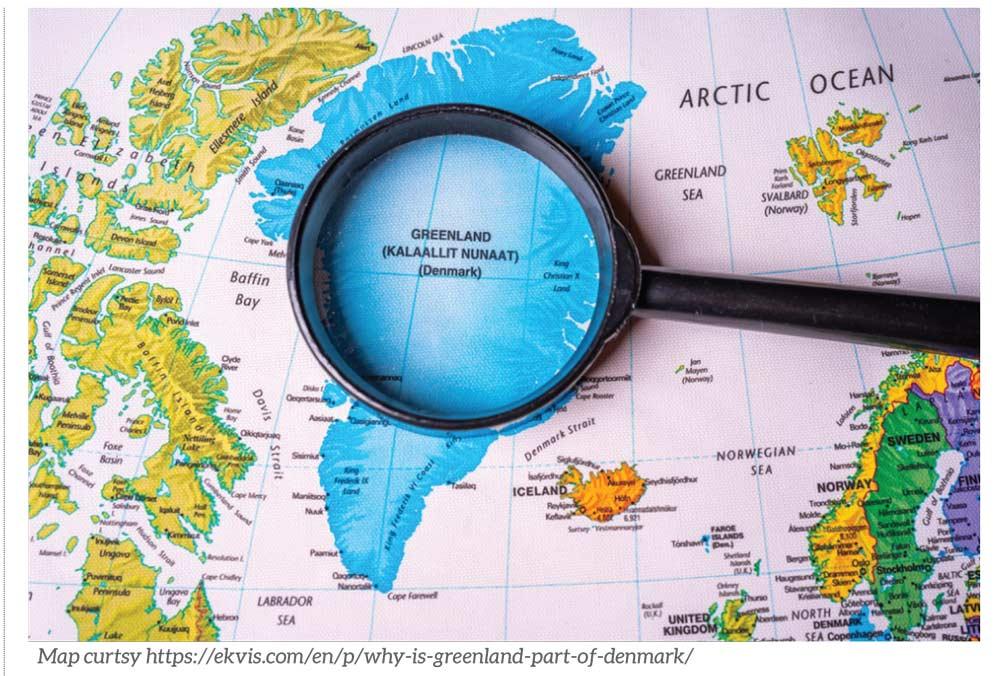
 Denmark still manages foreign affairs and defense, but Greenlandic leaders have a say in international matters that affect the island Denmark still manages foreign affairs and defense, but Greenlandic leaders have a say in international matters that affect the island |
 The EU is interested in Greenland’s fishing industry, resources, and strategic Arctic position The EU is interested in Greenland’s fishing industry, resources, and strategic Arctic position |
| President Trump saw Greenland as a potential resource hub that could benefit U.S. economic interests |
| As climate change makes the Arctic more accessible, the geopolitical stakes surrounding Greenland’s resources are expected to rise |
| The world’s largest non-continental island may have only 57,000 inhabitants but, it has an outsized role in security matters |
| There’s no publicly recorded direct trade between Sri Lanka and Greenland. Any economic exchange would likely occur under broader Sri Lanka–Denmark trade arrangements |
 Greenland is an autonomous territory within the Kingdom of Denmark. It governs most of its own domestic affairs: Denmark retains control over foreign policy, defence, and security matters. Greenland has had home rule (self-government or limited autonomy in internal affairs by a dependent political unit) since 1979 and expanded self-rule (the act of a country, a part of a country, or a nation choosing its own government and controlling its own activities) in 2009, meaning it controls areas like healthcare, education, and natural resources. Denmark still manages foreign affairs and defense, but Greenlandic leaders have a say in international matters that affect the island. There is an ongoing political debate in Greenland about full independence, but economic dependence on Denmark (which provides financial subsidies) makes this complex. While Greenland technically belongs to Denmark, it has increasing political independence and could one day become a fully sovereign nation. Greenland is important for several reasons, both environmentally and geopolitically as its home to the second-largest ice sheet in the world, after Antarctica. This ice sheet plays a critical role in regulating global sea levels. Its melting has significant implications for sea level rise and climate patterns worldwide. Greenland has vast natural resources, including minerals, rare earth elements, and potentially oil and gas reserves. As global demand for these resources increases, Greenland’s strategic importance grows. Geopolitically, Greenland’s location in the Arctic makes it strategically important. As it is situated between North America and Europe, and its waters are becoming more navigable due to climate change, opening up new shipping routes and access to resources. The majority of Greenland’s population consists of Inuit (Indigenous people of the Arctic, The word Inuit means “the people” in the Inuit language of Inuktut, who have lived there for thousands of years and have a strong cultural identity. Greenland is also important culturally, being home to indigenous communities like the Greenlandic Inuit. Their way of life and traditional knowledge contribute to the cultural richness of the region. Scientists study Greenland extensively to understand climate change and its impact on ice sheets. Research that has been conducted provides valuable insights into global environmental trends. Several countries and entities are interested in Greenland due to its strategic location, natural resources, and geopolitical significance. Who wants a stake in Greenland and why? Greenland has increasing self-rule but would need more financial independence to fully break away. In 2019 and again in 2025, President Donald Trump publicly expressed interest in buying Greenland, citing its strategic location and resources. The U.S. already has a military presence in Greenland (Thule Air Base), a key Arctic outpost for missile defense and surveillance. The U.S. also wants to limit China and Russia’s influence in the Arctic. Further, China is interested in Greenland’s rare earth minerals, crucial for technology and defense industries. Chinese companies have attempted to invest in mining projects, but Western nations especially Denmark and the U.S. have blocked some deals. Russia is expanding its military presence in the Arctic, increasing tensions with NATO. While Russia hasn’t made direct claims on Greenland, its Arctic strategy makes Greenland more important in global security. Greenland left the European Economic Community (EEC) (now the EU) in 1985 but still receives funding and maintains close ties. The EU is interested in Greenland’s fishing industry, resources, and strategic Arctic position. President Trump saw Greenland as a potential resource hub that could benefit U.S. economic interests. Owning Greenland would give the U.S. a stronger foothold in the Arctic, an area becoming more important due to climate change and new shipping routes. Denmark rejected the idea outright, with Prime Minister Mette Frederiksen calling it “absurd.” The Greenland’s government also dismissed the idea, stating, “Greenland is not for sale.” After Denmark’s firm rejection, Trump canceled a planned visit to Denmark and called Frederiksen’s response “nasty.” The proposal became a global headline, with many seeing it as an unusual diplomatic move.
Potential to control Arctic sea routes
Why is Greenland So Valuable? Greenland holds significant strategic value due to its potential to control Arctic sea routes, a key factor in global defence and geopolitics. Moreover, its rich deposits of rare earth metals, oil, and gas enhance its appeal for economic development and resource extraction. Together, these elements highlight Greenland’s growing importance in both security and global economic spheres. Climate Change Impact by melting ice is opening up new trade routes and mining opportunities. Greenland’s Prime Minister Mute Egede says “the Greenlandic people will determine their own future and do not want to be Danes nor Americans”. Egede made his comments in reaction to United States President Donald Trump, who has reiterated his desire to make Greenland a part of the US. Further Prime Minister Mute Egede said “We do not want to be Americans, nor Danes, we are Kalaallit [Greenlanders]. The Americans and their leader must understand that,” Egede wrote. “We are not for sale and cannot be taken. Our future is determined by us in Greenland.” Kalaallit are a Greenlandic Inuit ethnic group, being the largest group in Greenland, concentrated in the west. During his annual speech to the US Congress, Trump said he wanted to take the island “one way or the other”, promising financial gain and security to its “incredible people”. “We will keep you safe, we will make you rich, and together, we will take Greenland to heights like you have never thought possible before,” Trump said. “It’s a very small population, a very, very large piece of land, and very, very important for military security.” But Greenland’s ruling Inuit Ataqatigiit party has said it will not rush an independence vote after a March 11 general election, cautioning of possible economic and welfare implications. Opinion polls also suggest that most Greenlanders oppose joining the US, although a majority favour eventual independence from Denmark. Even before starting his second term as president, Trump said he hoped to make Greenland a part of the US, even though NATO ally Denmark says it is not for sale. Greenland’s strategic location and rich mineral resources could benefit the US. It lies along the shortest route from Europe to North America, vital for the US ballistic missile warning system. “We strongly support your right to determine your own future, and if you choose, we welcome you into the United States of America,” Trump said in his speech. But he made clear he would not give up if persuasion fails, saying: “One way or the other, we’re going to get it.”
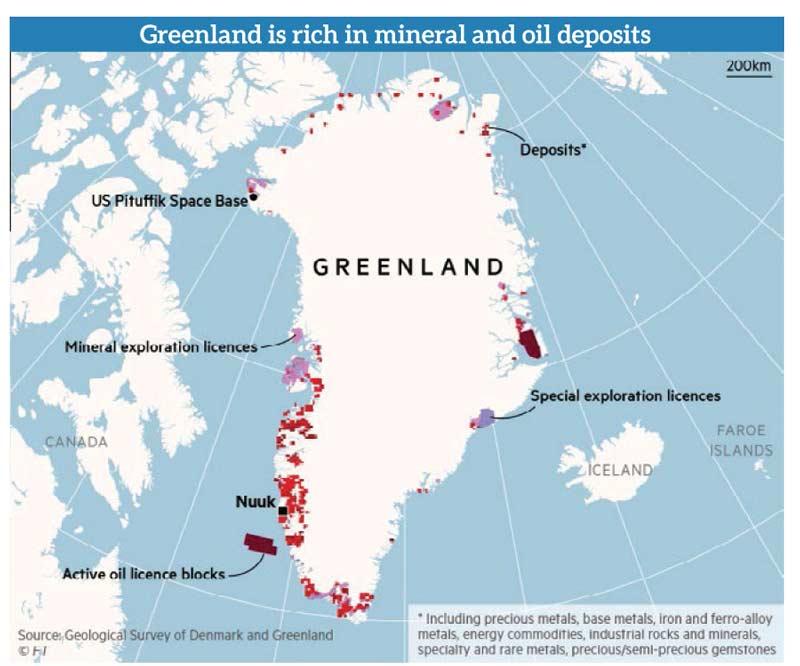
The world’s largest non-continental island may have only 57,000 inhabitants but, it has an outsised role in security matters. It sits at the start of both the north-west and north-east passages through the Arctic, which are likely to open up more to commercial shipping through melting, and is close to crucial routes for Russian and other submarines. Considered part of the North American landmass, Greenland is an autonomous territory of Denmark that has a capital that is closer to Washington DC than Copenhagen. “Greenland is intimately connected with our security for a lot of reasons and has been visibly since World War II,” John Bolton, the former national security adviser to Trump when he first floated the idea of buying Greenland, told The Free Press recently. Bolton added: “We know from repeated efforts by the Chinese to extend their influence, they want to become an Arctic power. So given Greenland’s geographic proximity to the US has it’s obviously a strategic interest.” In 1946, just after World War II, President Harry S. Truman proposed buying Greenland from Denmark for $100 million. He even considered swapping parts of Alaska for parts of Greenland, but this idea went nowhere. Fast forward to Trump’s first term, and he floated a similar idea—calling it a “large real estate deal.” When Danish Prime Minister Mette Frederiksen dismissed the notion as absurd, Trump retaliated by canceling a planned visit to Denmark in September 2019. US president-Donald Trump has refused to rule out military force to take Greenland. But America’s military presence there has long dwarfed the handful of ships, dog sled patrols and single surveillance plane operated by the Arctic island’s security guarantor, Denmark. Pituffik Space Base, located in the far north of Greenland since the end of the Second World War, is home to 200 US military personnel and 450 other forces and contractors from allies, part of Washington’s missile early warning system as well as offering space surveillance and satellite command.
The northernmost US base only about 1,500km from the North Pole is the most potent symbol of how vital Greenland is to American security. But its geostrategic importance is only likely to increase as climate change reshapes the Arctic, opening new trading routes close to North America and putting Greenland at the heart of the growing polar tussle between the US, China, and Russia. Mikkel Runge Olesen, senior researcher at the Danish Institute for International Studies, said: “For the US, the problem is Chinese and Russian interest in the Arctic. The US has started to see the Arctic as a region for geopolitical competition. It’s very important for the US to keep the other great powers out of Greenland.” When Trump first expressed interest in buying Greenland in 2019, he framed it as like “a large real estate deal” and emphasised the economic aspects of prising it away from Denmark. This time, his focus has changed. “We need Greenland for national security purposes,” he said, while mentioning the need to deter Russian and Chinese ships.
U.S-Greenland relations
Mikkel Runge Olesen has commented on U.S-Greenland relations multiple times over the past few years, from 2019 to 2025. In December 2024, Trump reignited the controversy, posting on social media that the U.S. considers “ownership and control of Greenland an absolute necessity” for national security and global freedom. Greenland’s Prime Minister, Múte B. Egede, promptly responded, “We are not for sale and will never be for sale.” Hours later, Denmark announced an increase in defense spending in Greenland by €1.3 billion. Danish Defence Minister Troels Lund Poulsen called the timing “an irony of fate,” but the response was clear. Beyond its military significance, Greenland boasts rich reserves of rare earth minerals, essential for modern technology like mobile phones, electric vehicles, and advanced weapons. Currently, China dominates global supply chains for these resources.
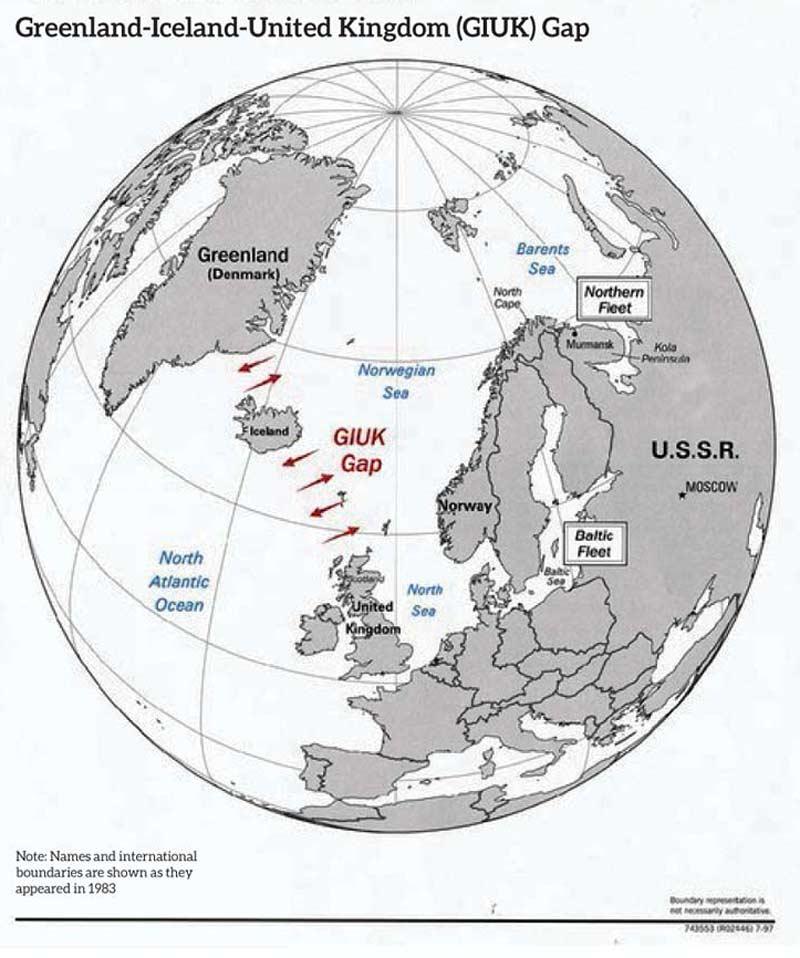
Although Greenland banned uranium mining in 2021, its untapped reserves remain a point of interest for global powers. Reporters note that the melting Arctic ice has opened new shipping routes, escalating competition among major powers to secure influence in the region. From an American perspective, limiting Russian and Chinese presence near Greenland is a clear strategic priority. However, the most effective way to achieve this isn’t by alienating allies but by strengthening partnerships that align with U.S. interests. But let’s be clear; Trump’s fixation on Greenland isn’t about strategic priorities it’s about spectacle. Leaders like Vladimir Putin exploit external threats to distract from internal failures, often through war. Trump’s approach is different but equally calculated—he creates media wars. During his presidency, he often insulted world leaders, turning international diplomacy into reality TV. Every outrageous statement kept his MAGA base cheering and ensured blanket media coverage. “Make America Great Again” (MAGA) is an American political slogan most recently popularized by Donald Trump during his successful presidential campaigns in 2016 and in 2024. This Greenland stunt wasn’t about actually buying the territory or preparing for war it was about controlling the conversation. Trump’s ability to dominate the narrative remains unparalleled. Control of the Greenland– Iceland–UK Gap The United States views control of the IUK Gap (Greenland–Iceland–UK Gap), as critical to the maritime defense of the Eastern United States, and unimpeded access to Greenland as necessary for control of the gap. Area in the northern Atlantic Ocean that forms a naval choke point. Its name is an acronym for Greenland, Iceland, and the United Kingdom, the gap being the two stretches of Open Ocean among these three landmasses. It separates the Norwegian Sea and the North Sea from the open Atlantic Ocean. A wartime priority of the United States was to “close the gap”, or prevent an adversary navy from exiting the Norwegian Sea and approaching the United States. In September 1957, the United States led “Exercise Strikeback”, the largest peacetime naval exercise in history, focused on stopping an aggressive “Orange Fleet” from transiting the gap, which was to be accomplished by means of a naval blockade involving hundreds of warships of the North Atlantic Treaty Organization (NATO) that took place over a ten-day period. During much of the Cold War, the importance of closing the gap was to prevent Soviet SSBNs from sailing to within firing range of Washington, D.C. and New York City. With the improvement of Soviet and, later, Russian missile ranges, the importance of gap control lessened, however, again became a priority in the early 21st century as the threat of hybrid warfare increased. Russia increased naval activity there, as part of greatly expanding its Arctic presence. It has increased cooperation with China, which wants a Polar Silk Road. NATO annually undertakes exercise Northern Viking and in 2024, involved the United States Sixth Fleet, the Standing Naval Forces, the Icelandic Police and Icelandic Coast Guard, focused on responding to a threat against the integrity of the gap.
Sri Lanka’s growing interest in renewable energy
Sri Lanka’s engagement with Greenland, being an autonomous territory within the Kingdom of Denmark, conducts most of its foreign relations through Denmark. Sri Lanka maintains diplomatic relations with Denmark but does not have a specific engagement with Greenland. There has not been any notable high-level visits, bilateral agreements, or diplomatic missions specifically between Sri Lanka and Greenland. Greenland’s resource rich environment and Sri Lanka’s growing interest in renewable energy and mineral investments could theoretically open future opportunities but currently, there’s no direct collaboration. While there are no active ties today, areas for potential cooperation could include, Climate research and environmental diplomacy, Renewable energy collaboration, especially given Greenland’s hydropower potential and Sri Lanka’s similar experience, Cultural exchange or academic partnerships via universities or Arctic research institutions. There’s no publicly recorded direct trade between Sri Lanka and Greenland. Any economic exchange would likely occur under broader Sri Lanka–Denmark trade arrangements. Optimistic Future Greenland has once again become a focal point of global attention amidst a heated geopolitical dispute involving the United States, Denmark, and Greenlandic leaders.
At the center of the controversy is Greenland’s newly elected Prime Minister, Jens-Frederik Nielsen, elected on 12th March 2015 who vehemently opposes recent claims by U.S. President Donald Trump. Trump has publicly asserted that the United States intends to assert control over Greenland, citing national security concerns as justification. This declaration has sparked intense debate, with both Denmark and Greenland firmly rejecting any U.S. annexation attempts. Tensions escalated further following a visit by U.S. Vice President JD Vance to a military base in Greenland in March 2025. Vance criticized Denmark’s defense approach, suggesting insufficient security measures. Danish Foreign Minister Lars Lokke Rasmussen responded sharply, expressing frustration with the U.S. administration’s aggressive stance, stating, “This is not how you address your close allies.” The exchange has strained traditionally cooperative U.S.-Denmark relations. Despite diplomatic efforts, Trump has not relented, even hinting at military intervention if Greenland and Denmark resist U.S. interests. This has raised concerns about Arctic stability, prompting European leaders to voice alarm over potential military conflicts. Meanwhile, Greenlandic officials remain steadfast in their commitment to self-determination, rejecting external control over their territory. Beyond politics, Greenland’s vast natural resources, including minerals, oil, and rare earth elements, fuel international interest. Competing for access to these resources are global powers like the United States and China. As climate change makes the Arctic more accessible, the geopolitical stakes surrounding Greenland’s resources are expected to rise. In this unfolding saga, Greenland finds itself at a crossroads of economic opportunity, national sovereignty, and strategic interests. Its leaders navigate pressure to balance aspirations for independence with the reality of superpower competition for its valuable assets. The world watches closely as Greenland defends its autonomy amid mounting external pressures.
(The writer is President Association of Retired Flag Rank Officers Senior Fellow South Asia Foresight Network Formerly Commander Sri Lanka Air Force, Ambassador to Afghanistan)
10 Jul 2026 4 minute ago
10 Jul 2026 11 minute ago
10 Jul 2026 34 minute ago
10 Jul 2026 45 minute ago
10 Jul 2026 1 hours ago