12 Mar 2025 - {{hitsCtrl.values.hits}}
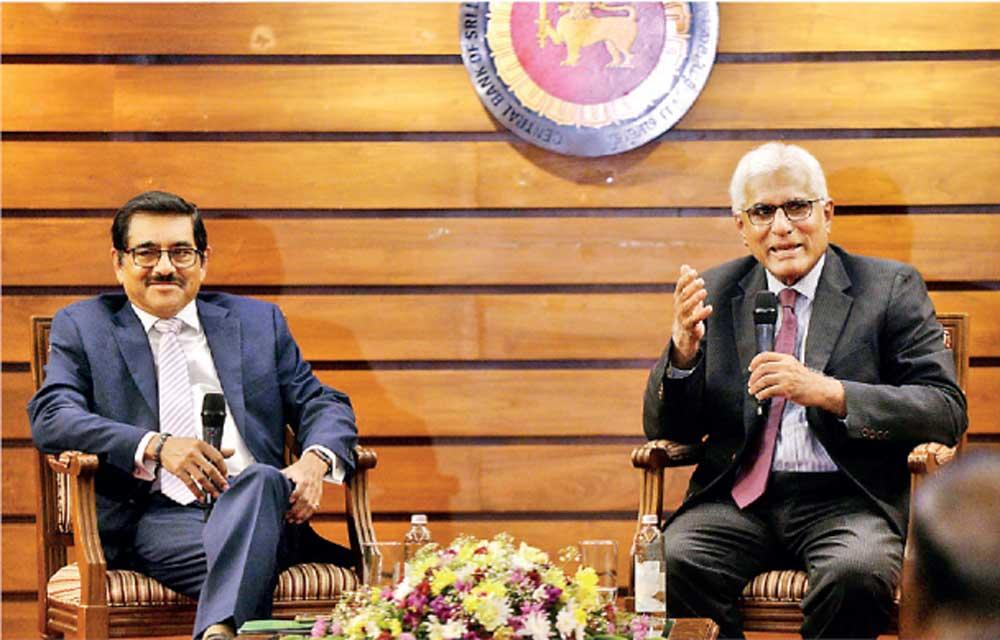
Former CBSL Governor Dr. Indrajit Coomaraswamy (right) drives home a point, while current Governor Dr. Nandalal Weerasinghe shares a knowing smile during the Q&A session of the public lecture facilitated by the Central Bank this week
- Pic by Pradeep Pathirana
By Nuzla Rizkiya
Sri Lanka’s ex-Central Bank Chief and senior economist this week urged policymakers to maintain a strong focus on structural reforms to sustain the current macroeconomic framework. This, he said, is essential to avoid another bout of instability that would necessitate seeking external financial assistance from the International Monetary Fund (IMF).
With decades of facilitating a persistent pattern of excessive fiscal deficits, Sri Lanka still risks falling into instability due to its strong tendency to adopt populist policies, fuelled by an entrenched entitlement culture, former CBSL Governor Dr. Indrajit Coomaraswamy said.
Addressing a public lecture hosted by the Central Bank this week, he highlighted how pre-election spending sprees and the domination of fiscal operations over monetary policy by successive governments had historically fuelled inflation and balance of payments crises in Sri Lanka.
These measures, he noted, had ultimately resulted in the country repeatedly seeking external financial interventions from the IMF—a total of 17 times.
However, Dr. Coomaraswamy pointed out that the bold reforms adopted post-crisis under the current IMF programme have established a new paradigm for macroeconomic management in Sri Lanka.
Anchored in three key legislative pillars—the Public Finance Act, the Central Bank Act, and the Debt Management Act—he explained that the new framework, now supported by the law, must be meticulously upheld to prevent future economic instability.
“Although we have successfully stabilised the economy under previous IMF programmes, we have often faced setbacks due to the failure to implement structural reforms. Every time an election comes, there is a big policy reversal, and everything slips. But now the task ahead is to secure the gains made through this new macroeconomic policy paradigm and accelerate growth,” Dr. Coomaraswamy said.
Looking ahead, he cautioned that Sri Lanka must prioritise building fiscal and external buffers to withstand potential economic shocks, including those arising from global uncertainties and climate change.
He referenced Singapore’s ability to finance pandemic-related fiscal support through its reserves as an example of the resilience Sri Lanka should aspire to achieve.
“There has to be pressure on political leadership to ensure the right decisions are made. Success in this round is only possible if everyone in the country takes an interest in macroeconomic policy,” Dr. Coomaraswamy stressed.
With income poverty doubling over the past two years and more than half the population facing multidimensional vulnerability, he pointed out that accelerating economic growth will be critical to avoiding another debt restructuring when the IMF programme concludes in 2028.
“So everyone must ensure that these landmark pieces of legislation are protected to maintain fiscal discipline,” he added.
Dr. Coomaraswamy also noted that Sri Lanka’s export performance has deteriorated significantly due to its protectionist outlook, including the use of para-tariffs, which have hindered the country’s ability to integrate into global production chains. He explained that the challenge in implementing structural reforms stems from the fact that political leaders are often not incentivised to pursue such reforms. Additionally, certain structural reforms may result in a few powerful losers, such as businesses and trade unions, who up to now have been successful in resisting the necessary changes.
“This may call for the establishment of another tariff reform commission, as the current tariff structure is distorted with various interests. Hopefully, this government can approach this issue without much baggage,” Dr. Coomaraswamy said.
With the establishment of an independent tariff commission to streamline and rationalise tariffs, he opined that ad hoc policy changes that distort trade and investment decisions could be prevented.
To facilitate trade and tax compliance, he suggested the full implementation of the Revenue Administration Management Information System (RAMIS) and the rollout of the National Single Window as effective efforts that would promote improved efficiency.
“The primary expenditure of 13 percent of GDP is tough to say, but I think there is considerable scope to increase revenue. If you can collect 17 percent in revenue, you can set the primary target at 15 percent. With laser focus on structural reforms, I believe we would need that,” Dr. Coomaraswamy said.
16 Jul 2026 42 minute ago
16 Jul 2026 1 hours ago
16 Jul 2026 2 hours ago
16 Jul 2026 3 hours ago