 MOHAMED AYUB
 Reply To:
Name - Reply Comment
Using suppression as their slogan may not help the opposition
 President Sirisena was out to send Rajapaksas behind bars using the widespread allegations of corruption against them, as he was in fear of his life in case of a comeback by them. However, the UNP, his partner in governance was not only indifferent to corruption but some of the UNP ministers even publicly vowed not to allow Gotabaya Rajapaksa to be arrested under any circumstance
For the second time in two months the Opposition parties have announced they are forming an alliance against the government, this time with a title for it.
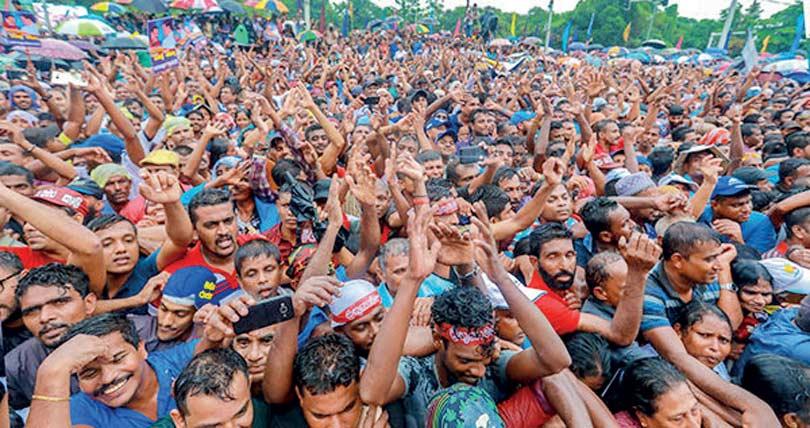
The Alliance, “Maha Jana Handa” or Voice of the People is to hold its first rally on November 21 in Nugegoda, a venue where many anti-government campaigns kicked off in the past.
The highly successful “Mahinda Sulanga” campaign by National Freedom Front (NFF) leader Wimal Weerawansa and Pivithuru Hela Urumaya (PHU) leader Udaya Gammanpila was also launched at the same vanue, within a month after the Presidential election in 2015 at which Mahinda Rajapaksa was defeated.
Within three years, in February, 2018, they recorded a huge victory at the local government election capturing over 230 out of 340 local councils for which elections were held.
However, it is not the venue but the context that is auspicious for a political campaign to succeed. The political setting that led to the “Mahinda Sulanga” to swept the electorate was a far cry from the context in which the current Opposition campaign was launched.
The current Opposition is not only numerically very weak in Parliament; it has also failed during the past one year since the National People’s Power (NPP) government assumed office to build a considerable public opinion against the ruling party. This warrants a powerful voice outside the Parliament to act as an unofficial Opposition that would press the government not to go against the wishes of the people.
On the contrary, Mahinda Sulanga was launched with the backing of an Opposition in Parliament which has the majority in the House. Even after the Parliamentary election in 2015, the United People’s Freedom Alliance (UPFA) led by Mahinda Rajapaksa had a strong say in Parliament with 95 seats in hand while the ruling United National Front for Good Governance (UNFGG) having only 106 seats, seven seats less than a simple majority that is needed to adopt any Bill or a motion. It was the Tamil National Alliance (TNA) which had bagged 16 seats that gave the lifeline to the government.
The UNFGG government or the Yahapalana Government, apparently owing to its indebtedness to the TNA, cosponsored the resolution on Sri Lanka at the United Nations Human Rights Council (UNHRC) in that year and twice later during their tenure. This resolution provided for the establishment of a hybrid mechanism with foreign judges for a process of accountability for the human rights violations in Sri Lanka.
The government also lifted the proscription imposed on eight Tamil diaspora organisations by the previous Rajapaksa government while planning to hold a diaspora meet as well. Although these measures were commendable from a reconciliation point of view, they helped the Mahinda Sulanga campaigners to further reach out to the Sinhalese people by rousing communalism among them.
In spite of one of the main pledges given by the so-called Yahapalana leaders at the 2015 Presidential election being eradication of corruption, within the first month after assuming office, they paved the way for the Central Bank bond scandal, one of the major scams in Sri Lankan history. This was a godsend for the Mahinda loyalists who capitalised it to the core.
President Sirisena was out to send Rajapaksas behind bars using the widespread allegations of corruption against them, as he was in fear of his life in case of a comeback by them. However, the UNP, his partner in governance was not only indifferent to corruption but some of the UNP ministers even publicly vowed not to allow Gotabaya Rajapaksa to be arrested under any circumstance.
This conflict created a division within the government giving further mileage to the Mahinda Sulanga, and Basil Rajapaksa taking advantage of all these formed the Sri Lanka Podujana Peramuna (SLPP) as Mahinda Rajapaksa had handed over the leadership of both the Sri Lanka Freedom Party (SLFP) and the UPFA to President Sirisena following the latter’s elevation to Presidency.
Current Opposition is not fortunate enough to build their campaign “Voice of the People” under such an advantageous context. Despite the NPP faced with a serious setback at the local government elections held in May this year, it is still the most powerful force within and outside the Parliament.
Subsequent to the passage of the Presidents’ Entitlement (Repeal) Bill which deprived the former Presidents of all their perks except for the pension in September, the Opposition parties attempted to create a sympathy wave in favour of them, on which they planned to form a broad alliance of Opposition parties. Yet, even the former Presidents lost interest in it within weeks.
Then attempts are still being made to form an alliance between the UNP and the SJB, but the latter, the only Opposition party that has a considerable vote base, seems to be not so enthusiastic about the move. Also, the SJB was so indifferent towards the “Maha Jana Handa” that it did not send a representative to the launch of the campaign.
In fact, these moves for the unity among Opposition parties were not based on principles, but made out of fear of being put behind bars under the government’s campaign against corruption and drugs, apart from their greed to grab power which would open the floodgates of wealth through legal as well as illegal means. Their main slogan - rise against oppression - also seems to be counter productive given their track record in respect of oppression.
There was a time during the J.R. Jayewardene and Ranasinghe Premadasa regimes when there were certain areas in the country like Biyagama, Mahiyanganaya and Kekirawa that were out of bounds for the Opposition parties. Opposition parties were proscribed on unfounded grounds and journalists such as H.E.Dayananda and Wimal Surendra were murdered.
An unofficial ban on opposition political activities was in force in areas such as Anamaduwa and Kelaniya during Chandrika Kumaratunga administration as well. Thugs attacked protests conducted by the Opposition. Journalists Rohana Kumara, D. Sivaram and Mailvaganam Nimalarajan were killed under mysterious circumstances.
Under the Mahinda Rajapaksa government also protesters were shot dead in Katunayake, Chilaw and Rathupaswala, and journalists were killed, abducted and assaulted while media institutions were torched. The oppression under Ranil Wickremesinghe could be summed up by the fact that even two women with placards were not allowed to walk on the road.
Hence, the current Opposition parties have chosen a wrong slogan for their campaign against the NPP government, and it seems to be too early for them to form any alliance when no election is within sight, as none of them are cadre-based.