Reply To:
Name - Reply Comment
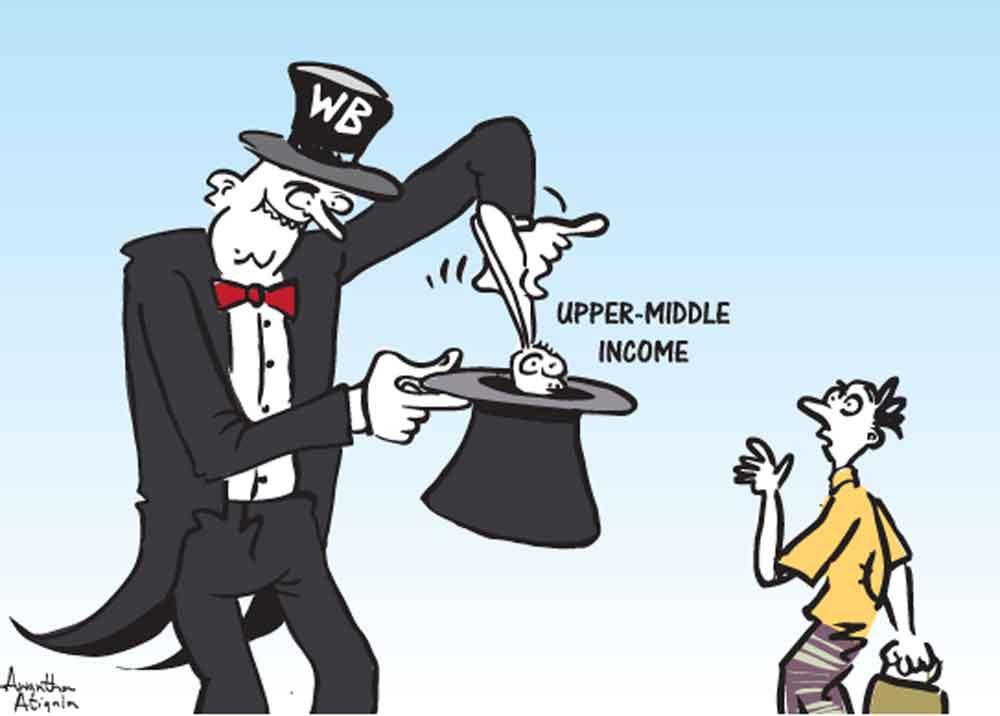
The World Bank last week upgraded five countries - Vietnam, Sri Lanka, Philippines, Jordan and Micronesia - from lower-middle to upper-middle income category. This is the second time Sri Lanka achieved this important milepost in the recent past.
Although Sri Lanka came under the same World Bank income classification in 2019 for the first time, within a year it again sank into the previous lower-middle income group of countries, due to the shortsighted economic measure including the massive tax cut announced by the Gotabaya Rajapaksa Government in December 2019.
Given the political culture of the country, the latest upgrade of the country by the World Bank might have discouraged the Opposition parties, which have been predicting for the past one year that the economy was about collapse again to level of 2022.
Unlike the classification of Vietnam, which has been attributed to its sustained export-led growth where exports expanded by more than 15% in both 2024 and 2025, Sri Lanka’s achievement marks a remarkable recovery from the severe economic crisis in 2022.
However, pointing to a welcome situation, the ruling National People’s Power (NPP) did not celebrate the latest achievement as the then ruling party did last time. In fact, Sri Lanka cannot celebrate the current achievement as the country is floating just above the upper middle-income countries’ threshold of US$4,636. Sri Lanka’s Gross National Income (GNI) per capita rose to US$4,670 in 2025 just 34 dollars above the threshold of an income group ranging between US$4,636 and US$ 14,375. That means the country has only just managed to qualify. The new classification is valid from July 1 2026 to the end of June 2027.
For an ordinary man in the country, the World Bank upgrading Sri Lanka to the upper Middle-income category means nothing. Duminda Nagamuwa of the Frontline Socialist Party pointed out that the new classification means a monthly family income of around Rs. 500,000 which is far from the reality. This is true in a country where 1 in 4 of the people are in poverty, two out of every 5 Sri Lankans cannot afford a healthy diet and 1 out of 3 of the children under 5 years is malnourished. Therefore, the new classification of Sri Lanka by The World Bank does not mean every Sri Lankan has become better off.
This is the result of the income and wealth inequality in the country. UNDP’s Sri Lankan economist, Dr. Vagisha Gunasekara said in a 2023 report: “Sri Lanka is a country with fairly high-income inequality; we are in the top one third of the highest unequal countries in the world, and wealth inequality is also very high.”
According to the report: “The indebtedness in the country is disastrously deepening; 31 percent of Sri Lankan households depend on loans; 24 percent are dependent on money lenders and 23 percent on bank loans. As of June (2023), the country’s staggering household debt reached more than 7 percent of the GDP.”
Former Central Bank Deputy Governor, Dr. W.A. Wijewardena says that the current elevation of the country is just a number on paper. For practical purposes, Sri Lanka remains a low-income country for receiving concessional loans. However, he views it as a positive development. He states: “A significant plus point for Sri Lanka is that it is still classified under the World Bank’s low-income country financing window, the International Development Association (IDA), for receiving World Bank and ADB loans. This was done at the request of the Government in 2023, and these loans are highly concessional, with low interest rates, longer grace periods, and longer maturities.”
In an article Dr. Wijewardena further says that the upper middle-income label is a guidepost. It is not the destination. He insists that the government must “make sure growth reaches the poor. The Government must invest in education. Every child, rich or poor, must have a chance. It must invest in healthcare. It must build roads, electricity, and internet infrastructure in rural areas. Businesses must be able to grow outside Colombo. Social safety nets must be strengthened. Families hit by shocks must not fall into poverty.”
‘Your Thought’ is a space, a right of the readers to support or contradict and discuss the issues highlighted in the editorial and other articles in the editorial and op-ed pages. Designed as the reader’s editorial; our readers can send in their writings, with a word count not exceeding 200, to ‘Your Thought’, Daily Mirror Political Features Desk, No 8, Hunupitiya Cross Road, Colombo 2 or email to [email protected]