Reply To:
Name - Reply Comment
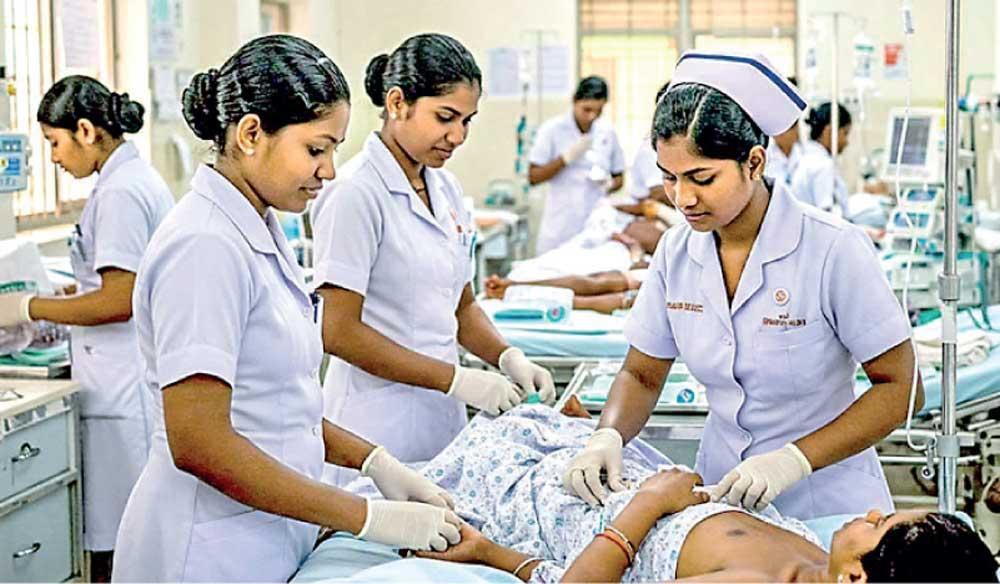
Nursing isn’t a nine-to-five job, though it appears to be a six-hour day on paper; nurses often work longer hours due to overtime and six days a week. FILE PHOTO
 The health sector comes under a lot of fire. In the recent past, several patients have died due to alleged mistakes made by nurses, who are often accused of being short-tempered and rude in government hospitals. But there is another side to this story.
Medical workers, from doctors to nurses, physiotherapists and attendants, are the most overworked sections of Sri Lanka’s workforce. They have always worked under pressure, but the five years since the COVID-19 pandemic have been especially severe on both the system and workers in a sector which has been underfunded by successive governments during the past decades, leading to shortages of both equipment and staff.
Just as the pandemic’s pressure began to ease, Sri Lanka’s economy crashed in 2022. Hospitals became overcrowded with those no longer able to afford private medical care, while doctors began leaving the country. It’s hard to pinpoint exact numbers, but one report says over 1,800 doctors left between 2022 and 2023. Others claim that as much as ten per cent of all Lankan doctors have migrated after the pandemic and subsequent economic crisis.
Even before the crisis, the total number of doctors for the country (put at over 20,000) was insufficient. The doctor-to-patient ratio is given as one doctor per 1000 people, though this differs widely on a provincial basis (170 per 100,000 people in Western Province versus less than 70 in Uva Province). When doctors are under pressure, that pressure comes down to the nurses. In 2021, Sri Lanka had approximately 40,000 registered nurses (including the private medical sector). It is not known exactly how many nurses there are in the state health sector, but one can guess that the majority work in government hospitals, which number 555. Nurses and midwives per 1,000 people in Sri Lanka were reported at 2.439 in 2021, according to the World Bank collection of development indicators.
Statistics apart, what we see and hear for ourselves in state hospitals tells its own story: crowded wards, long queues for checkups, snappy medical staff. In hospital hierarchies, doctors hold the most power (as evidenced by the GMOA). Nurses and attendants lag far behind. There was a time, at least two decades ago, when the nurses’ union had some clout, but things have changed.
There is nothing like talking to a nurse to get an insider’s view of the nurses’ story.
Generally speaking, the medical profession is closeted, and it’s hard to find people willing to talk frankly about their troubles. But one willing source, a nurse from a leading state hospital in the Kandy region, was found, and what she said amounts to a grim picture of a grinding profession with relentless pressure on its practitioners.
Imashi (not her real name) is a Grade II nurse who began her training in 2012 and was appointed as a Grade III nurse in 2015 (there are three nurse grades). Now she is a mother of two, and it comes in handy that her husband is self-employed and hence able to care for the children in her absence.
Nursing is not a nine-to-five job. It sounds easy on paper: it’s a six-hour working day, not eight as in most jobs. But in actual practice, nurses always work longer hours because of overtime, and they work six days a week.
This is another Catch-22 bureaucratic situation. Overtime is not compulsory; nurses have to request OT. But it’s an unwritten rule that they must request it. There is no question of avoiding that and staying home. To make things worse, the Sunday day off is not always given, and Imashi says nurses are known to work fifteen days straight.
Considering that they are on their feet much of the time, that has to be quite exhausting. Doctors are free to leave their wards and spend time in allocated rooms, and they can even go out of the hospital. Nurses, being in uniform, do not have that luxury. If they report late to work, a red line is drawn across the attendance sheet. Imashi says the ‘red line’ rule is not applied to doctors. There are other anomalies, and we’ll look into those later.
The nights are long and strenuous. The evening/night shifts last eighteen hours. In some cases, the shifts are even longer. For example, Imashi is used to finishing her day shift (from one to seven pm) and working again till seven the next morning. It can even continue till one p.m. the next day, which is twenty-five hours: more than a day. There is a two-hour break, but that’s hardly enough time to sleep. Sometimes, they have five normal days of work in between these killer long shifts, but they can occur every two or three days.
Nurses go in pairs or in small groups of four for meals. There is no specific lunch hour or dinner time. They aren’t provided even a cup of tea by this hospital, a basic that is given to employees in most institutions, government and private. Nimesha brings her own tea in a flask from home.
Lack of sleep is now identified as a major health risk factor, and can lead to serious conditions such as dementia in later life. Working in less-than-ideal conditions, nurses are expected to give their best. One general complaint is that they can be snappy. Given their working conditions and daily stresses, this is quite understandable.
Obtaining leave too, is difficult. This refers to conditions before the recent Health Ministry circular suspending all staff leave. While nurses are entitled to 21 days vacation leave, 21 days casual leave, and 14 days medical leave, etc, like other state employees, only a maximum of four days leave per month can be obtained, and sometimes they have to work even on day-offs.
While conditions may be easier in some rural hospitals, wards are usually crowded in urban hospitals, whether they are medical wards or casualty wards. Imashi sometimes spends three to five days in a casualty ward, and those are very busy days. There are four to five nurses per fifty-bed ward. While occupancy can be a low thirty on some days, it can reach one hundred on some days. This hospital frowns upon floor mats and uses extra folding beds instead. On average, there are fifty to seventy patients per ward.
Present nursing salary scales do not compensate for all the hard work. Imashi’s basic salary when she started was Rs. 38,000. With overtime, she had a take-home pay of about Rs. 90,000. Today, the basic has been raised to Rs. 55,000, but cuts too have increased. In real terms, it’s around Rs. 45,000. There is no point in arguing that the basic pay of almost all state employees is poor. The hard truth is that what this nurse earns is not enough for a secure future or retirement plan, given the health risks inherent in her line of work. Another glaring anomaly, while doctors are entitled to duty-free vehicles, nurses and other staff are not, a very good example of how Sri Lanka creates privileged classes while rendering others underprivileged. In real terms, a nurse cannot even afford a scooter with her salary. Only single nurses are given quarters, but only a few hospitals provide quarters for married nurses.
It’s no wonder that some nurses have gone ‘AWOL’—to use a popular military term for going absent from duty. Whether married or single, nurses also need above-average family support, since long absences from home and fatigue can take their toll. In the case of married nurses, husbands try to be self-employed or find work-from-home situations (just like in Imashi’s case). This can put a heavy strain on marriages, too.
Nurses have the option of finding better-paying jobs abroad, but competency in English is needed for this. Many of our nurses have poor English or none at all. In any case, the new ministry circular, which cancels foreign leave, puts a stop to all such possibilities.