Reply To:
Name - Reply Comment
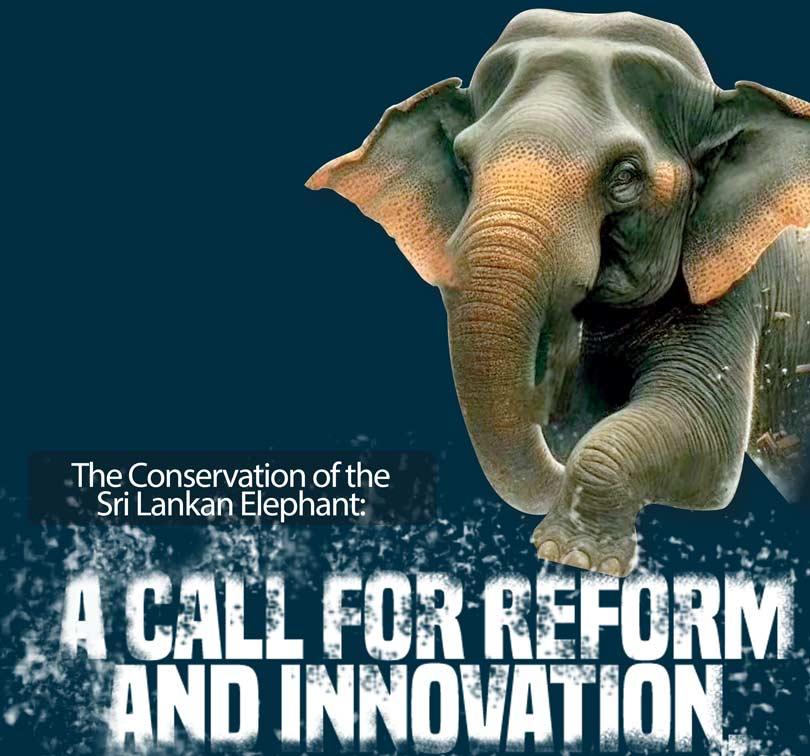
 Sri Lanka’s elephants are more than majestic creatures; they are living symbols of our heritage, biodiversity, and the deep spiritual and cultural ties we share with the natural world. Yet today, elephants face one of their gravest threats, not from nature, but from us.
The recent surge in elephant killings in Sri Lanka has reignited concern over the country’s deepening human-elephant conflict (HEC). While mitigating HEC is crucial, the national focus on this issue has overshadowed the more pressing need for a robust, comprehensive, long-term, forward-thinking conservation strategy that protects both elephants and the people who live alongside them.
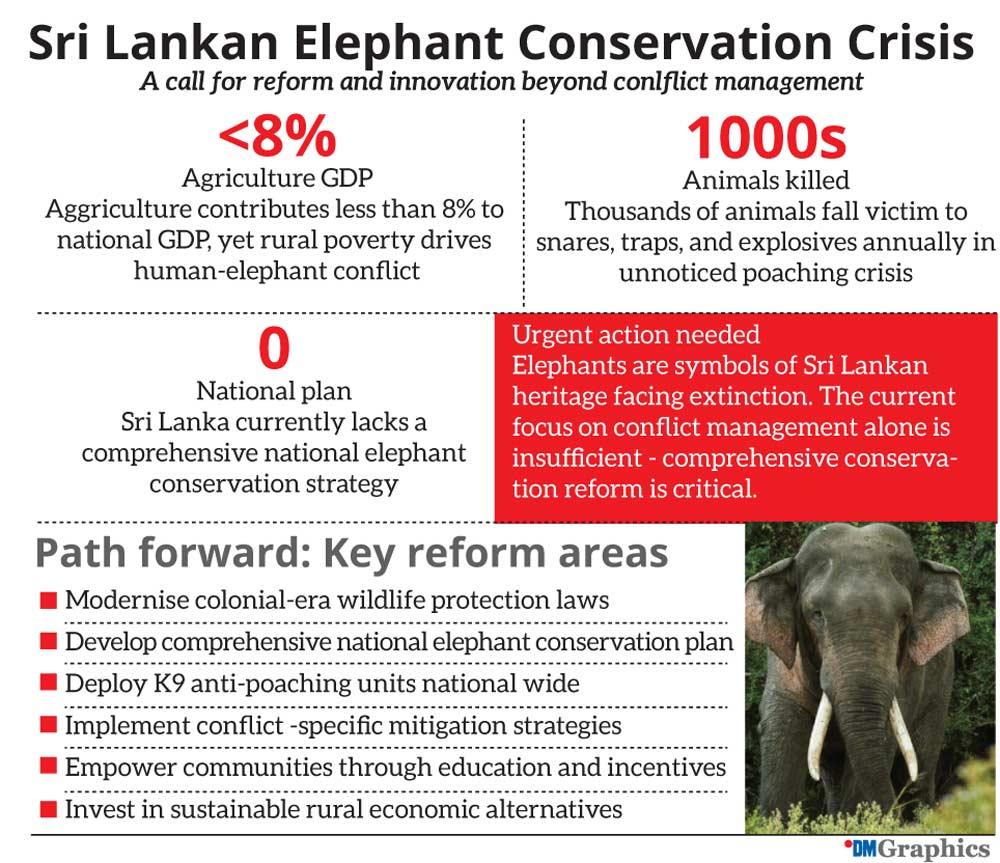
Sri Lanka currently lacks an effective conservation plan for its elephants. The Department of Wildlife Conservation has shown limited capacity to manage HEC or to implement proactive conservation measures. The absence of a national action plan and meaningful government support further undermines these efforts. Current laws, particularly the outdated Fauna and Flora Protection Ordinance (FFPO)—a colonial-era relic—exclude public and civil society involvement, stifling broader conservation initiatives and undermining collective responsibility for wildlife protection.
The root causes of HEC in most high-conflict regions are intertwined with rural poverty and unsustainable agricultural practices. The government often views elephants as obstacles to rural development, but with agriculture contributing less than 8% to the national GDP, the real challenge lies in economic diversification. Subsistence farmers must be supported to transition toward sustainable livelihoods, including non-agricultural industries such as manufacturing, eco-tourism, and relocation. Innovative agricultural practices like hydroponics, regenerative farming, sustainable livestock farming, and agroforestry can also provide sustainable alternatives.
True elephant conservation demands a paradigm shift, from reactive conflict management to proactive, inclusive, and innovative long-term planning. Only through updated legislation, empowered communities, and sustainable development can Sri Lanka hope to secure a future for its elephants and its rural populations alike.
The recent spike in elephant killings has once again thrown the HEC into the national spotlight. While this attention is needed, it risks missing the forest for the trees. The bigger crisis is not just the conflict, but the absence of a long-term, forward-thinking elephant conservation strategy.
We Can’t Save Elephants by Focusing Only on Conflict
The dialogue around HEC has dominated headlines for years. Yes, managing this conflict is vital—but it’s only one part of a much larger picture.
The intense focus on HEC has drawn attention to several pressing issues: the ineffective mitigation measures in place, the limited government support, and the clear inability of the Department of Wildlife Conservation to manage and resolve these conflicts. However, this narrow lens has overshadowed the broader and more urgent task of ensuring the long-term survival of the Sri Lankan elephant.
Mitigating HEC is important, but it is not synonymous with elephant conservation. Without a cohesive national action plan and a dedicated elephant conservation strategy, these reactive measures remain short-term and insufficient. A strategic shift is needed—from conflict management to the conservation of elephant populations and their habitats.
The reactive, piecemeal approach has created a dangerous cycle. Elephants are increasingly seen as dangerous and a nuisance, rather than as endangered wildlife needing protection. If we don’t pivot toward a holistic conservation model—one that includes habitat protection, community involvement, and ecological planning—we risk losing not just elephants, but entire ecosystems that depend on them.
Elephant conservation in Sri Lanka cannot succeed in isolation from broader environmental, economic, and social reforms. By aligning conservation with community empowerment and ecological sustainability, Sri Lanka can ensure that its elephants continue to thrive for generations to come.
Mitigation Must Shift from Blanket Solutions to Conflict-Specific Solutions
One of the primary reasons that most HEC mitigation efforts have failed is due to an overreliance on “one-size-fits-all” approaches that disregard the complex, site-specific dynamics driving these conflicts. Conventional mitigation efforts have focused mainly on one solution: the electric fence, rather than tailoring strategies to address the factors that lead to conflict in individual communities and elephant populations. This approach, while easy to replicate, often ignores critical factors such as fence location, maintenance, and, most importantly, the underlying causes of conflict in each area.
Effective HEC mitigation requires a paradigm shift toward conflict-specific interventions that consider the environmental, cultural, and spatial variables influencing elephant behavior and human responses. For instance, the Sri Lanka Wildlife Conservation Society has pioneered innovative, community-based strategies that illustrate the effectiveness of localised solutions. Projects such as community-managed village elephant fencing, Project Orange Elephant (which encourages farmers to cultivate unpalatable crops), and the EleFriendly Bus Service (which provides safe transportation for children through an elephant corridor) all reflect the value of designing solutions rooted in the life experiences of affected communities.
Electric fences, while useful in some contexts, have too often been deployed indiscriminately, without understanding whether they are addressing the root causes of conflict or merely acting as temporary deterrents. In areas where the interface between human settlements and elephant habitat is narrow, well-defined, or obscure, a more appropriate solution would be a permanent elephant fence. A permanent elephant fence, if carefully designed not to obstruct essential elephant movement, could significantly reduce conflict by preventing elephants from entering villages while allowing them to range unimpeded.
For regions with intense conflict, well-planned, permanent fencing would be more effective than electric fences in durability, effectiveness, and in building community trust. Permanent elephant fences designed based on ecological needs of elephants would be a more sustainable investment than the continuous repair and replacement of poorly placed electric fences.
The failure of many HEC mitigation efforts lies in the mistaken belief that one solution can fit all situations. Effective solutions must be grounded in conflict-specific strategies that align with local needs, elephant ecology, and long-term coexistence goals. Only then it would be possible to reduce conflict, protect livelihoods, and ensure the survival of elephants in increasingly human-dominated landscapes.
Outdated Laws Are Holding Us Back
A major roadblock to conservation is the outdated legal framework that governs wildlife protection. The FFPO, a colonial-era law originally enacted to serve British colonial interests, continues to guide conservation policy today. The FFPO—a colonial-era artifact no longer serves the needs of a modern, ecologically vulnerable country. It centralises authority and excludes meaningful involvement from communities, researchers, and civil society in conservation efforts. While it may have had historical relevance, the FFPO is now archaic and grossly inadequate for addressing modern conservation challenges.
By centralising responsibility within government institutions, it has effectively removed the sense of ownership and stewardship from local communities. This alienation has led to a culture where rural populations feel little responsibility toward wildlife, placing the burden entirely on an overstretched Department of Wildlife Conservation. When people feel excluded from conservation, they become indifferent—or even hostile—to it. This disconnect is a key reason why local communities often view wildlife as a burden, rather than a shared responsibility.
The Silent Crisis: Poaching and Wildlife Crime
While elephants and leopards make the news, an invisible crisis continues in silence. Every day, thousands of animals—mammals, birds, reptiles—fall victim to snares, traps, firearms, illicitly rigged powerlines, and homemade explosives. This brutal slaughter rarely receives attention, and almost never results in meaningful enforcement.
Poaching in Sri Lanka has reached epidemic proportions. Armed with traps, snares, guns, illegally rigged powerlines, and even explosives, poachers kill thousands of animals every year, often causing prolonged and agonising deaths. Despite the scale and brutality of this crisis, little effort is made to combat it. Public outcry surfaces only when high-profile animals—like elephants or leopards—are killed, while the daily decimation of countless other species continues unnoticed and unaddressed.
This selective concern reflects a broader failure in Sri Lanka’s wildlife protection efforts. The silence around the routine slaughter of birds, reptiles, and various other mammal species signals a dangerous indifference that undermines the ecological integrity of the entire country.
One of the most successful and proven methods to fight poaching globally is the deployment of K9 anti-poaching units. Dogs are the most effective and safest to use, and they can be trained to detect the scent and track trap guns, snares, jaw bombs, illicitly rigged power lines, and even poachers from a kill site to their hideouts. Their presence alone serves as a powerful deterrent, significantly increasing the risks for poachers and reducing wildlife crimes in areas where they are deployed.
In light of this, it is deeply ironic and troubling that when the Sri Lanka Wildlife Conservation Society proposed the establishment of a K9 anti-poaching unit to address the ongoing rampant poaching in the Wasgamuwa region, the initiative was met with outright resistance. Both the Department of Wildlife Conservation and the Forest Department refused to support the project, despite the clear and urgent need for such an intervention.
This lack of institutional support reflects a broader failure to prioritise and implement effective wildlife protection strategies. Ignoring a well-documented, cost-effective, and results-driven approach like K9 deployment not only undermines conservation efforts but also enables the continued destruction of the country’s natural heritage.
The Path Forward: Shared Responsibility, Long-Term Vision
If we want a future where elephants and people thrive together, we must shift from reactive crisis management to proactive conservation rooted in inclusion, science, and sustainability. Here’s what that could look like:
This Is a National Crisis, But Also a National Opportunity
The question is no longer if we should act, but how soon we could act with courage, creativity, and inclusion. To ensure a stable future for our wildlife is possible. But it will take leadership, reform, innovation, and, most importantly, the willingness of politicians and state officials to listen and create a clear pathway for cooperation with people and organisations who can effectively contribute to these efforts.