Reply To:
Name - Reply Comment
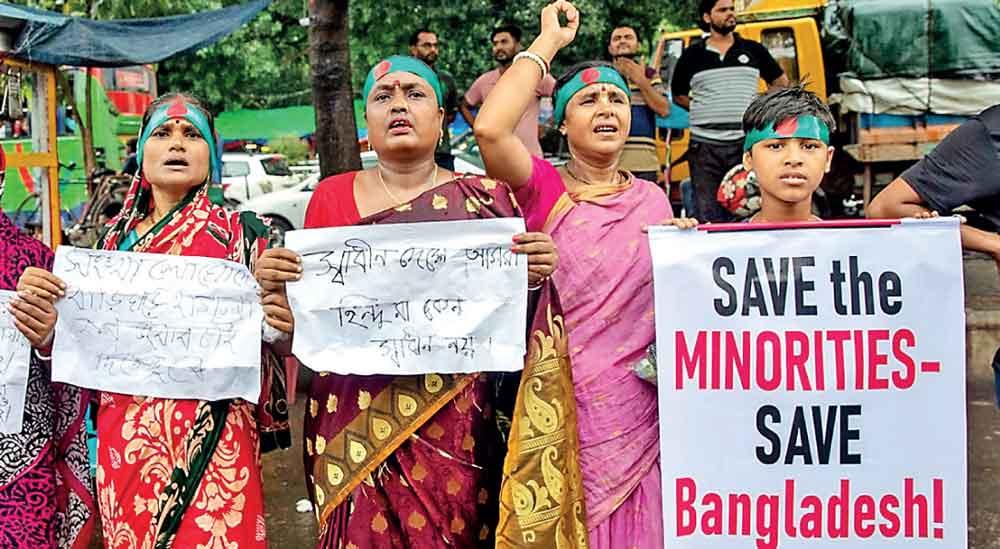
Islamists in Bangladesh have reassembled, organising large rallies that have drawn thousands of crowds. Attacks on the Hindu minority, which account for 8 per cent of the population, and minority Christians have steadily increased
 South Asia’s youth revolutions began with the Aragalaya in 2022, followed by deadly protests in Bangladesh that ousted Sheik Hasina last year and in Nepal, where the pro-China government of K.P. Sharma Oli fell this year.
Sometimes, comparisons could be misleading; over 1400 died in Bangladesh when police turned guns on the protesters, and hundreds perished in Nepal. In Sri Lanka, not a single bullet was fired throughout over six months of the protest campaign. One should give credit to Gotabaya Rajapaksa, as well as to the military and police, for the restraint. That might also be proof that, despite two nihilistic terrorist campaigns in the recent past —by the LTTE in the North and the JVP in the South— Sri Lanka has historically offered ample political space for change, through the regular ballet, or even through chaotic street protests, as long as agitators do not resort to ‘Galkatas’ justice and suicide terrorism. Though the JVP had learned that powerful lesson, belatedly and is now in power through elections, I doubt whether the Northern elites did, and might give it a try whenever the state is weak.
However, a far more sinister divergence is emerging. Bangladesh is on a race to the bottom and is in the throes of growing Islamist fundamentalism. It has become increasingly clear that it was the extremist Islamist factions, previously banned by the deposed Sheik Hassina administration, that have most benefited from the regime change. In exchange for freedom from Hassina’s authoritarian, but economically uplifting regime, Bangladesh has bred a monster which threatens to consume the state- and beyond.
Last week, a Hindu devotee was lynched in Dhaka—his body was tied to a tree and set on fire by the angry mobs after his colleagues accused him of blasphemy. In the same week, protesters set ablaze the office of the Daily Star and Bengali language Prothom Alo, two independent newspapers that had always been in the crosshairs of the previous regime. In both cases, arrests had been made, though police had been accused of inaction leading up to both attacks.
The arson attack on the newspaper house followed the killing of a firebrand student leader Sharif Osman bin Hadi, who was also a virulent anti-India activist. His supporters had accused India of the murder, alleging
that the assailants had taken refuge in India.
Anti-India sentiments are on the rise, partly owing to Hasina’s flight to India and her government’s pro-Indian policy. However, an increasingly religious, Islamist ideological bent guiding anti-India sentiments is also evident and is a cause for worry.
The post-Hasina political vacuum has been worsened by the timid and ineffective transitional government of Nobel Prize-winning economist Mohammed Yunus, which relies on the good graces of the protest leaders. The vacuum has been exploited to devastating consequences by the Islamist groups, such as the banned Hefazat-e-Islam Bangladesh (HIB) and Anser al Islam, which campaign for Sharia law and capital punishment for blasphemy. Islamists have reassembled, organising large rallies that have drawn thousands of crowds. Attacks on the Hindu minority, which account for 8 per cent of the population, and minority Christians have steadily increased. Though most past attacks were associated with the political loyalists of the deposed Awami League, the new bout of attacks had taken an increasingly sectarian line. The tightening grip of Islamism on the country of 170 million is partly owing to the controversial bail release of known Islamist leaders and around 300 rank-and-file activists, previously held under terrorism charges. In the meantime, intelligence agencies have noted that transnational terrorist groups Al-Qaeda in the Indian Subcontinent (AQIS), the Islamic State of Khorasan (ISK), and the Pakistan Taliban (TPP) are making inroads into Bangladesh.
Officially too Bangladesh is straying away from its constitutional secularism towards a more pronounced Islamist identity.
The key officials drafting the constitutional amendments have announced plans to drop ‘secularism’ as a defining characteristic of the nation. Earlier, Islamists took to the streets when the government proposed legal changes granting equal property rights for women.
In the public space too, Bangladesh had all gone all out Burka— perhaps the most potent sign of the grassroots Islamisation of any society, which Sri Lankans familiar with the run-up to the Easter Sunday attack would know.
Unveiled women have been assaulted, and moral policing by the Islamists, have become increasingly common. While the hardline Islamists remain a minority and would not draw enough votes, their electoral alliance with the main opposition Bangladesh Nationalist Party (BNP) and Jamaat-e-Islami magnifies their influence. Bangladesh is expected to schedule general elections in February next year.
Meanwhile, Sheik Hasina has been sentenced to death in absentia for her role in the killings of protestors, and the Awami League has been banned. Experience in Bangladesh may not always apply to Sri Lanka. Still, it fits into general practice in the Muslim world, where political vacuum and political change are often followed by heightened Islamist takeover, ranging from post-American Iraq to the Arab Spring.
Another lesson might be that nations are often built by flawed leaders, much less by self-righteous demigods. For all her imperfections, Hasina oversaw an economic miracle in Bangladesh, which had not long ago been viewed as a basket case.
Now, she is gone, and it is at risk of falling back to become not just that, but also a dangerously Islamist one.
Follow @RangaJayasuriya on X