Reply To:
Name - Reply Comment
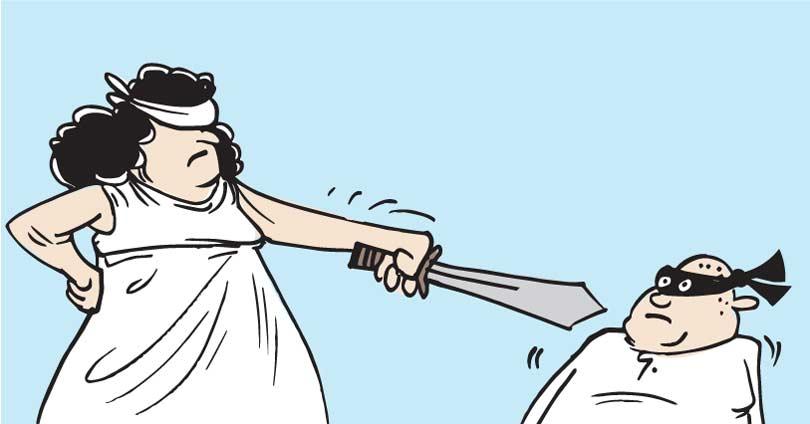
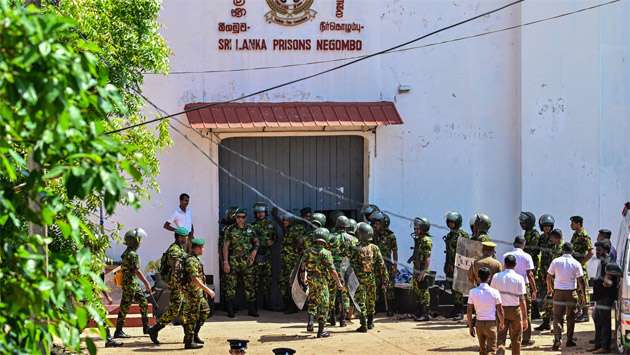
On the 22nd of this month in a surprise move, officers of the Criminal Investigations Department (CID) arrested former President Ranil Wickremesinghe, produced him before a Magistrate and later had the former ‘strongman’ leader remanded at the infamous Welikade jail.
The Welikade jail, is best known for the organised massacre of Tamil political prisoners during ‘Black July’ in 1983. The massacre took place within the prison on two different days.
It was reported that the doors to the cells of Sinhalese prisoners had been left open by prison authorities to facilitate the dastardly deed.
During that dark period of our history, the former President was a Cabinet Minister in that government. Perhaps images of that massacre flooded his mind as he was led into the precincts of the prison.
Strangely enough, former President Wickremesinghe was again a Cabinet Minister during the 1988 - 1990 Janatha Vimukthi Peramuna (JVP) uprising and has been accused of involvement in incidents of torture during that time.
During that time (1988 – 1990), by coincidence our present President Dissanayake – then a university student -- was being hunted by state and para-military forces.
While some sections of the public claim the wheel has turned full circle and fate has caught up with the former president, larger numbers believe Wickremesinghe’s incarceration is an act of political vengeance exacted by the current rulers for his role in the crushing of the JVP insurgency of 1988 - 1990.
Minister Bimal Rathnayake -- Minister of Transport, Highways, Ports, Civil Aviation and Leader of the House -- denied government was seeking vengeance. He claimed the past president he was facing justice for allegedly engaging in a personal tour using public funds.
Minister of Public Security and Parliamentary Affairs Ananda Wijepala told parliament the government was ensuring the supremacy of the law, which will be implemented equally regardless of stature or social rank. He added if anyone committed a mistake, government would not hesitate to bring them before the law.
Both Minister Rathnayake and the Public Security Minister are right. Justice is blind to rank and stature, nobility or commoner. As both ministers emphasised, anyone who commits mistakes would be brought before the law. In this light, the arrest and remanding of the former president seems justified.
But, “Justice must not only be done, but must also be seen to be done”. Both ministers refer to the past president’s crimes as mistakes which he needs to pay for.
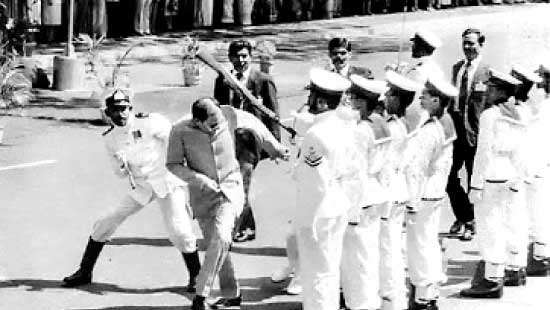
Yet, the JVP itself brutally killed its political opponents, declared unofficial curfews, disrupted public life, damaged public buildings, burned state buses and killed bus drivers to enforce curfews imposed by them. Their activities caused billions of rupees damage to public property. Addressing a meeting in London, in June 2014, JVP Leader Anura Kumara Dissanayake expressed ‘regret’ over the killings for which his party was responsible during the 1988-89 petriod. Former JVP leader Somawansa Amarasinghe admitted that nearly 6,000 people died due to the underworld activities of the JVP. Then MP Dissanayake referred to the killings as ‘unfortunate incidents’. If, as Ministers Bimal Rathnayake and Ananda Wijepala claim the law will be applied uniformly, does it mean the police will be free to investigate and prosecute the ‘mistakes’ our present president and his co-insurgents made during the insurgency of 1988 – 1990? The police force would, we are certain, be happy to oblige. Seeing that among the ‘mistakes’ the JVP made were killing security forces personnel and threats to kill parents of policemen and soldiers who refused to resign their posts. Will the country soon see AKD being hauled before a Magistrate, handcuffed and led off to Welikada jail? This country still needs to repay its foreign debt. We need to think of novel ways to diversify our economy if we are ever to reach our economic goals. Let’s drop these dramas and get our country’s economy back on track. With all his faults, Wickremesinghe did perform a rescue act during the financial crisis. But as the character ‘Mark Anthony’ in William Shakespeare’s ‘Julius Caesar’ was wont to say: “The evil that men do lives after them; the good is oft interred with their bones”.