Reply To:
Name - Reply Comment
 Parliamentarian Harsha de Silva, SJB’s economic czar, has gone viral on X, formerly Twitter. In a post with nearly 485,000 views as of yesterday, he says: “called out the Govt in @ParliamentLK for mocking India’s bold stand against Trump’s trade tariff. #India, our true ally, stood by us in our toughest times. We should honour their fight, not laugh. India’s courage inspires Asia!”
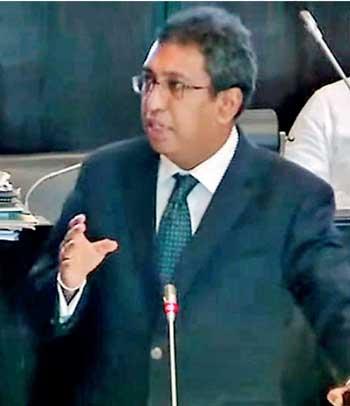 |
| Dr. Harsha de Silva creates a Twitter storm |
He had tagged a video of his speech in Parliament with English subtitles. Normally, Sri Lankan Twitter has a limited reach, at best 20,000 for a mass circulated post. Silva’s post, by some miracle or the algorithm of the social media platform, or his hashtag of India, has reached the vast Indian audience. An Indian Twitter account quoted him in a post which had 1.7 million views, though much of it smacked of bot traffic. Still, the Indian reception was refreshingly positive -- though not all. Some Indian posters accused Sri Lanka of being ungrateful, backstabbing and rejoicing at India’s troubles despite New Delhi’s generous assistance to the island nation during its economic crisis.
Sri Lankan commentators were, however, less reserved.
“What a master class of cheap politics,” one exclaimed. Others accused Silva of creating problems for self-glory, dragging India into the equation to deflect the fallout of his predictions on Trump’s tariff on Sri Lanka, and hiding negative comments in his post.
Many asked where the government of Sri Lanka mocked India. Silva has not responded; instead, he restricted comments to this particular post.
Silva’s spectacle is a classic case of the poverty of local politics. It is even disappointing for Silva’s academic credentials and his usual insights in Parliament. Some even consider him to be a better choice for the party leadership.
However, dragging India into the equation is a new low. Even more so when there is no public statement by any leading government figure, even its backbenchers, belittling the Indian approach over the Trump tariff. At best, Silva might have amplified small talk in the Parliament canteen or just invented it.
Even these self-serving follies could have a devastating fallout for the nation. Several members of the Maldivian ruling party belittled India’s Prime Minister Narendra Modi on the social media platform X, and Indians boycotted tourism to the Maldives. (It was also during that time that Indian external affairs minister Jayshankar recommended that his compatriots visit Sri Lanka as the next tourist destination.)
The strained relationship between President J.R. Jayawardene and India’s then-prime minister Indira Gandhi was a key factor that saw India arming and training Tamil militancy in the island. Black July was a catalyst, but India had its plate full of far more egregious ethnic conflagrations, including one just following Prime Minister India Gandhi’s assassination by her Sikh bodyguard.
Indian nationalism is also at a crossroads from an India that took great pride in its secular state, democracy and pluralism barely a decade ago. Nothing could be more representative of the new attitude than Indian Twitter nationalism, which is insular, paranoid, and race-baiting with a varying degree of Islamophobia and overdose of Hindutva ideology. That may be due to a much larger demographic shift that controlled the narrative from an urbane old guard, who were few but world-class, to a new brand of teeming millions. So is the change in intellectual ownership of the narrative from the venerated old guards, like N Ram, to the likes of Palki Sharma. Offending this demography would have unexpected consequences, and no one in their right mind would indulge. More so, given our precarious balancing act between India and China.
The government has so far navigated the country’s foreign relations skilfully with key partners who have competing interests over Sri Lanka. Its professional approach in the Trump tariff negotiations is commendable. Imagine how Trump tariffs would have worked out under Gotabaya Rajapaksa or Mahinda Rajapaksa’s conspiracy theory-driven foreign policy.
This is a country where successive governments have run the foreign policy against its own commonsense long-term national interest, simply to cultivate a larger-than-life image for their inconsequential leaders.
In this historical backdrop, one should appreciate the foreign policy commonsense at play in this government, which was indeed refreshing considering all its pre-election rhetoric.
Yet, questions remain about what benefits the president and the government had accrued from this general goodwill extended by our foreign partners, other than the usual largess received by all their successors. Visiting India, China, Japan, the European Union or even Israel at the appropriate time, the government should cultivate economic and technological partnerships aimed at economic modernisation, rather than settling for foreign jobs for unskilled and semi-skilled youth.
It can learn lessons from how countries like Taiwan, South Korea or Singapore built technological clusters with international cooperation, leapfrogging in technological transformation
Politicians from both sides of the political divide can serve the country better by campaigning for greater economic cooperation with India and interlocking the Sri Lankan economy with its growing behemoth next door. Sri Lanka should strive to lure India’s world-beating IT and technological sector through dedicated economic zones similar to those in Vietnam and generous incentives.
India’s tariff worries are unlikely to last long, considering its geopolitical importance for America’s Asia-Pacific strategy as a balancer for China. However, geopolitical anxiety would prompt at least some Indian companies and their foreign partners to diversify into other locations. That is an opportunity Sri Lanka could tap into.
Rather than mocking India, Sri Lankan leaders should strategise to exploit this geo-economic opening to bilateral interest.
Follow RangaJayasuriya on X