Reply To:
Name - Reply Comment

 “When Indian Ocean Dipole becomes positive, what’s expected is that the western parts of the Indian Ocean, from Sri Lanka will experience very heavy convection type rainfall especially during October and November. In 2023 there was a nearly strong El Niño where the temperature increased to about 2 degrees Celsius. We had a massive rainfall during October/November due to the IOD becoming positive”
- Buddhi Marambe, Senior Prof. in Crop Science Peradeniya University
 “Food imports from other countries such as India would be affected and we discussed how we could promote home gardening concepts and drip irrigation systems. Many vulnerable groups would emerge as a result of an El Niño and we need to be prepared with solutions well in advance”
- Prof. L. M Abeywickrema, Member of Parliament
 “ When talking about El Niño the best technical term to describe it is ‘tele-connection’, which means if something happens somewhere at a lone distance, its impact could be felt somewhere else, maybe around 1000 kilometres away. If you take a research article on El Niño you will frequently come across this term. This is the best example to show that the people who have spoken about El Niño don’t seem to have a sound knowledge about this phenomenon”
- Dr. Ranjith Punyawardena, Former Director of the Natural Resources Management Centre, Department of Agriculture, Peradeniya University

Global climate scientists indicate that a rapidly intensifying El Niño phenomenon is currently underway. Many countries around the world are already ‘feeling the heat’ with temperatures nearing 40 degrees Celsius. According to predictions, countries in South Asia for instance may experience impacts of this phenomenon that originates from the central and eastern equatorial Pacific Ocean at varying degrees. Local media reports had been abuzz about the potential impacts of El Niño on Sri Lanka. However, according to climate scientists and subject experts, if handled judiciously, Sri Lanka would be able to manage the drastic impacts of an impending El Niño.
El Niño and tele-connections
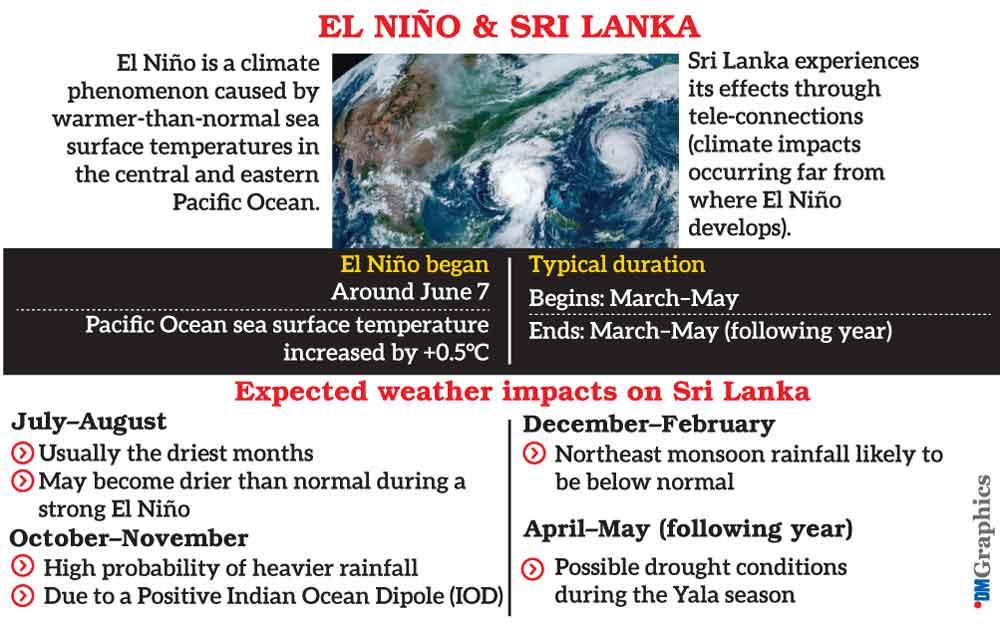
According to the US-based National Ocean and Atmospheric Administration (NOAA), El Niño is a naturally occurring climate phenomenon characterised by warmer-than-average sea surface temperatures in the central and eastern equatorial Pacific Ocean.
Speaking to the Daily Mirror, leading climate expert and former Director of the Natural Resources Management Centre, Department of Agriculture at the Peradeniya University Dr. Ranjith Punyawardena, there’s an unnecessary fear being created regarding El Niño and the main reason is because it’s origins, impacts haven’t been discussed at length and breadth. He claimed that the term tele-connection wasn’t seen anywhere in local media reports.
“When talking about El Niño the best technical term to describe it is ‘tele-connection’, which means if something happens somewhere at a lone distance, its impact could be felt somewhere else, maybe around 1000 kilometres away. If you take a research article on El Niño you will frequently come across this term. This is the best example to show that the people who have spoken about El Niño doesn’t seem to have a sound knowledge about this phenomenon,” he claimed.
Explaining further, Dr. Punyawardena said that during El Niño, the Atacama Desert, believed to be the driest place on Earth, floods. “Countries such as Indonesia, Malaysia and Australia which usually experience heavy rainfall become dry. Sometimes we too get the direct impacts in the form of low air quality. During this period, there’s an 80% probability of the southwest monsoon in India becoming weaker. It has already weakened by now. Indian media reports indicate that the country is receiving 40% less rainfall than expected. These are examples of tele-connections. During an El Niño some of the driest places in USA, such as Texas and California experience heavy rainfall,” he added.
Indian Ocean Dipole
When talking about El Niño, another phenomenon that occurs is the Indian Ocean Dipole (IOD), a climate phenomenon defined by the irregular oscillation of the sea surface temperature in the Indian Ocean. In his remarks, Senior Professor in Crop Science at the Peradeniya University Buddhi Marambe said that this phenomenon was identified around 1999. He said that there’s a highly likely chance for IOD to become positive during an El Niño year.
“When IOD becomes positive, what is expected out of that is that the western parts of the Indian Ocean, from Sri Lanka will experience very heavy convection type rainfall especially during the month of October and November. In 2023 there was a nearly strong El Niño where the temperature increased to about 2 degrees Celsius. We had a massive rainfall during October/November due to the IOD becoming positive,” he said.
Probable climate impacts on Sri Lanka
Experts opine that El Niño isn’t a devil as is being portrayed in media. Dr. Punyawardena said that some countries may experience greater impacts, but that is not the case in Sri Lanka. “However we need to prepare to face it. El Niño is just one element in the world’s climate system. This is not going to be the final El Niño for this century. But what we do know is that with current trends of global warming, climate change is a reality and not a myth. If we take short-term, medium and long-term measures to cope with climate change, then we have automatically adopted strategies to face the El Niño phenomenon,” he said.
Concerns have been raised about experiencing a drought as a result of El Niño. But according to Dr. Punyawardena, the chances of facing a drought this year is extremely low. “If at all a drought could be expected next April-May during the Yala season. The National Adaptation Plan 2026-2035 is a government approved document which includes strategies to adopt to climate extremes such as droughts, floods, landslides, torrential rains and so on. This has been approved by UNFCCC and is our roadmap for the next few years. This roadmap includes technological, policy and attitudinal level adaptations and therefore nobody needs to have an unnecessary fear regarding El Niño,” he added.
He further said that the El Niño begins around March-April-May in a given year. “This year this phenomenon commenced around June 7 where the sea surface temperature in the central eastern Pacific Ocean increased by +0.5 degrees Celsius. So ideally even though it is supposed to commence in March, April or May, this year it began in June and it would subside by March, April, May next year. By the time it subsides, there’s a probability of weakening the first inter-monsoonal season in Sri Lanka. But I don’t see a weakening of rainfall patterns this year as claimed in certain media reports,” he said.
Indirect impacts
Dr. Punyawardena said that Sri Lanka is likely to experience the indirect impacts of El Niño and that it would be an impact on our food security if the southwest monsoon in India weakens. “India receives 80% of its total annual rainfall from the southwest monsoon. In Sri Lanka, we only receive 30% of annual rainfall from the southwest monsoon. If the southwest monsoon weakens, India’s agriculture sector would be affected. We depend on them for onions, potatoes, mysoor dhal, peanuts and other items. Sometimes we import rice as well. What they would immediately do is ban exports. If India doesn’t provide us with mysoor dhal then we turn to Australia. If Australia is also impacted by El Niño they too wouldn’t be able to help us. Then we turn to Türkiye, but we don’t know to what extent we have established trade relations with them,” he forewarned.
Impact on agriculture
When it comes to Sri Lankan agriculture, dry and intermediate zones are extremely important areas,” according to Prof. Marambe. There is two-thirds of land there and it is the heart of our agriculture. July and August are the two driest months in any given calendar year. He said that a very strong El Niño could make the southwest monsoon cease quickly where July and August would become drier than usual.
“We are in the Yala season where people in some parts of the country have cultivated early and are already harvesting now. In other areas, harvesting takes place in August and September. Paddy encounters a problem if it’s planted late. Even without an El Niño year if you plant paddy late and if the reproductive stage of the plant reaches July or August the pollen can get dried out. Then there’s no reproductive cycle that takes place. So you would find a panicle, but most grains would be empty. When you speak to small and medium scale millers they complain about grains being empty and Sri Lankan paddy farmers know about this phenomenon. They call it Ehela Pussa – Ehela is the month of July and pussa means empty. If July becomes drier than normal the Ehela Pussa could be stronger,” he explained
Prof. Marambe said that in addition, when dry months become drier, the soil also becomes drier. “Soil moisture gets depleted to a point where crops cannot even withstand on soil,” he said.
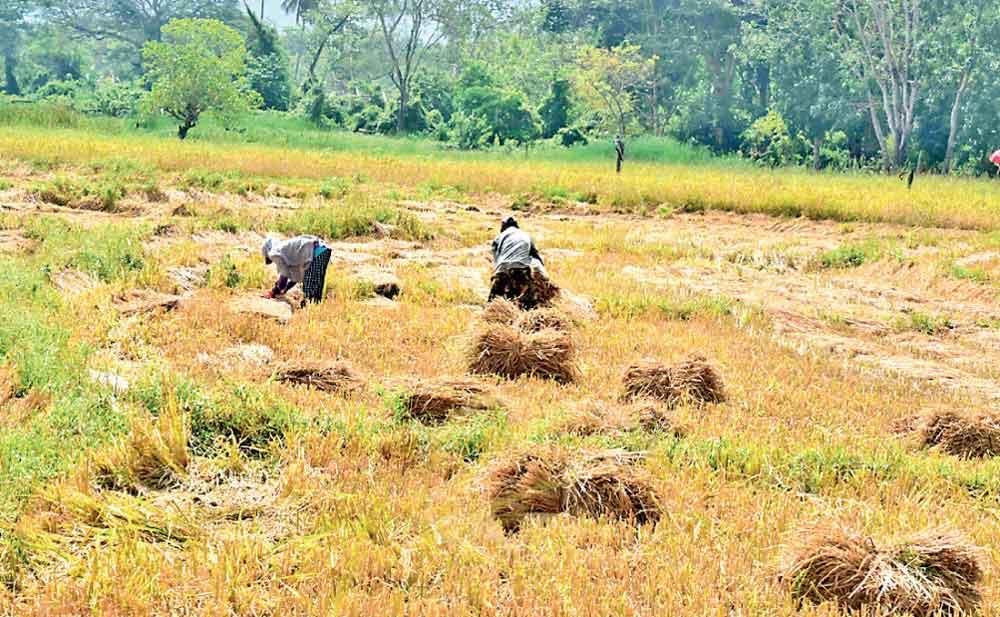
Paddy farmers in Galgamuwa in the North Central Province. Experts warn that vulnerable groups would emerge in key sectors such as agriculture as a result of an impending El Niño. (Pic by Kithsiri De Mel)
An unseen threat
Dr. Punyawardena further said that one of the direct impacts of El Niño would be on public health because an increase in temperature is an obvious factor. “The last El Niño happened in 2023 where the temperature increased by 2 degrees Celsius. People feel the heat stress and those living in urban areas such as Colombo would feel it more due to the urban heat island effect. There’s more concrete, tarred roads and an unbearable heat. Heat stress is an unseen threat. Apart from underserved Colombo dwellers, there are many garment factories in the country. Some have good facilities and others have bare minimum facilities. Some of them don’t have a fan or drinking water. Farmers working in the dry zone are exposed to scorching temperatures. They don’t like to drink water due to the brackish taste, leading to dehydration. This ultimately leads to chronic kidney disease. Therefore it is important to provide them with supplementary drinking water provisions,” he explained.
This is not an isolated event. An El Nino will come again, so the best option is to have a long-term resilient strategy rather than a short-term strategy. We have the policy environment to develop a long-term resilient strategy. There are three recent documents – national climate change policy 2023, national determined contributions 2026-2035.
Coping strategies
According to Dr. Punyawardena, as a result of prevailing El Niño conditions there’s a high probability of experiencing more rains during the second inter-monsoonal season (October/November) this year. But the northeast monsoons rains during December, January and February are likely to be below normal. If we manage the rains we are likely to experience in October and November then we can save a considerable amount of water in our reservoirs for the next harvesting season. As a thumb rule, if around 40-50% of water is saved in the reservoir by the end of the harvesting season, farmers can begin the next harvesting season without any issue. Farmers know about El Niño much more than we know.
Sri Lanka’s readiness
To discuss actions being taken by authorities to face an impending El Niño, the Parliamentary Caucus on Climate co-chaired by Opposition Leader Sajith Premadasa and Member of Parliament Prof. L. M Abeywickrema convened a meeting recently. Officials from various institutions including the Forest, Wildlife Conservation Departments, National Aquatic Resources Research and Development Authority (NARA) attended the meeting.
Speaking to the Daily Mirror, Prof. Abeywickrama said that each department spoke about actions being taken to safeguard vulnerable groups in key sectors such as agriculture and fisheries. He said that the officials discussed alternatives sources of income for people involved in fisheries for instance when coastal temperatures increase during the dry season. Steps are being taken to mend reservoirs and tanks inside forest reserves, so that wild animals would have adequate water during this period, he said.
“Food imports from other countries such as India would be affected and we discussed how we could promote home gardening concepts and drip irrigation systems. Many vulnerable groups would emerge as a result of an El Niño and we need to be prepared with solutions well in advance,” he cautioned.