 Kamanthi Wickramasinghe
Reply To:
Name - Reply Comment
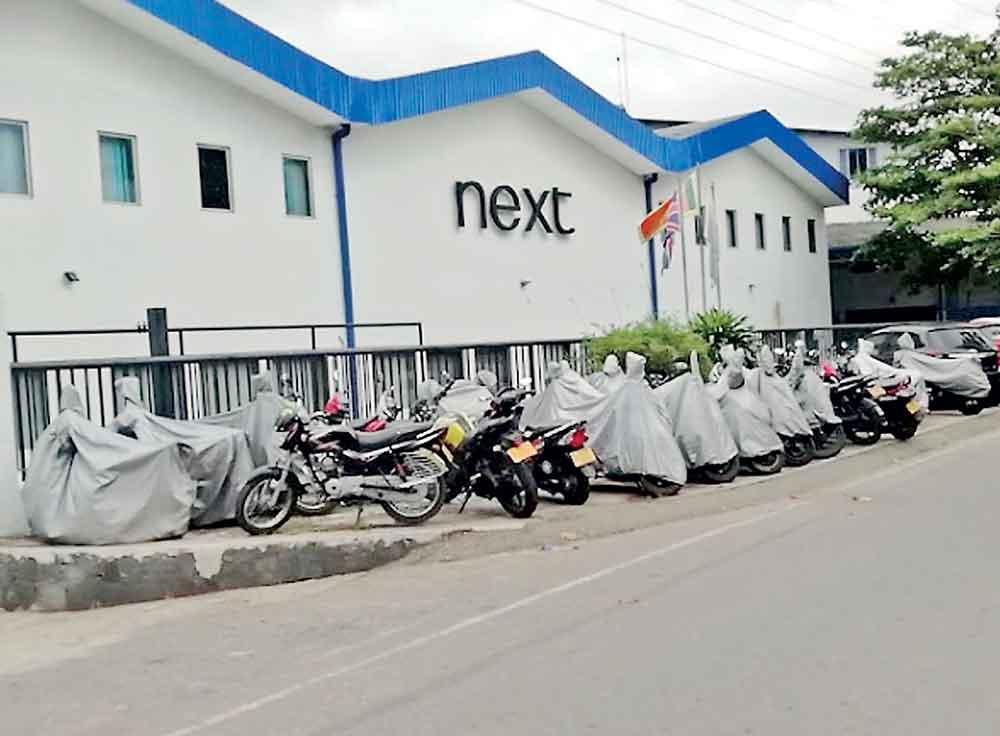
 Rights groups and trade union representatives have expressed their disappointment regarding the abrupt closure of apparel giant NEXT Manufacturing (Pvt) Ltd, at the Katunayake Free Trade Zone, which employed over 1300 workers. The company is being blamed for its failure to give prior notice to its employees while taking steps to inform the labour commissioner regarding their decision.
A desperate situation for employees
*Ramya Kumari (40) from Nuwara Eliya is one among 1341 employees who lost their jobs on Monday when NEXT Apparel ceased operations. Her five-year contract was terminated abruptly. Being a single mother of three, Ramya is the sole breadwinner in her family. “As soon as I was informed about the termination of my contract, I started a manpower job at a hotel for a daily pay of Rs. 1600,” she said, speaking to the Daily Mirror.
Despite uncertainties revolving around manpower jobs, which are usually available on a temporary basis, Ramya has no option but to work 24 hours to put food on the table. “I was asked to come to the BOI on 27th to receive the balance payment the company owes me. We were told that it would be made as a partial payment and that we would get the remaining amount within three months time. But I’m not sure whether we would get it as promised,” she added.
Being a diabetic patient herself, Ramya depends on an insulin injection, which needs to be administered thrice a day. She needs around four bottles of insulin per month. On top of that, she has to bear expenses for meals, boarding fees, utility bills and other commodities. Many others like Ramya were thrown into a desperate situation and they believe that the least the company could do is to provide them with compensation.
Job security of employees at stake
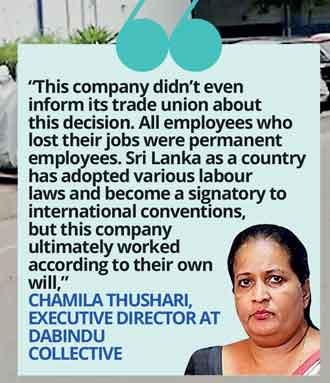 The company in question had followed a five-day work week for sometime. Therefore, employees didn’t have work during weekends. However, the Daily Mirror learned that the employees were asked to report to work on Sunday (18) and were promised to be paid for overtime charges as well. “On Monday, the human resource department had obtained all contact details of the employees and after they returned home from work they were informed about the termination of employment,” said Chamila Thushari, Executive Director at Dabindu Collective who had been at the forefront in voicing for the rights of garment factory workers in the free trade zones. “This company didn’t even inform its trade union about this decision. All employees who lost their jobs were permanent employees. Sri Lanka as a country has adopted various labour laws and become a signatory to international conventions, but this company ultimately worked according to their own will,” she added.
Thushari further said that it is misleading to state that the company closed down due to Trump’s tariffs when, in reality, the company supplies directly to the UK-based brand. “There is something called ethics. During the COVID-19 pandemic, this company exploited its workers to an extent that if PCR tests were done on 30 employees, at least 25 of them tested positive. Employees were never given a relief package during the pandemic. They operated during the pandemic and even during the crisis,” she complained.
She also expressed concerns over lapses in informing the Labour Commissioner before such decisions were being made. “These employers have their unions and there’s a procedure they need to follow. Employers cannot endanger the job security of these employees. Some of them have been in service for around 22 years. The company management has simply ignored fundamental rights of these employees who never complained or went on strike even during the most desperate situations,” she added.
Thushari further said that low-level skilled workers have to bear the brunt of decisions taken at a global level. “This had always been the case. It sets a bad precedent as women, especially, are now in a vulnerable situation and would go in search of high-risk jobs as they need some kind of employment to make ends meet,” she underscored.
More companies vulnerable to closure?
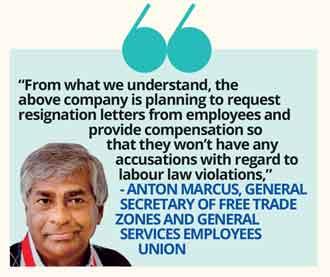
“This is a trial for what is going to happen after July 9, after which Trump’s reciprocal tariffs would come into effect,” warned Anton Marcus, General Secretary of Free Trade Zones and General Services Employees Union. “So, more apparel manufacturing companies would close down in this manner and labourers would be in a dilemma. From what we understand, the above company is planning to request resignation letters from employees and provide compensation so that they won’t have any accusations with regard to labour law violations. Even though there are specific labour laws in the country which indicate that the labour commissioner needs to be informed prior to closing down a large-scale operation of this nature, this particular company failed to do so,” he complained.
Even though the company in question had inked a collective agreement with trade unions, they have failed to uphold the rights of its workers. “The government should be blamed for this crisis. They need to speak to apparel manufacturing companies that are vulnerable to closure and discuss how they could protect the rights of workers. That is the role of a government. Providing compensation is not the answer,” he further said.
Marcus recalled that the government, on a previous occasion, said that the production costs in apparel manufacturing companies in free trade zones are high. “In that case, they need to provide a solution without allowing companies to close in an ad hoc manner,” he underscored.
A promise to pay all outstanding payments
In a statement, its Manufacturing Director, David Reay, said that at the heart of this decision is the increasingly high operating cost of the Katunayake Manufacturing Plant. The statement indicates that the Katunayake plant had been unprofitable despite efforts to rectify the situation. It stated that although the Katunayake plant had closed down its two other manufacturing plants in Andigama and Nawagaththegama would continue operations. The statement assures supporting employees who lost their jobs to find alternative means of employment while tabulating how production and attendance bonuses, gratuity and outstanding holiday pay would be paid.
*Name withheld to protect identity