Reply To:
Name - Reply Comment
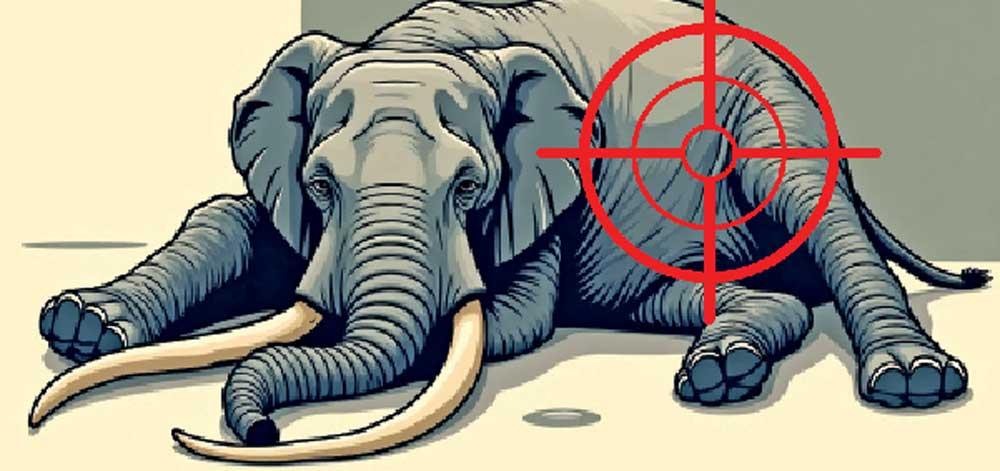
 “Elephants currently inhabit 62 percent of Sri Lanka’s land, and only 18 percent of this area is strictly elephant habitat. Deaths occurring in those 18 percent of forested areas are not reported. Natural elephant deaths are very rare in Sri Lanka. While the average lifespan of an elephant is about 80 years, data from recorded deaths show that most elephants die before reaching 45 to 65 years of age”
- Nayanaka Ranwella, Chairman Wildlife Conservation Forum
By Sudharika Gurusinghe
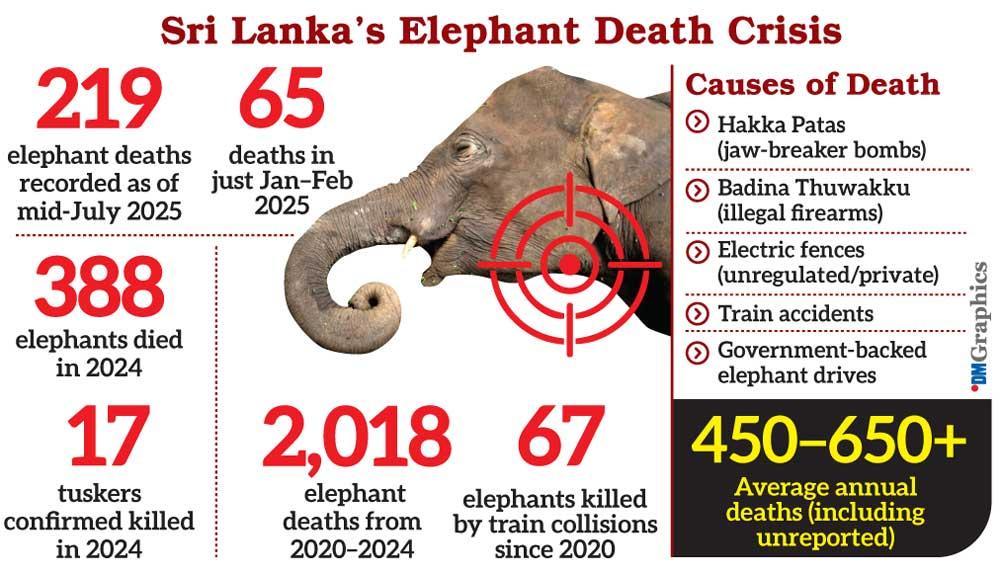
Elephant deaths, a topic frequently discussed these days, have drawn widespread attention. It appears that elephants are being killed with the intention of removing their tusks. Department of Wildlife Conservation (DWC) has confirmed that elephants are being killed using Hakka Patas (jaw-breaker bombs), Badina Thuwakku weapons and poisoning.As of mid-July this year, 219 elephant deaths have been recorded; 37 of them dying through shootings. In 2024, 388 elephant deaths were reported. DWC confirmed that 17 of them were tuskers. Between 2020 and 2024, a total of 2,018 elephant deaths occurred. Additionally, 65 elephant deaths were recorded in the first two months of 2025. From 2020 to February 2025, 67 elephants died when they collided with trains.
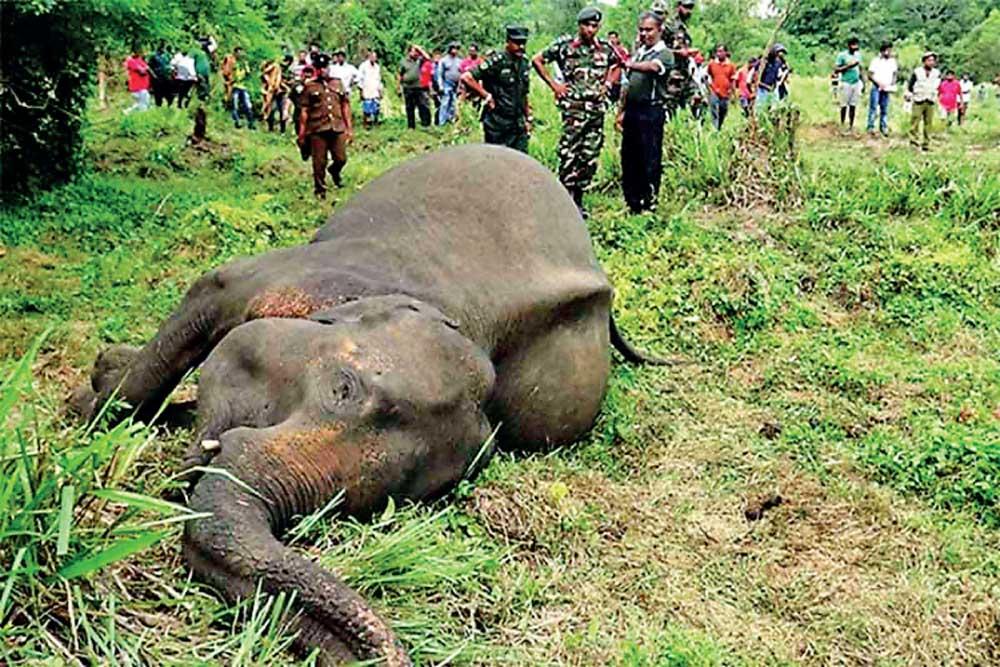
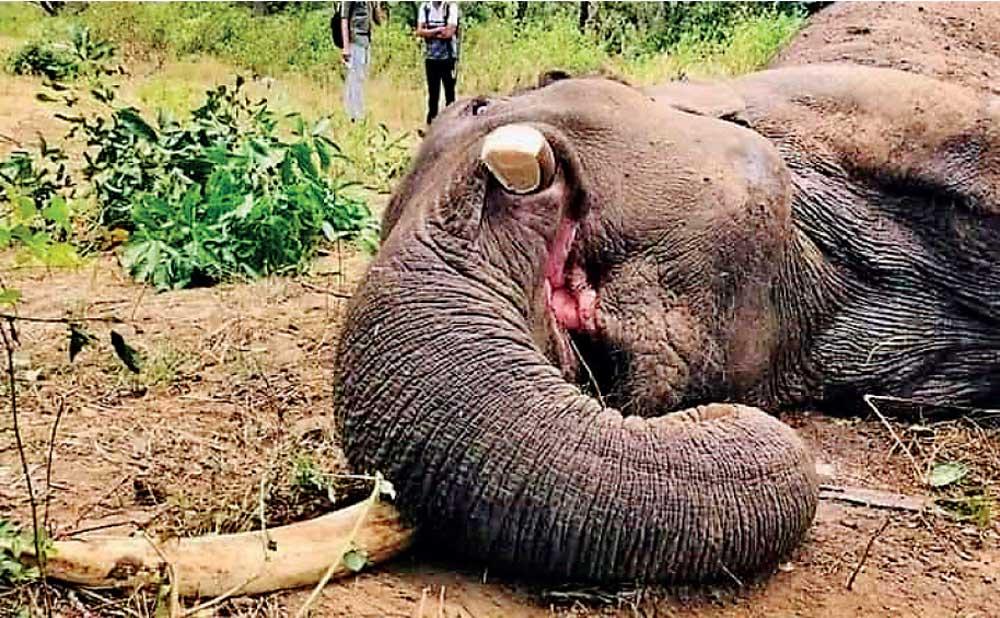
Sri Lanka currently ranks first in the world in the number of elephant deaths
Although the human-elephant conflict was highlighted as a major issue to gain political power, it was later forgotten as if promises were never made. Human-elephant conflicts have been reported in 19 districts and 131 Divisional Secretariat divisions across Sri Lanka. Based on this information, this newspaper was able to confirm some of the records. Sri Lanka has become the country with the highest number of elephant-human deaths. This record was set in 2020, when many precious elephants were lost.
In 2024, plans were made to implement a national action plan aimed at reducing human-elephant conflict and elephant encroachment. Department of Agrarian Development installed around 300 community-based electric fences. This helped DWC reduce the need to chase and relocate elephants. Consequently, there was a slight decrease in both elephant and human deaths in 2024.
DWC confirmed that connecting three phrase electric power to private elephant fences has contributed to an increase in elephant deaths. In some areas, people still struggle to understand elephant behaviour patterns, which are a major cause of human-elephant conflict. Some responsible government officials have also failed to identify these behaviour patterns. Previous governments were unable to develop a proper methodology to address this issue. Although the current government claims a readiness to solve the problem, the measures taken so far have proven to be failures. Over the past few years, the current government has implemented various efforts to address the human-elephant conflict, aiming to fulfill their election promises.
Boastful claims by Govt.
Despite boastful claims, the government has not succeeded in reducing elephant deaths or resolving the human-elephant conflict. As of today, about 288 elephant deaths have been reported this year alone. This shows that the current government has not been able to change the existing situation and has ultimately failed. It is clear that they are also unable to provide a permanent solution to this ongoing issue. The committee responsible for preparing the National Action Plan has now completed its term. Unfortunately, the government is yet to take any substantial action following this development.
Recently, District Secretaries from conflict-affected districts participated in a discussion led by the President. These Secretaries were also members of the previously mentioned Action Committee. Wildlife officers also attended the meeting, but community-based electric fencing was not mentioned. The ministers of the current government believe that releasing elephants back into protected areas is the solution.
After the present government assumed power, the release of elephants into protected areas was carried out hastily with the support of the DWC. The release was largely a media spectacle, and the elephants soon invaded villages again. The release operation, which began in the Kekirawa area, was a failure and it was later expanded throughout the Anuradhapura district. This effort was so unsuccessful that the DWC confirmed that 44 elephants had died in Anuradhapura alone. Similar attempts to drive elephants away in the Puttalam, Matale and Polonnaruwa districts also failed. Instead, these efforts resulted in thousands of Ali Wedi explosives being used to chase away elephants. The several gun shots that were fired caused immense suffering and increased the hostility between elephants and humans. When taking into account the costs of drones, Ali Wedi, and bullets used, the financial burden was significant.
Previous governments also took various measures to control elephant invasions into villages. Among these, cutting ditches in reserved forests caused environmental damage and incurred high costs, but such efforts were not successful in controlling elephant encroachment. To combat this, an Elephant Holding Ground was established in Horowpathana in 2012 with an allocation of Rs. 200 million from the government budget. According to census reports, as of July 2019, 52 elephants had been brought to this holding ground, which spans 997 hectares. However, only nine elephants remained there, while 12 had died. According to audit report IEN/F/DWC/19 PR/11, five of these deaths were due to malnutrition. DWC has no information on the status of the remaining 31 elephants—whether they escaped, died, or are still at the centre. The holding ground lacks the grass that elephants normally consume. Although food and water are provided, the supply is inadequate, resulting in confirmed cases of malnutrition among the elephants. Wildlife officials noted that nearly 75 elephants have been referred to this place so far.
On average, an elephant consumes more than 150 kilograms of food per day and spends about 17 hours feeding. It also needs approximately 200 litres of water daily and typically walks over 25 kilometres. At Horowpothana Elephant Holding Ground, the only facility available to the elephants is space for walking. DWC confirmed that there are about 35 elephants currently at the ground, but has no information on the whereabouts of the other elephants.
It is clear that DWC cannot protect the elephants alone. A shortage of officials, vehicles and transportation facilities are major factors stifling efforts taken to reduce risks that elephants are exposed to. Many of the country’s elephants have been mercilessly killed during the past. The famous elephant known as the ‘Mahakanadarawa Tusker’ was killed, and its head was sawed off to obtain its tusks. Elephants such as Walagamba and Dhatusena have disappeared. Others—including Deeghajantu, Siyambalangamuwa Tusker, Barana, Revatha, Mahesakhya, Nila, Thekka Raja, and the blind Dala Poottuwa—were slain by ruthless criminals.
The largest tusker remaining in Sri Lanka is Kavantissa. There are three or four other similar tuskers in the country, but their identities are kept a secret to protect them from poachers. Several elephant herds inhabit the Galgamuwa and Kala Wewa areas. These herds guard Kavantissa with great devotion. While an average elephant weighs between 3,500 and 4,000 kilograms, Kavantissa weighs over 5,000 kilograms. Standing more than 11 feet tall, it is the tallest elephant in the country. Usually, the tusker places itself near the centre of the herd. A female elephant or a tusker leads the herd by walking at the front, while themales generally do not take the lead.
However, due to its height and size, Kavantissa leads the herd by walking at the front. This reflects its strong character, but also exposes it to serious threats. Being as large as an African elephant, Kavantissa currently faces significant risks to its life. Being at the front exposes Kavantissa to dangers such as Hakka Patas, Badina Thuwakku, shootings, poisoning, and unprotected electric fences. District secretaries have distributed lands where people have installed high-voltage electric fences. If Kavantissa becomes entangled in these wires, its life will be at serious risk.
Kavantissa has been shot at multiple times before. Although it has not been critically affected so far, it must be emphasised that these threats endanger its life. If Kavantissa were to be shot in the front legs, the injury could be devastating due to the elephant’s weight. About one third of an elephant’s body weight is carried by its front legs, so an injury there could render the animal unable to support itself. This risk is heightened because Kavantissa moves at the front of the herd.ww
Environment enthusiasts have recommend that a dedicated unit be deployed specifically protect and monitor Kavantissa. They say that combining the small forests of Siyambalangamuwa, Galnewa and Bulnewa into a national park would greatly improve Kavantissa’s safety. The government should also provide alternative land to people who lose property due to the establishment of such a national park. This approach would significantly help protect elephants in the Galgamuwa area.
Commenting on this, environmentalist Nayanaka Ranwella, Chairman of the Wildlife Conservation Forum, said: “On average, about 450 elephant deaths are reported annually, but there are approximately 150 unreported deaths. Elephants currently inhabit 62 percent of Sri Lanka’s land, and only 18 percent of this area is strictly elephant habitat. Deaths occurring in those 18 percent of forested areas are not reported. Natural elephant deaths are very rare in Sri Lanka. While the average lifespan of an elephant is about 80 years, data from recorded deaths show that most elephants die before reaching 45 to 65 years of age. The number of elephants killed by Badina Thuwakku and Hakka Patas is never counted. Reports only cover the 44 percent of land where elephants coexist with humans”.
National Action Plan
Elephant deaths decreased last year due to the National Action Plan established in 2020. Initiated by Dr. Prithviraj Fernando and developed with input from many experts, the plan was implemented by former President Ranil Wickremesinghe. As part of this plan, 283 rural electric fences were installed, resulting in a reduction of about one hundred elephant deaths. However, the current government has shelved the report, dismissing it as Ranil’s work. Had the committee been re-established, further reductions in elephant deaths would have been possible. Instead, over 260 elephants have died within the first seven months of this year alone — these are only the reported deaths. When unreported deaths are included, the total could exceed 500 to 650. Elephant deaths have risen sharply since Minister K.D Lal Kantha gave instructions to take action against any animal entering farms. Measures such as shooting and chasing elephants away were taken to prevent them from entering villages, but these efforts have failed. Instead, they have caused elephants to panic, which likely contributed to the increase in elephant deaths this year.
This newspaper reached out to Director General of Wildlife, M. S. L. R. P. Marasinghe, for comments on this issue. However, he was engaged in an emergency parliamentary meeting.
Sri Lanka currently ranks first in the world in the number of elephant deaths. Within the next decade, the elephants residing in the country face the real threat of being completely wiped out. In Africa, very few tusked elephants are born, primarily because poaching for tusks happens at a rapid pace there. Sri Lanka risks facing a similar fate. The tusked elephants of Sri Lanka have been killed without giving much thought to the fact a gruesome act is being committed.
If the current government fails to implement effective measures to curb the ongoing elephant deaths, this year could mark the highest number of elephant fatalities in the Sri Lankan history. It is crucial to address this crisis based on accurate data.