 DARSHANA SANJEEWA BALASURIYA
 Reply To:
Name - Reply Comment
*26 including 7 prison officers killed in Negombo jail riot
*Justice Minister accepts responsibility
*Opposition Leader blames govt., demands independent parliamentary inquiry
*Prison overcrowding puts inmates and officers under immense pressure, Gammanpila
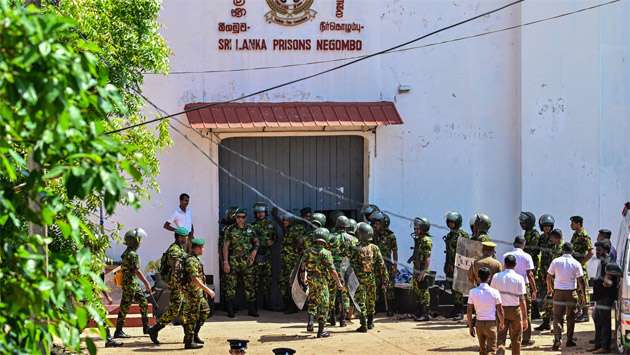
Colombo, July 07 (Daily Mirror) - In what appeared to be yet another deadly outbreak of rioting, 19 inmates and seven prison officers were killed, and around 100 were injured in the Negombo jail yesterday. Initially, riots broke out between two drug gangs on Sunday, and the confrontation rapidly spiralled into one of Sri Lanka's deadliest prison riots in recent history, resulting in heavy casualties and exposing serious security concerns.
According to Justice Minister Harshana Nanayakkara, the prison officers had received gunshot injuries, raising concerns about whether the rioters accessed prison guns to carry out the carnage.
Official data showed that prisons across Sri Lanka held 41,250 inmates as at July 5, about four times their capacity.
While most are receiving emergency treatment locally, several critically injured victims have been transferred to the National Hospital of Sri Lanka in Colombo for specialised medical care.
Yesterday's unrest also exposed major security failures after inmates reportedly seized two T-56 assault rifles, which authorities say remain missing.
According to preliminary investigations, the violence is believed to have stemmed from an internal dispute between rival inmate factions, reportedly linked to illicit activities within the prison. One of the groups was allegedly led by an inmate identified as Katuallagame Suresh, who is suspected of playing a key role in an illegal drug-smuggling network operating inside the facility. Investigators believe tensions escalated after information concerning alleged contraband activities was shared with prison authorities, triggering retaliatory attacks between the rival groups that ultimately spiralled into widespread violence.
The initial violence reportedly resulted in the deaths of two inmates, while several others climbed onto prison rooftops on Sunday in an attempt to escape the clashes. As tensions escalated, rioting inmates broke into the prison's medical unit, looting significant quantities of prescription medication, including medicines intended for inmates undergoing treatment for drug addiction, along with common pharmaceuticals.
Police and Special Task Force (STF) personnel were deployed around the prison complex on Sunday night as authorities sought to contain the unrest. Prison officials initially attempted to restore order through negotiations rather than launching an immediate armed intervention. By early Monday morning, inmates who had occupied the rooftops descended and gathered in common areas of the prison instead of returning to their cells, leaving the volatile situation unresolved.
The violence intensified dramatically on Monday morning as prison staff prepared for routine court transfers and family visits.
According to Prison Media Spokesperson A.C. Gajanayake, the unrest began in the morning when prison officers attempted to distribute breakfast to the inmates. An altercation suddenly broke out among groups of inmates, and when officers intervened to bring the situation under control, they were violently assaulted by a large group.
During the ensuing chaos, members of the prison's Special Security Unit were reportedly ambushed inside corridors and confined spaces, where they were attacked with clubs, stones, and other blunt objects. Seven prison officers later died from their injuries.
Amid the disorder, inmates overpowered prison guards and reportedly seized two T-56 assault rifles assigned to prison security personnel. According to security sources, inmates attempted to use the stolen weapons to fire toward security personnel positioned outside the prison through reinforced security windows.
As the violence intensified, the Special Task Force (STF), the Armed Forces, and the Colombo Crimes Division (CCD) launched a joint operation to bring the situation under control. Authorities later confirmed that order had been restored inside the prison by last evening. However, the two T-56 rifles taken by inmates during the unrest have not yet been recovered, and investigations are continuing to locate the missing weapons.
The incident has also drawn attention to longstanding operational challenges at Negombo Prison. It was reported that a recent outbreak of dengue fever among prison officers had significantly reduced available manpower, leaving an already overstretched staff to manage more than 2,000 inmates in a facility originally designed to accommodate approximately 900 prisoners.
Authorities have begun arrangements to transfer a group of inmates from Negombo Prison to other prisons across the country following the deadly unrest at the facility.
The spokesperson reassured anxious family members that necessary measures are being taken to restore complete order and ensure security within the prison, which currently houses nearly 2,400 inmates.
Following the unrest, security has been strengthened in and around the prison. Personnel from the Sri Lanka Army, Navy, Air Force, Police, and the STF have been deployed to assist in maintaining security while investigations into the incident continue.
Meanwhile, Minister of Justice and National Integration Harshana Nanayakkara has expressed deep shock and sorrow over the deadly violence saying he accepts responsibility as the minister in charge of the subject.
Speaking to the media on Monday, Nanayakkara said the tragic incident occurred within an institution that falls under his ministry and stressed that the loss of any human life is unacceptable.
The Minister said that the security situation at the prison has now been brought under control by the authorities. However, he said urgent measures must be taken to ensure that a similar security failure does not occur again in any correctional facility.
Nanayakkara also said that a comprehensive on-site investigation would be carried out to determine the circumstances that led to the violence and identify any failures within the prison administration.
He said the government's priority is to identify the root causes of the incident, strengthen the prison system, and implement measures to prevent similar tragedies in the future, adding that the focus should be on resolving systemic shortcomings rather than assigning blame.
Meanwhile, Opposition Leader Sajith Premadasa has strongly criticised the government over the deadly unrest at Negombo Prison, describing the incident as evidence of a failed and inefficient prison administration.
Addressing the media, Premadasa held the government accountable for the loss of life and the injuries sustained during the clashes, saying the tragedy reflected serious shortcomings in the country's prison management.
He recalled that senior political leaders had previously maintained that the government must bear full responsibility when lives are lost inside correctional facilities. Premadasa argued that although the current administration came to power promising to "change the system," the events at Negombo Prison demonstrated that those promises had not been fulfilled.
Questioning the government’s ability to maintain law and order, he said the public expects immediate action, transparency, and clear answers on preventing similar incidents. He also called for an independent parliamentary inquiry into the incident.
Speaking on the prison system, former MP Udaya Gammanpila said frequent clashes, officer confrontations, and suicides reflect a deeper structural crisis rather than isolated incidents. He noted that although the system has a capacity of 10,395 inmates, it is currently holding over 42,000, more than four times its limit, leading to severe overcrowding and intensified competition for basic facilities.
Gammanpila said the situation has also placed enormous psychological and operational pressure on prison officers, who are tasked with managing an inmate population that has doubled in recent years without any corresponding expansion in prison infrastructure.
According to Gammanpila, approximately 75 per cent of Sri Lanka's prison population consists of remand prisoners awaiting trial, making judicial delays a key factor behind chronic overcrowding.
He urged the government to increase the number of courts and judges while strengthening the Attorney General's Department and the Government Analyst's Department through the introduction of modern technology to expedite investigations, legal advice, and court proceedings.