15 May 2025 - {{hitsCtrl.values.hits}}
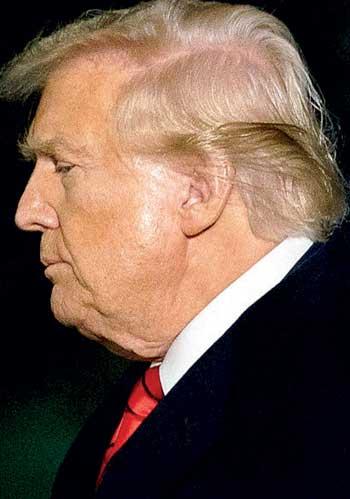
 Donald Trump’s economic policies shave met with stupefaction and withering scorn on the part of journalists and economists worldwide. However, among the criticisms of his “liberation” rhetoric, I have not yet come across any reference to the role AI plays in the new global economy and in his ambitions.
Given the impact tariffs will have on American consumer spending, it is unlikely that Trump’s policy will survive for very long. Nevertheless, we need to remember that Trump is hand-in-glove with, and perhaps even a puppet of, the hi-tech billionaires who got him to where he is today. And China is their biggest obstacle to the global domination they crave.
 We also need to remember who contributes to the global AI empire of Google, Microsoft, Amazon, Meta, Palantir, OpenAI and their lesser-known rivals. The answer: All of us.
The language of “cloud computing”, “virtual reality” and “cyberspace” has blinded us into thinking that the web and AI systems are floating in an ethereal, other-worldly sphere that is divorced from physical bodies and their natural environments.
However, AI relies on manufacturing, transportation, and physical human work; on data centres, undersea cables and satellites. And the computing industry cannot function without the minerals and resources that go into our smart phones, laptops and supercomputers. Much of this is extracted in poor countries and involves processes that leave local communities and their natural habitats devastated. AI demands vast quantities of energy and minerals.
In her ground-breaking Atlas of AI, Kate Crawford extended the metaphor of “extraction” to the way data-sets are collected to train the large-language-models of AI systems. She highlights the basic belief that underlies the computer industry: everything out there is for us to take. The Commons is privatised and turned into corporate capital. Everything is scraped off the internet by the tech billionaires to consolidate their profits and global power.
Every time we respond to a Captcha on a website we are helping improve Google’s image-recognition models. Every click of the mouse, every App we choose to open, every photograph we upload to Meta or Instagram sends information about ourselves to tech companies that pass them on to thousands of invisible advertisers. Neither the people depicted in the photographs nor their families have any say about how these images are used and likely have no idea that they are part of the testing programs of the hi-tech AI companies, most of them American.
And then there is the psychologically damaging labour of those men and women in countries such as India and the Philippines who must review all that is posted on Meta or Instagram for violent and abusive content.
Hence Kate Crawford’s pungent conclusion: “Contemporary forms of artificial intelligence are neither artificial nor intelligent. We can—and should—speak instead of the hard physical labour of mine workers, the repetitive factory labour on the assembly line, the cybernetic labour in the cognitive sweatshops of outsourced programmers, the poorly paid crowdsourced labour of Mechanical Turk workers, and the unpaid immaterial work of everyday users. These are places where we can see how planetary computation depends on the exploitation of human labour, all along all the supply chain of extraction.”(p.69)
Add to all this the huge number of engineers and AI programmers, not to mention doctors and other professionals, in the US who were trained in the universities of the “developing” world often at local taxpayers’ expense. Taking into account the “brain drain”, capital flight into offshore tax havens (which include many American and British protectorates), debt repayments at high rates of interest, tariffs on agricultural exports, and the re-location of profits by Western multinational companies, the net financial flows in the world are not from the rich nations to the poor but from the poor to the rich.
Trump’s “reciprocal tariffs” rhetoric blissfully ignores all this.
There is, of course, a cunning in Trump’s madness. He approaches global politics as a business deal (something at which he was never any good). In targeting countries like Sri Lanka, Cambodia, Vietnam etc, with high tariffs, he wants to wean them away from dependence on Chinese investment. He expects them to come grovelling, seeking concessions. What will he demand of them in turn? Exploitation by American companies of their mineral resources (as in the case of his threats to Ukraine, Canada and Greenland) or perhaps military sales and bases?
This is simply blackmail. The Chinese have called it so. Ironically, Trump’s assault on China has united a country that was otherwise unravelling under a sluggish economy and growing opposition to President Xi Jing Ping.
There is also a bitter humour in the fact that the Republican Party which stood for limited government and libertarian economics has ushered in the most authoritarian government in the history of the USA. And mercantilism and oligopolies have supplanted capitalism.
Adam Smith must be turning in his grave.
Dr. Vinoth Ramachandra is a Christian theologian and served for four decades on the Senior Leadership Team of an international university organization. He also holds both bachelor’s and doctoral degrees in nuclear engineering from the University of London and currently is an Advisory Fellow at Verité Research.
10 Jul 2026 1 hours ago
10 Jul 2026 2 hours ago
10 Jul 2026 3 hours ago
10 Jul 2026 3 hours ago
10 Jul 2026 3 hours ago