11 May 2026 - {{hitsCtrl.values.hits}}
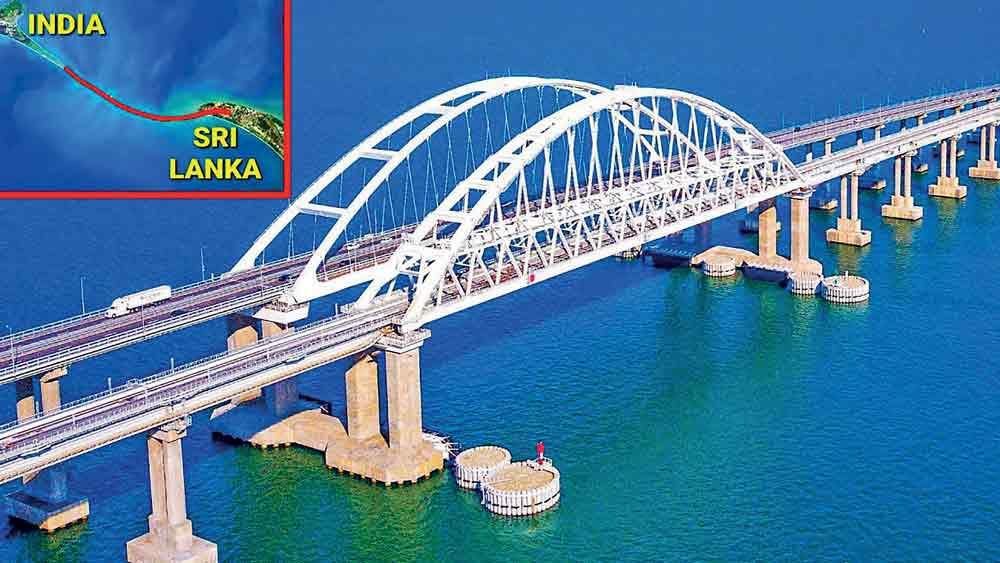
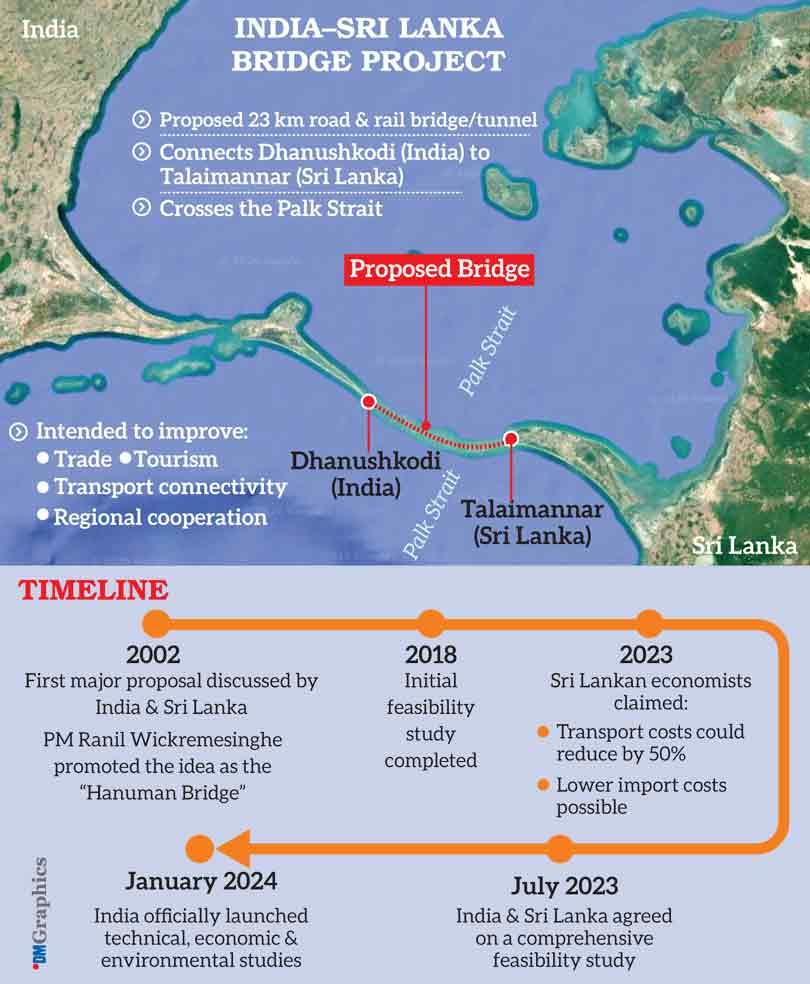
 The Palk Strait Bridge and Tunnel is a proposed 23-kilometre (14 mile) link across the Palk Strait between Dhanushkodi in the Indian state of Tamil Nadu and Talaimannar on Mannar Island off the northwestern coast of Sri Lanka.
The bridge between India and Sri Lanka was first seriously proposed by the governments of these two countries back in 2002. During the 2002-2004 Peace Accord, the then Prime Minister, Ranil Wickremesinghe, asked India to help build what he called the ‘Hanuman Bridge’.
An initial feasibility study of the bridge-tunnel combination was done in 2018. The study says it would increase trade, tourism and employment. In 2023, a further study by Sri Lankan economists concluded that the bridge would reduce transport costs to the country by 50%, thereby reducing the cost of imported goods and services.
During a two-day visit of Sri Lankan President Ranil Wickramasinghe to India in July 2023, both nations agreed to conduct a thorough feasibility study for a proposed bridge connecting India and Sri Lanka. That study was initiated by India in January 2024, and will evaluate technical, economic, and environmental aspects to determine the project’s viability. The bridge aims to enhance trade, tourism, and overall connectivity between the two countries, and foster closer ties and cooperation.
In this backdrop, it is imperative to pursue a critical study to determine whether the proposed bridge would pause a threat to National security.
THE PROPOSAL: A BRIDGE OF AMBITIONS
A proposed physical bridge linking India and Sri Lanka — a long-standing vision that has re-entered public discourse with renewed political and economic momentum — has sparked intense debate across both nations. While advocates hail it as a transformative infrastructure project that could unlock bilateral trade, tourism, and cultural connectivity, critics in Sri Lanka are sounding the alarm over serious national security implications that could outweigh the economic benefits.
First floated decades ago, the concept of a bridge or tunnel connecting Rameswaram in Tamil Nadu with Talaimannar in Sri Lanka has resurfaced with India’s expressed interest in funding and developing the project. With India actively pursuing regional connectivity initiatives under its “Neighbourhood First” policy, this bridge could become a landmark symbol of South Asian integration.
For India, the project promises to reduce shipping and transportation costs, deepen trade partnerships, and provide direct access to Sri Lanka’s markets and ports. Sri Lankan policymakers, however, are walking a tightrope — attempting to evaluate long-term economic benefits against a backdrop of historical tensions, sovereignty concerns, and regional power dynamics.
A GATEWAY FOR GROWTH?
Proponents argue that the bridge could position Sri Lanka as a regional logistics hub, enhance cross-border tourism, and facilitate the movement of goods and services. With the right border controls and legal frameworks in place, it could create new employment opportunities in northern Sri Lanka, boost local economies, and improve infrastructure in underdeveloped regions.
According to transport analysts, the connectivity would slash the cost and time of bilateral trade, offering a strategic alternative to sea and air routes. It would also reduce Sri Lanka’s reliance on Chinese-funded infrastructure, offering a diversified portfolio of partnerships.
SECURITY CONCERNS TAKE CENTRE STAGE
The proposed bridge is a land connectivity project that aims to link Sri Lanka and India over the Palk Strait. While this idea promises economic, cultural, and logistical benefits, its implications on national security, especially for Sri Lanka, are profound and multifaceted. Sri Lanka, as a small island nation with limited military resources, must weigh the geostrategic consequences of such a decision.
Despite the economic optimism, national security experts and opposition voices in Sri Lanka have raised red flags. The question remains: Will this bridge build unity, or will it bridge vulnerabilities into the very heart of our island nation?
The concerns surrounding the proposed India–Sri Lanka bridge are of greater importance to National security. Experts warn that the project poses economic, geopolitical, cultural, demographic, and environmental threats. Below, we explore these concerns in depth.
1. NATIONAL SECURITY VULNERABILITIES
The most pressing worry is the potential for unregulated movement of people and goods. Unlike airports and seaports, which offer controlled entry points, a bridge could become a high-risk corridor for smuggling, arms trafficking, illegal immigration, and even infiltration by extremist or separatist elements.
Military Vulnerability: Strategic depth compromised: The northern region would be militarily exposed due to easier physical access. In a conflict scenario, the bridge could become a vulnerable point of infiltration, potentially allowing rapid land-based mobilisation by foreign military or proxy groups. If India were to face domestic insurgencies or geopolitical tensions, spillover threats could destabilise Northern Sri Lanka.
2. REIGNITING SEPARATIST SENTIMENTS
Tamil Nadu has historically been sympathetic to Tamil separatist aspirations in Sri Lanka. Critics argue that a bridge could provide easier physical and ideological access to elements that might reignite secessionist sentiment in Sri Lanka’s north and east.
The LTTE diaspora, though scattered and weakened, still has ideological supporters, and physical access via a bridge could empower the resurgence of such movements under new names or forms.
3. ECONOMIC OVER-DEPENDENCE ON INDIA
There are legitimate fears that this bridge would tilt Sri Lanka dangerously toward economic dependency on India. Sri Lankan farmers, small-scale manufacturers, and retailers worry about being undercut by the sheer scale and speed of Indian imports, potentially devastating local industries. The bridge may open access, but it may also close the door on local enterprise.
4. UNCONTROLLED MIGRATION AND DEMOGRAPHIC IMPACT
The bridge could facilitate a slow, unchecked inflow of Indian migrants — legal and illegal — leading to long-term demographic shifts, particularly in the Northern and Eastern Provinces. This could threaten the cultural identity and political autonomy of these regions and may fuel communal tensions.
5. TERRITORIAL INTEGRITY AND SOVEREIGNTY AT RISK
The presence of a foreign country’s citizens and goods moving freely on land increases the potential for covert influence and even demographic manipulation over time. The bridge might demand joint security protocols, requiring Sri Lanka to share operational control of its borders, undermining independent sovereignty.
Sovereignty and Surveillance: An open land route may invite increased Indian presence and influence, raising fears about sovereignty and the ability of Sri Lankan forces to monitor such movement effectively.
A land link fundamentally alters Sri Lanka’s identity as a sovereign island nation. Critics argue that physical connectivity with a regional giant like India with asymmetrical power may gradually erode Sri Lanka’s ability to independently manage its internal affairs. The concern is not only about territorial compromise, but also about strategic autonomy in foreign policy, trade, and military alliances.
Sri Lanka’s territorial integrity and sovereignty which has ensured National security is largely based on being an island. The proposed land bridge connecting India Sri Lanka will have a negative impact on long term National security.
6.ENVIRONMENTAL DEVASTATION
The Palk Strait is home to a delicate marine ecosystem, including coral reefs, fisheries, and migratory paths of marine species. A mega-infrastructure project of this scale risks irreversible ecological damage, threatening both biodiversity and the livelihoods of thousands of fishing families. Fisheries unions in Mannar and Kilinochchi have already voiced their opposition, citing potential destruction of fishing grounds and disruption of traditional livelihoods.
7. ETHNIC AND POLITICAL SENSITIVITIES
The Northern Province has a history of Tamil separatism. Direct physical access from Tamil Nadu might embolden cross-border political sympathies, rekindling separatist aspirations.
Security forces may find it harder to monitor new actors or activities arising from this increased interconnection.
Tamil Nadu’s historic involvement in Sri Lanka’s ethnic conflict still casts a long shadow. The bridge could be exploited by extremist groups, rekindling tensions in the Northern Province.
Physical proximity may lead to increased Indian political interference, both overt and covert, especially in Sri Lanka’s northern politics. There is concern that Tamil Nadu-based parties and Indian agencies may exert more direct pressure on Sri Lankan Tamil politics undermining national unity.
8. TERRORISM AND HUMAN TRAFFICKING RISKS
Sri Lanka has previously battled waves of terrorism and human trafficking, much of which was linked to international networks. An accessible bridge could become a pipeline for organized crime syndicates trafficking drugs, weapons, and people overwhelming Sri Lanka’s existing law enforcement infrastructure. The possibility of the re-emergence of terrorism cannot be ruled out in the future which would endanger the National security of Sri Lanka.
9. CULTURAL AND RELIGIOUS SENSITIVITIES
There are also concerns of cultural dilution and religious friction, particularly in Buddhist-majority areas, if large-scale Indian tourism or migration reshapes the demographic makeup. Religious institutions worry about potential tensions arising from increased Hindu-nationalist influence which in turn will have an impact on national security.
10. GEOPOLITICAL REPERCUSSIONS
China-Sri Lanka relations: Sri Lanka’s strategic alignment with China may be viewed with suspicion by India, and vice versa. A bridge would increase Indian surveillance reach into Sri Lankan territory. Sri Lanka may be pressured into India’s regional security framework, reducing its non-aligned foreign policy options.
China, which has made strategic investments in Sri Lanka, may view this India-led bridge as a direct encroachment into its sphere of influence, prompting diplomatic retaliation or withdrawal of investment. The bridge may, therefore, pull Sri Lanka deeper into regional power struggles, complicating its delicate balancing act between global powers.
WHAT COMES NEXT?
Strategic and Geopolitical Ramifications: Sri Lanka’s unique position in the Indian Ocean has long made it a point of strategic interest for global powers. The bridge could alter this geopolitical balance, potentially provoking China or inviting increased militarisation of the region.
The Sri Lankan government has so far not made any official commitment, and has promised a full national review before any decision is made. However, civil society groups are calling for greater transparency, parliamentary debate, and even a public referendum on such a consequential decision.
CONCLUSION
While the Mannar-Rameswaram bridge could deliver economic and diplomatic gains, its construction would erode Sri Lanka’s physical isolation, a key aspect of its traditional defense doctrine. The risk of illegal activities, foreign influence, territorial infringement, and military vulnerability must not be understated.
Civil society organisations are calling for broad-based public consultations and a national referendum before any agreement is signed. Development must not come at the cost of territorial integrity and sovereignty of the motherland inclusive of National security, and National identity.
The writer is a distinguished International Researcher, Author and analyst with a career spanning over 36 years of service in the Sri Lanka Army, including 20 years in active combat. A seasoned Infantry officer, Major General (Retd) Dr Boniface Perera[N1] holds a PhD in Economics and has authored 17 books and over 200 research articles. His multifaceted expertise bridges the gap between National Security, Global Politics and Economic strategy. As an entrepreneur and International analyst, he provides strategic insights into the intersection of security and economic policy. He can be reached [email protected]
25 Jun 2026 21 minute ago
25 Jun 2026 25 minute ago
25 Jun 2026 25 minute ago
25 Jun 2026 31 minute ago
25 Jun 2026 2 hours ago