Reply To:
Name - Reply Comment
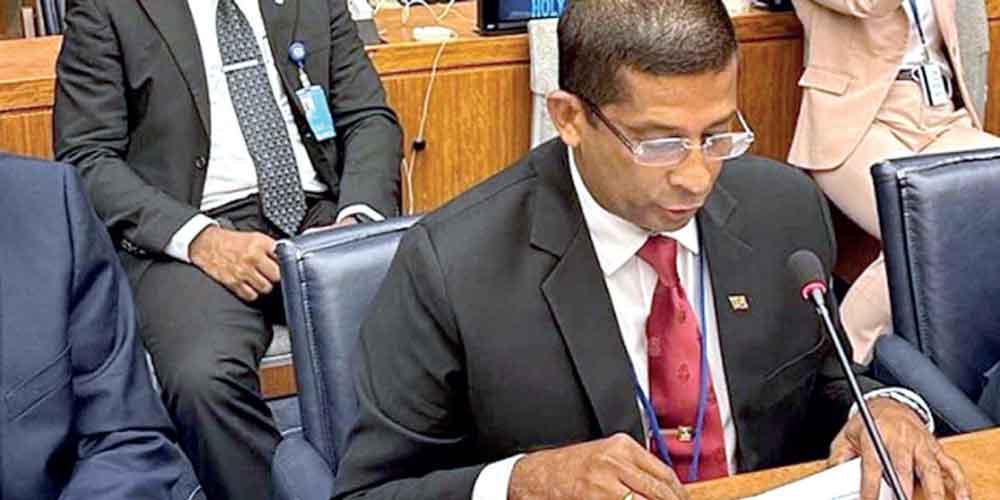
The detention of former maj. gen. Suresh Sallay remains highly controversial
 The idea that nine Islamist suicide bombers had blown themselves up, after pledging allegiance to the Islamic State, to bring to power a Sinhala nationalist as the head of the state is a plot worthy of Orwellian Doublethink.
Ignorance is strength.
However, when the theatre of the absurd becomes a legal argument and is pursued ever more judiciously, solely based on a statement by a dubious asylum seeker, it leaves more questions than answers about the integrity and competence of everyone involved.
The detention of former head of military intelligence Major General Suresh Sallay, now past 100 days under the Prevention of Terrorism Act (PTA), stems from this perverted logic.
The PTA, as a legal instrument, lost its utility when the war ended, and should have been replaced long ago with a new act compatible with modern anti-terrorism legislation, with sufficient checks and balances and judicial oversight.
That being apart, a lopsided local investigation into the Easter Sunday attack risks internationalising domestic conspiracy theories. Potential international consequences would be devastating.
For a starter, the Easter Sunday attack is not a purely domestic tragedy. Among its 279 fatalities, there were 45 foreign nationals belonging to at least 14 countries. Over 500 were wounded, including dozens of foreign nationals. Leading international investigative agencies—FBI, Scotland Yard, Australian Federal Police, Interpol, etc.—conducted their own investigations into the attack.
On December 20, 2020, the FBI, in an extraordinary affidavit submitted to the District Court of Central California, identified Zahran Hashim as the ‘mastermind of the Easter Sunday attack and the self-proclaimed leader of ISIS in Sri Lanka’.
Alongside Zahran, the FBI implicated three other individuals: Mohamed Naufar, ‘the second emir of ISIS in Sri Lanka, who allegedly led propaganda work and recruited members to ISIS, Mohamed Anwar Mohamed Riskam, who allegedly manufactured IED and Ahamed Milhan Hayathu Mohamed, who allegedly killed a police officer in Vavunathivu.
Similarly, the Australian Federal Police concluded its investigations. When CID sought its assistance, AFP informed that” there are no ongoing investigations by the AFP into the 2019 Easter Sunday attack.’
There was also a series of presidential commissions and inquiries into the Easter Sunday Attack. They include: The select committee of Parliament to look into and report to Parliament on the Easter Sunday Attack submitted on October 23 2019, The commission of Inquiry Report, The Special Investigation Board Report by Justice Vijith Malalgoda, The Commission of Inquiry Report by Justice Imam into allegations made in the Channel 4 Documentary, The commission of inquiry report into intelligence coordination and investigative process by Retired Judge A.N.J. de Alwis and Sectoral Oversight committee on National Security Report ( February 2020).
Each of these investigations provided useful insights, and all in general held the political leadership and the leadership of intelligence agencies responsible for their failure to act on prior intelligence warnings. Yet, none found, even remotely, a nexus between the military intelligence and the Easter Sunday attacks.
Notwithstanding all these local and international investigations, the NPP government seemed to believe in a discredited statement by asylum seeker Asad Maulana to Channel 4, a British broadcaster.
The CID’s entire investigation hangs on that self-contracting statement by Maulana.
The integrity of the CID’s crown witness itself is subject to question. Maulana faces two warrants against money laundering, and fled the country on a visit visa, only after the Gotabaya Rajapaksa administration was ousted by Aragalaya protests.
Serious contradictions
His statement also contains serious contradictions. He has claimed to have organised an alleged meeting between Suresh Sallay and Zahran at Karadippooval in Puttalam, though Sallay has claimed and immigration records confirmed that he was serving at the Sri Lankan High Commission in Malaysia at that time.
On the other occasion, Maulana claims Sally called him and asked him to transport an individual, whom Maulana suspects to be the failed suicide bomber, Jamil. However, records show Sally was in the Indian National Defence College at that time.
The Commission of Inquiry Report by Justice Imam into allegations made in the Channel 4 Documentary observed that every attempt to contact Maulana had failed, and that he had failed to appear before a cross-examination. The report noted, “His ( Maulana’s) allegations, therefore, lack the merit of being allegations tested by cross-examination.”
CID chief Shani Abeysekara is said to have met Maulana in the Sri Lankan embassy of France and obtained a statement. However, whether Maulana addressed the irregularities of his channel 4 testimony is not clear.
The politicisation of the Easter Sunday attack would have far-reaching consequences beyond Sri Lanka. Implicating the state agencies for the attack, no matter how lopsided domestic investigations could be, would lead to compensation claims against the Sri Lankan state by the families of foreign nationals killed and maimed in the Easter Sunday attack. Reputational damage for the Sri Lankan armed forces and the state itself would be immense.
The government might be slow to understand the potential drawback of this ill-advised manoeuvre. However, it would be the Sri Lankans as a whole who face the blowback.
There is already an attempt to defame the Army’s intelligence.
The primary grouse seemed to be rising from an alleged attempt by the military intelligence to implicate two former LTTE cadres for the murder of a policeman in Vavunathivu. Those allegations surely raise serious concerns, though the question before is far more serious than planting evidence to obtain a detention order.
Probably, any investigation into the lead-up to the Easter Sunday attack should probe the manifest failure by the CID, TID and Police to follow up on the discovery of a haul of explosives and detonators in a plantation in Wanathawilluwa, along with four suspects. It was the explosives and detonators from the same site, which had already been moved elsewhere, that were used in the Eater Sunday attack. The other incident worth investigating is the vandalism of Buddhist statues in Mawanella and the subsequent arrest and release of four suspects, including two sons of a leading Mavlavi.
The charges that the military intelligence paid the Pillayan faction or the Karuna faction, or, for that matter, EPDP, PLOTE military wings during the height of the war are cheap publicity stunts for domestic consumption. Such partnerships are required by the very nature of military intelligence work, and any intelligence agency worth its salt maintains such relations.
Last but not least, here is the mother of all concerns. The Easter Sunday attack may not be the last Islamist terrorist attack in Sri Lanka. No country in the world that suffered under Islamist extremism had managed to confine it to a one-off incident. Anyone who undermines the military intelligence, which is the most efficient intelligence agency of all in Sri Lanka and national security at large, will have much to answer for one day when history repeats itself.
Follow @RangaJayasuriya on X