31 Jan 2026 - {{hitsCtrl.values.hits}}
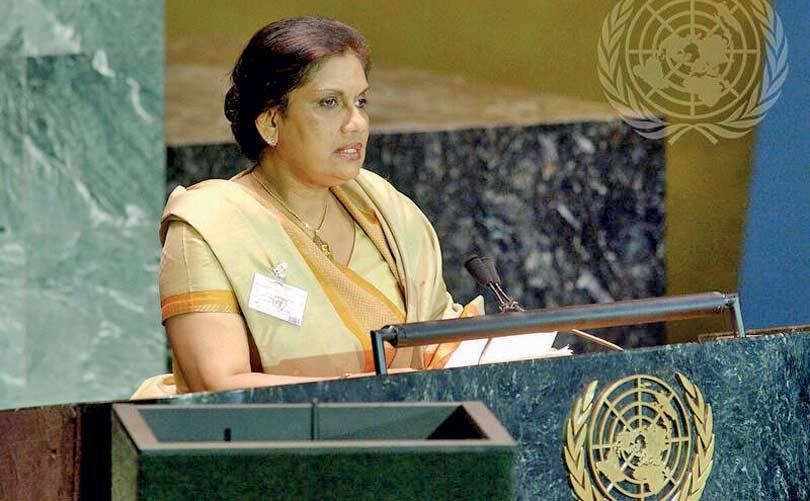
It was only President Chandrika Kumaratunga who managed to present a complete new draft Constitution in 2000 (UN Photo)
 In Sri Lanka, except for two major Constitutional overhauls in 1972 and 1978, all other attempts to amend or repeal the existing Constitutions have ended up in crises, compelling the governments of the day in most cases to abandon those attempts. The 13thAmendment to the Constitution was adopted in 1987 amidst a huge political turbulence which intensified the armed conflicts in the southern and northern parts of the country
There are several promises which the National People’s Power (NPP) gave during the last Presidential and Parliamentary elections, but cannot keep as a government -- at least for the moment. One of them is replacing the current Constitution with a new one.
Nine months have elapsed since Prime Minister Dr. Harini Amarasuriya told parliament that her government has two urgent priorities before commencing the process of formulating a new constitution for the country.
While answering a question by Ilankai Thamil Arasu Katchi MP Shanakiyan Rasamanickamon on April 9 2025 as to when a new constitution will be drafted since it was one of the main election pledges of the NPP, Dr. Amarasuriya said the government, when it came to power last year, was fully focused on stabilising the economy and ensuring democracy in the country by conducting the elections that were delayed.
She asserted that the new government was currently working on stabilising the economy, while noting that two elections have been held during the previous six months, while another election was be held in May. The Prime Minister said the provincial council election is also due since several years, and the government will commence the process to drafting a new constitution once the provincial council election is held.
Her observation on the economy was not wrong then, despite the NPP leaders time and again making highly positive remarks on the economic situation in the country. One cannot contest her contention that the government cannot embark on a Constitutional reform process at a time when the economy is in a fragile situation, as such reforms might lead to political upheavals.
Two major overhauls
In Sri Lanka, except for two major Constitutional overhauls in 1972 and 1978, all other attempts to amend or repeal the existing Constitutions have ended up in crises, compelling the governments of the day in most cases to abandon those attempts. The 13thAmendment to the Constitution was adopted in 1987 amidst a huge political turbulence which intensified the armed conflicts in the southern and northern parts of the country.
All attempts to solve the ethnic conflict in the country engulfed in controversies and led to tensions among communities. The NPP government, too, cannot bring in Constitutional reforms without addressing the ethnic issue; hence, such reforms are likely to create political instability in the country. Therefore, the Premier’s assertion on embarking on Constitutional reforms amidst economic instability cannot be contested. However, months after her statement, the NPP leaders are now boasting about bringing about economic stability, indicating the possibility of venturing into serious issues such as Constitutional reforms. On the other hand, holding the provincial council elections is not a prerequisite for initiating the drafting process of the new Constitution. Also, the government does not seem to have any plan to conduct provincial council elections in the coming months.
The Government cannot trivialise now the importance of introducing a new Constitution in spite of the process having a possibility of threatening its survival. Every party that assumed power since the early nineties has promised new Constitutions with special emphasis on abrogation of the executive Presidency, a simple and fair electoral system and resolution of the ethnic problem. Some parties have made at least ill-conceived attempts after assuming office to introduce piecemeal amendments to the Constitution with regard to these three issues – executive Presidency, electoral reforms and the ethnic problem. They in total have appointed dozens of committees, Parliamentary select committees and experts’ panels for this purpose, spending billions of rupees of public money.
New draft constitution in 2000
It was only President Chandrika Kumaratunga who managed to present a complete new draft Constitution in 2000 despite her government not having the two thirds majority to enact it in Parliament. However, the main Opposition, the United National Party (UNP) rejected it and its members set the copies of the draft on fire within the chamber of the Parliament.
The Maithri-Ranil government in 2016 converted the Parliament into a Constitutional Assembly in order to draft a new Constitution. A report was compiled by a committee headed by Attorney-at-Law Lal Wijenayake after public consultations across the country, and six subcommittees comprising the MPs of both the ruling party and the Opposition were formed to compile sector-wise proposals. A Steering Committee headed by Prime Minister Ranil Wickremesinghe finally was to give legal form to those proposals. However, the Steering Committee presented an interim report to the Parliament which itself sabotaged the entire exercise.
The report described Sri Lanka as “Aekeeya Rajyaya” in Sinhala and “Orumiththa Nadu” in Tamil. The two terms were very clearly conflicting and nationalist forces among both Sinhalese and Tamils rejected it as sheer deception.
The NPP in its manifesto titled “A thriving Nation, A beautiful life” presented in 2024 gave much emphasis on the party’s proposed new Constitution. Despite the impression made by the NPP that it would introduce a new Constitution immediately after its assumption to power, Health and Media Minister Dr. Nalinda Jayatissa told media in December 2024 that the new Constitution would be introduced only after three years.
Nevertheless, Justice Minister Harshana Nanayakkara told media in the same month that drafting of the new Constitution would be initiated in January, 2025. It was against that backdrop that the Prime Minister told in April last year that process of drafting a new Constitution would be initiated after the provincial council elections. Then again, Prime Minister Amarasuriya responding to a question raised by Samagi Jana Balawegaya (SJB) MP Ajith P. Perera stated in Parliament on July 25 last year that initial steps are being taken to introduce a new Constitution which would be introduced before the term of the present government ends (not in three years). Dr. Amarasuriya made a brief explanation on the progress of the process of Constitution making on December 19 last year. Responding to a question by Opposition Leader Sajith Premadasa in Parliament, she said that at present, reports of committees previously appointed to draft a new Constitution, along with other constitutional reform proposals, are being considered. Thereafter, a basic concept paper will be submitted to the Cabinet of Ministers. However, she did not elaborate as to who considers previous committee reports.
Only civil society and the media would be able to exert pressure on the government to expedite Constitutional reforms, as the Opposition parties have hoodwinked the masses over it during every past election. Sincerity of members of those parties that alternately supported the 17th, 18th, 19th, 20th and 21st Amendments to the Constitution, which had mutual negating effects, would definitely be questioned.
Against this backdrop, efforts are being made by One Text Initiative (OTI), a civil society group, to present a model Constitution by the end of 2027 by perusing all past and present Constitutions and relevant reports with the assistance of an AI device. The group is planning to hold its first public interaction on February 3 at the BMICH.
25 Jun 2026 7 hours ago
25 Jun 2026 7 hours ago
25 Jun 2026 7 hours ago
25 Jun 2026 8 hours ago
25 Jun 2026 8 hours ago