25 May 2026 - {{hitsCtrl.values.hits}}
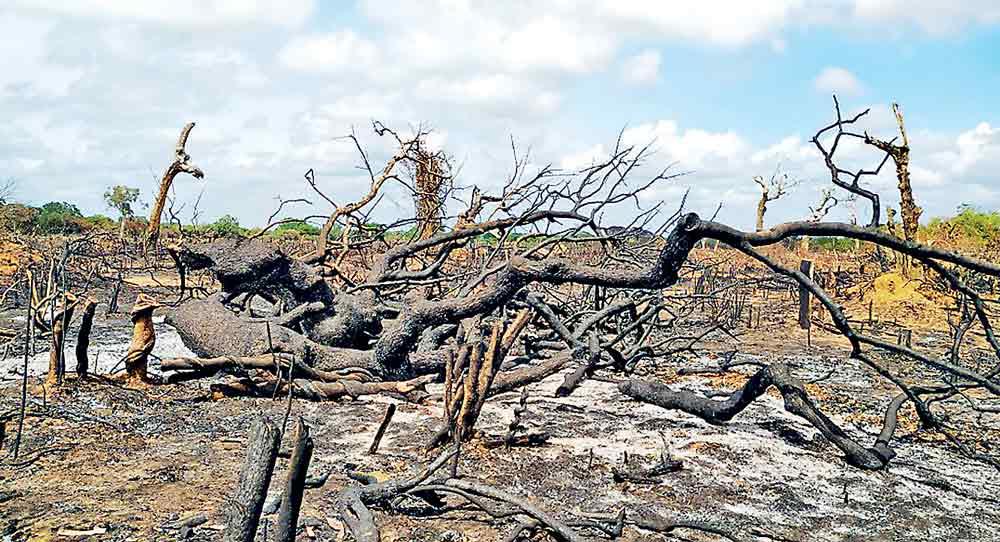
Despite Sri Lanka’s pledges at the UN, deforestation continues unabated
 Despite the global significance of this resolution, it has not generated substantial public attention in countries like Sri Lanka, which are already experiencing severe impacts of climate change

The United Nations General Assembly on Wednesday, May 20, 2026, voted 141–8 to adopt a landmark resolution endorsing the advisory opinion of the International Court of Justice (ICJ), which states that States have a legal obligation to address climate change. It is indeed a powerful pronouncement on international law, climate justice, and science.
The resolution was initiated by the Pacific island nation of Vanuatu, one of the countries on the frontline of the climate crisis. Following intense negotiations and discussions surrounding several proposed amendments, the resolution was adopted with 141 votes in favour, eight against, and 28 abstentions. The countries voting against were the United States, Russia, Israel, Saudi Arabia, Iran, Belarus, Liberia, and Yemen. It is noteworthy that Sri Lanka was among the 141 countries that voted in favour.
When the International Court of Justice ruled in July 2025 that states have an obligation to protect the environment from greenhouse gas (GHG) emissions, the decision attracted widespread attention as a major breakthrough in the global fight against climate change. UN Secretary-General António Guterres described it simply as “a victory for our planet.” The Court further ruled that if States breach these obligations, they may bear legal responsibility and could be required to cease the wrongful conduct, provide guarantees of non-repetition, and make full reparations, depending on the circumstances.
Although ICJ advisory opinions are not legally binding, they carry considerable legal and moral authority by helping to clarify and develop international law and define States’ obligations. The General Assembly’s adoption of the resolution following the ruling sends a strong message that addressing the climate crisis is a legal duty under international law, rather than merely a political choice.
The resolution calls on all UN Member States to take all possible measures to avoid causing significant harm to the climate and environment, including emissions generated within their territories, and to fulfil their existing commitments under the Paris Agreement. Governments are urged to cooperate in good faith, strengthen global coordination in tackling climate change, and ensure that climate policies safeguard fundamental human rights, including the rights to life, health, and an adequate standard of living.
In a statement released after the General Assembly vote, António Guterres declared that those least responsible for climate change are paying the highest price. He further stated that the path to climate justice “runs through a rapid, just, and equitable transition away from fossil fuels toward renewable energy.” The UN Secretary-General also noted that renewable energy has proven to be the cheapest and most secure form of energy and that the goal of limiting global warming to 1.5°C above pre-industrial levels remains within reach.
Despite the global significance of this resolution, it has not generated substantial public attention in countries like Sri Lanka, which are already experiencing severe impacts of climate change. Public understanding of climate-related issues remains limited. Concepts such as mitigation, adaptation, loss and damage, and Nationally Determined Contributions (NDCs) are often perceived merely as technical jargon. Although Sri Lankans experience the impacts of climate change in their daily lives, this knowledge gap hinders the ability to connect these hardships to the broader climate crisis.
One of the most recent examples is the Cyclonic Storm Ditwah, which left a major humanitarian crisis in its wake. Cyclone Ditwah demonstrates how even a moderate-intensity cyclone can cause disproportionately severe impacts — in this case, estimated at USD 4.1 billion — when intense rainfall and slow translational speed combine to trigger severe flooding and widespread landslides. Climate change is creating conditions that increase the likelihood of such destructive storms.
At the same time, this UN vote reflects the contradictory stance of the Sri Lankan government. While presenting an environmentally responsible image to the international community, it continues to facilitate the destruction of the country’s remaining forest cover. This contradiction is particularly evident against the backdrop of Sri Lanka’s Nationally Determined Contributions 3.0 (2026–2035), submitted in September 2025, which pledged the restoration of forest cover and degraded lands to at least 32% by 2035. Despite these commitments, deforestation continues across different parts of the country.
For example, 17 companies have illegally cleared nearly 1,000 acres of elephant habitat in the Seenukkugala, Orukengala, and Kapapuwewa areas within the Hambantota Divisional Secretariat Division, along the boundary of the Hambantota Managed Elephant Reserve, and have commenced the construction of large-scale solar farms. Similarly, authorities have still failed to halt the extensive deforestation taking place in the Wandama–Demaliya forest area, which was intended to be declared a Managed Elephant Reserve.
Instead, plans have been made to allocate a further 250 acres of the Kadawarawewa forest area for paddy cultivation. Furthermore, although a proposal was due to be presented at the Ampara District Special Coordination Committee meeting attended by the President to release 4,000 acres from the Wattamaduwa forest and grasslands belonging to the Bakmitiyawa forest in Ampara for paddy cultivation, it was temporarily hidden at the last moment.
Therefore, if the Sri Lankan government genuinely intends to uphold the principles it endorsed through its vote at the United Nations General Assembly, it must move beyond symbolic international commitments and translate them into meaningful action on the ground. Adhering to the spirit of the UN resolution, as well as landmark judicial decisions such as the Nakolagane Forest Case (SCFR 351/22), requires strengthening forest conservation, preventing environmentally destructive development projects, and recognising ecosystems as critical safeguards for both biodiversity and climate resilience.
Protecting forests, elephant habitats, wetlands, and other natural landscapes is not merely an environmental obligation but an essential investment in the country’s long-term ecological security, economic stability, and human well-being. At a time when climate change is intensifying disasters and threatening vulnerable communities, Sri Lanka must choose a path grounded in science, environmental justice, and sustainable development to ensure a truly resilient and sustainable future for generations to come.
10 Jul 2026 11 minute ago
10 Jul 2026 20 minute ago
10 Jul 2026 58 minute ago
10 Jul 2026 1 hours ago
10 Jul 2026 2 hours ago