04 Oct 2016 - {{hitsCtrl.values.hits}}
It is widely known that children struggle with reading. Reading is a key factor which determines literacy rates.
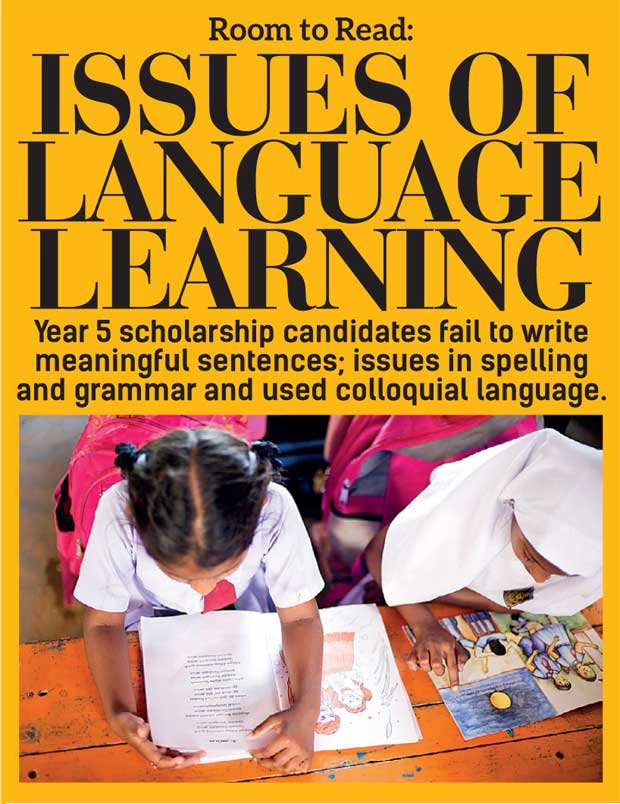
Though according to World Bank reports Sri Lanka has a 91% adult literacy rate and a 98% youth literacy rate, children have shown less enthusiasm in reading and this has affected educational performance. A report by the Research and Development Branch of the Department of Examinations states that 71.6% of candidates have not scored a single mark in the essay question of the 2015 Grade 05 Scholarship Examination because students had failed to meet the specified requirements.
Accordingly candidates have failed to write meaningful sentences. There have been issues in spelling and grammar, while candidates have used colloquial language. Candidates have also displayed a misunderstanding as there has not been a connection between the sentences written and the essay topic. This raises concern about children’s writing skills and language competency.
Experts are skeptical of the approach widely adopted in our schools to teach reading. In this system early primary school children ‘discover’ letters and words in passages. The purpose is to first  familiarise them with the word and then offer an explanation.
Known as the ‘whole language approach’ experts have equalled this method to random learning as children may or may not know the meaning of the word, when they read the passage. This is contrary to the phonics based approach, where letters and words are systematically taught to the child. Research proves that the phonics based approach is the most effective method to teach language.
Room to Read is a US based Non Profit global organisation which promotes education by focusing on language and gender equality in education.
It has proposed and adopted a phonics based approach to teach language in rural schools in Sri Lanka. The approach adopted is scientific evidence based and it has produced good results worldwide
Speaking to the Daily Mirror the Director of ‘Room To Read’, Arumugam Selvendran said that research had found that the whole language approach was not appropriate for language teaching. “This is random learning. Here children with higher IQ learn better as they can remember well. We should cater to all the children in the class equally,” he said.
‘Room To Read’ mainly focuses on language in primary grades. There are 419 schools under their programme and currently 56, 951 students benefit.
‘Room To Read’ also assists libraries by making them more dynamic so that reading would appeal to the eye of a child.
Research has shown that reading 45 words per minute is the basic number of words per minute a child needs to be able to read and understand to become fluent.
‘Room To Read’ assisted schools have an average of 51.4 words per minute compared to unassisted schools, which have an average of 31 words per minute. An evaluation conducted in October 2015 has shown that children read faster and with greater comprehension when they learn from systematic reading instruction that focuses on phonics.
Apart from the books provided by the government the organisation provides supplementary pupil books and letter cards. As the approach of teaching language by the organisation differs to the mainstream method found in schools, the organization needs different books.
Elaborating on the difference between the mainstream method (whole language approach) and the phonics based approach Selvendran said that their instructional design was based on several researches done on language instructions.
“Our teaching method is very explicit. In the whole language approach children randomly learn words. But in our approach we focus on individual sounds. We teach every sound. We’re working on Sinhala and Tamil. We analyse the nature of the language, the phonics of each language, how it is organized, the frequency of the phonics and we have come up with a letter sequence that is used in teaching,” Selvendran said.
Room to Read is currently working in Anuradhapura, Moneragala, Badulla, Vavuniya, Nuwara Eliya, Matale, Colombo, Mannar, Puttalam and Trincomalee. The organization urges the government to adopt a phonics based approach in schools.
29 Jun 2026 18 minute ago
29 Jun 2026 38 minute ago
28 Jun 2026 8 hours ago
28 Jun 2026 28 Jun 2026