13 Sep 2025 - {{hitsCtrl.values.hits}}
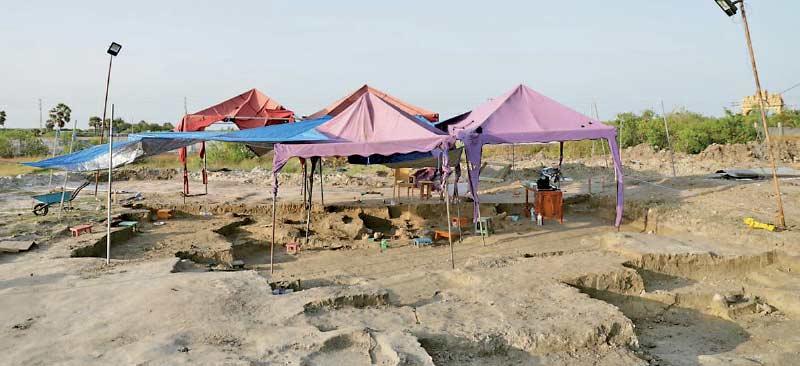
Despite unearthing of mass graves like Chemmani in the North, the government has rejected the UN call for an international mechanism of accountability for human rights violations
The National People’s Power (NPP) government has rejected the decade old recommendation by the UN High Commissioner for Human Rights Volker Türk to establish an international mechanism for accountability for human rights violations committed during the war between the armed forces and the Liberation Tigers of Tamil Eelam (LTTE).
The high commissioner’s latest recommendation came in his annual report on Sri Lanka and Foreign Affairs. Minister Vijitha Herath rejected it on September 8, the first day of the 60th Regular Session of the United Nations Human Rights Council (UNHRC).
Minister Herath instead told the council that Sri Lanka is committed to establishing a domestic mechanism for the purpose, a commitment made by several past governments as well. He was of the view that an international mechanism would undermine ongoing domestic efforts to ensure justice and reconciliation, thus signaling that the NPP government would reject the resolution on Sri Lanka’s human rights situation that is to be presented to the council later at the session, as it did last year.
Unlike the governments headed by Rajapakses, rejection of a resolution on human rights violations by a government led by a party that has been a victim of two bloody suppressions in recent history, sacrificing over 70,000 of lives of its supporters and sympathisers is an irony. It was said that over 10,000 people were killed in the first insurrection of the Janatha Vimukthi Peramuna (JVP), the prime constituent party of the current ruling NPP in 1971, and over 60,000 had perished during their second insurrection in 1988/89.
Although the NPP had opposed the foreign interventions in Sri Lanka’s human rights issues, Lord Avebury visited Sri Lanka, then Ceylon, on behalf of Amnesty International, in the aftermath of the JVP’s first insurrection, to report on the human rights situation in the island -- interestingly at the invitation of former Parliamentarian the late Prince Gunasekara, a prominent JVP supporter.
However, the foreign interventions in Sri Lanka’s human rights issues now creates survival issues to the NPP. This was very clear when the NPP government had to face a UNHRC resolution at a time between the Presidential election and the Parliamentary election last year. The candidate of the party Anura Kumara Dissanayake had managed to get only 42 percent of votes at the presidential election creating doubts in NPP leaders if they would be able to get a simple majority at the Parliamentary election.
The UNHRC met in Geneva for its 57th regular session at such a precarious time for the NPP where it was so careful not to hurt the sentiments of the majority Sinhalese and thus the rejection of the UNHRC resolution on Sri Lanka by the new NPP government was obvious. It did not seem to be a matter of principle, but a matter of survival.
Similarly, in spite of the NPP government being armed with a two thirds majority in Parliament now, its popularity at the grass-root level has not been firmly established. It was not political literacy but an urge instilled by an unprecedented economic crisis that prompted a large majority of people who did not vote for the NPP in 2019 to vote for it last year. The mindset of the voters was shaped up also by the slogans of the “Aragalaya” of 2022.
Hence, the NPP is maintaining a vulnerable support base which is evident from the difference between the results of the last Parliamentary election and the recent local government elections. Their support base has shrunk from 62 percent to 43 percent, indicating that the party is faced with a survival issue. It is not in a position to make radical decisions, especially in respect to the ethnic problem.
Minister Herath’s argument that an international mechanism would undermine reconciliation efforts can hardly be contested. Once investigations begin into war-time actions by individual members of the armed forces, especially by any popular commander, Sinhala and Tamil media would report them in a manner that would pacify their audiences, as happened during the war, leading to further divisions. However, the outcome of investigations by a domestic mechanism would also hardly be different.
The reactions by Sinhala and Tamil leaders to the idea of an international mechanism indicates their presumption that only the armed forces had violated human rights during the war. Yet, the report of the investigation conducted by the Office of the High Commissioner for Human Rights in 2014 on violation of human rights during the separatist war accused the LTTE as well as the armed forces alike for killings, abductions, torture and other crimes. Subsequent to the release of the report in 2015, TNA leader the late R. Sampanthan in a statement said Tamils have to admit that crimes have been committed in their name.
Though the fact that justice has to be meted out to victims of a war is undeniable, it is ludicrous to see Western countries expressing concerns over human right violations in countries like Sri Lanka, while supplying thousands of bombs to Israel to carry out its genocidal campaign in Gaza and legitimising that genocide.
However, the NPP government also seems to be attempting to act differently from past governments regarding the ethnic problem. It facilitated the excavation of Chemmani mass graves from which over 200 human skeletal remains have been exhumed so far. It also facilitated the UN human rights chief’s visit to Chemmani during his Sri Lanka tour in June, ignoring protests by some southern politicians.
Yet, some Tamil politicians and certain ultra-leftist groups in the south accused President Dissanayake for his failure to visit those mass graves during his visit to Jaffna District this month. If he had gone there, the same critics might portray it as a media show, though such a visit might antagonise the southern people. Nevertheless, in a balancing act, the government is set to excavate Kurukkalmadam area in Batticaloa District where bodies of 167 Muslims who were killed by the LTTE while returning from the Haj pilgrimage in July, 1990 are believed to have been buried.
Dissanayake also attempted to address another sensitive issue that the northern Tamils are faced with during his Jaffna tour. He visited Kachchathivu Island which is closely associated with Indian fishermen’s poaching in Sri Lankan seas. The visit follows a statement by Tamil Nadu film star Vijay who at a recent rally in Madurai had claimed India’s ownership to the island. The President seemed to want to send a counter message to Vijay by his visit to Kachchathivu.
11 Jul 2026 59 minute ago
11 Jul 2026 4 hours ago
11 Jul 2026 4 hours ago
11 Jul 2026 7 hours ago
10 Jul 2026 8 hours ago