22 Aug 2016 - {{hitsCtrl.values.hits}}
There is a need to broad base and further intensify the process of public education on the reconciliation process as knowledge about what the government is proposing to do is not well known at the community level. This has left open a vacuum of knowledge that can be filled by nationalist propaganda and inaccurate information that can reduce the public support for the transitional justice process. This is evident in the ongoing debate on the Office of Missing Persons (OMP) that is to be set up by the government. The OMP is one of the four domestic mechanisms the government undertook to set up at the UN Human Rights Council meeting in September 2015 in response to the international pressure for Sri Lanka to agree to international mechanisms to ensure accountability for war crimes and serious human rights violations. The other three mechanisms are a truth commission, an office of reparations and a special court.
The passage of the OMP bill in parliament without a vote demonstrated that the government’s solid majority in parliament that comes from the UNP-SLFP alliance has given it decision making power that the opposition has no answer to. With the SLFP component of the government falling in line with President Sirisena’s support for the OMP bill, there was an overwhelming parliamentary majority ready to vote in favour of the bill.
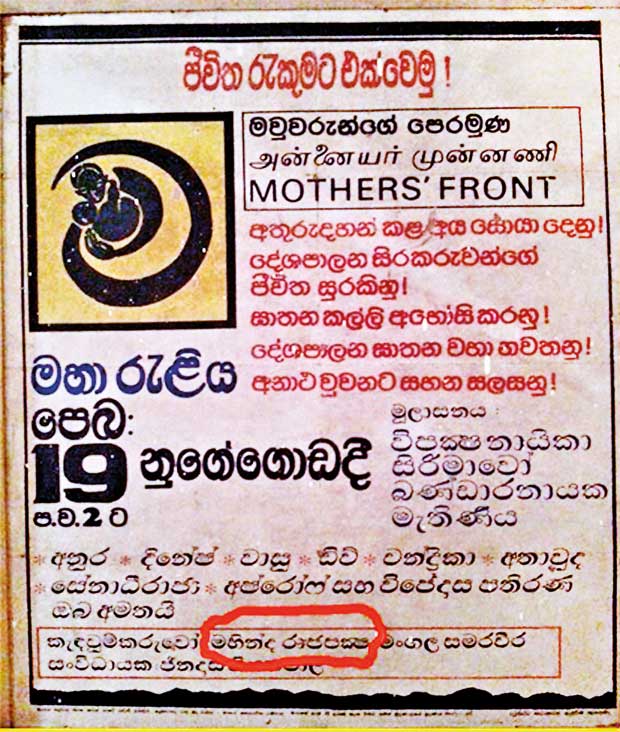 Former President Mahinda Rajapaksa, as an ordinary opposition MP, calling for a meeting of the Mothers Front, an umbrella group of organizations that supported the rights of victims during the period of the JVP insurrection at the end of the 1980s and early 1990s
So long as the government leadership, in particular the President and Prime Minister, are united on any matter it will not be possible for the opposition to stall them in parliament. The Joint Opposition was numerically too small to stand in the way of the passage of the bill through a vote. This may explain why they took the rowdy alternative in parliament. Not only did they fail to utilize the opportunity to debate the bill, propose their amendments if any and thereby educate the general public. They also lost the opportunity to vote as they were too busy demonstrating when the vote took place.
It was unfortunate that those who were human rights champions in the 1980 and 1990s, and widely admired for this, displayed their opposition to OMP by word and deed. A widely circulated poster on social media was of former President Mahinda Rajapaksa, who was then an ordinary opposition MP, calling for a meeting of the Mothers Front, an umbrella group of organizations that supported the rights of victims during the period of the JVP insurrection at the end of the 1980s and early 1990s. The underlying rationale of the OMP is not much different from the message on the poster that former president Rajapaksa was bold enough to put out two decades ago. It is that people, whatever their ethnicity or political affiliation, need to know what happened to their loved ones so that they can stop the endless search for them.
The purpose of the OMP is to find out what happened to those missing that stretch back decades and the insurrections that took place in both the North and South of the country and were bloodily suppressed. The OMP is to help them to end the search, and to bring closure to that open wound that exists in the body politic. The OMP law constitutes a maximum effort that the Sri Lankan state can take to find out where they are if they are living and if not living what happened to them. This is why the law provides that evidence that is not admissible in courts of law is admissible in the OMP investigation. This is also why evidence that is confidential is permissible, which even the Right to Information Act cannot access. It is these provisions that the Joint Opposition has sought to make into a national security threat.
The OMP is a very important element of the country’s transitional justice process and the set of institutions and measures outlined by the government. But it is only one part of the process of transitional justice. After the successful passage of the OMP bill in parliament, government spokespersons have said that the government would set up a Truth Commission, a judicial mechanism to deal with accountability (and punishment) issues and an office of reparations. These additional mechanisms that the government has still to set up will offer more avenues for truth and accountability seeking. Truth, justice and reconciliation will be delivered via the totality of these bodies, and not just the OMP.
The swift passage of the OMP bill into law in parliament is a possible prototype for the reconciliation mechanisms that are to follow. Foreign Minister Mangala Samaraweera has said that the next mechanism that will be making its appearance will be the Truth Seeking Commission. The government is awaiting the outcome of the deliberations of the Consultations Task Force that it has appointed. The Consultation Task Force on Reconciliation Mechanisms (CTF) was appointed by the Prime Minister in January 2016 to conduct public consultations on the design of the four mechanisms that would advance truth, justice and reconciliation in
Sri Lanka.
So far the government has been focussing upon consulting with civic groups on the four proposed mechanisms. As knowledge about the government’s proposed reconciliation mechanisms has been limited the process of consultations has been necessarily limited to those groups that have some familiarity with the government’s proposed course of action. Civic groups particularly from the north and east have been in the forefront of making proposals, and critiques, of the government’s proposed mechanisms. One of the main critiques to emerge from the north and east is that the consultation process has not been sufficient. This has been articulated in the interim report of the Consultation Task Force which was entrusted by Prime Minister Ranil Wickremesinghe with gathering the views of  the public with regard to the reconciliation mechanisms.
The Consultation Task Force headed by veteran human rights activist Manouri Muttuwegama has already come out with a comprehensive and intensive report on the OMP mechanism. This report distils the experience of a wide range of persons affected by disappearances, including those who experienced the war in the North and East, families of servicemen missing in action, disappearances from the hill country Tamil Community, fishermen of all ethnicities who disappeared in waters in the North and East of Sri Lanka, disappearances attributed to the LTTE and other armed militant groups, or occurring in the context of the political violence of 1987-91 period.
The submissions made to the task force raised concerns about the lack of public awareness of the government’s intentions and objectives with regard to the reconciliation process and the OMP, and the lack of official information available on the consultations, which also impairs public participation. The lack of awareness on the OMP bill among victim families for instance contributes to their feeling of isolation and marginalisation by the government. Some submissions recognise the need for a public awareness campaign in the South to address the lack of awareness and to counter racist rhetoric.
The experience of civic organizations such as the National Peace Council (NPC) has been positive with regard to taking the message of the government’s plan with reconciliation to the general public. During the past several months NPC has been conducting dialogues and discussions at the district level with its partner organizations and their members who have included religious clergy from all four religions, school teachers and grassroots society members, on the concept of transitional justice. There is a general appreciation that the concept of transitional justice is a reasonable one and fair and essential by the larger society. More significantly, when they were asked to respond to questions, most agreed that the truth about the past needed to be ascertained. Almost an equal number agreed that those who committed crimes outside of their duties should be punished, and close to half of them had no objection to a hybrid court with international participation.
What was encouraging was the willingness of the participants to appreciate the need for a lasting political solution to the problem of the Sri Lankan state with the ethnic and religious minorities. Chairman of the Western Province Zonal Consultation Task Force Wasantha Kariyawasam, who chaired consultations with civic groups in Galle, Matara and Hambantota noted the openness of those who came before the task force to foreign judges to ensure a fair outcome in the judicial process. He also said that the people could relate to the problems of the war in the north and east by reference to their own experience of the JVP insurrection. He said that a list of 98 names of missing persons from the JVP era was given to the task force by the divisional government officer who had obtained the names from the village level officials.
During discussions with civil society groups, two key messages get highlighted. The first was the limited information available to the general population regarding these issues. There is an absence of strong and systematic messaging by the government at this time. So far what is taking place is a process of consultation with those who are more knowledgeable, and not one of mass education which needs to come at least in the post-consultation phase. Second, the message from the Tamil-speaking participants from the North and East is their scepticism about the ultimate outcome of the ongoing transitional justice process. This highlights the need for greater inclusion of such groups into the process and for trust building with them. The role of civil society in these circumstances in taking the message to the people and in ensuring a sense of participation is extremely important.
29 Jun 2026 34 minute ago
29 Jun 2026 35 minute ago
29 Jun 2026 37 minute ago
29 Jun 2026 39 minute ago
29 Jun 2026 49 minute ago