08 Jan 2026 - {{hitsCtrl.values.hits}}
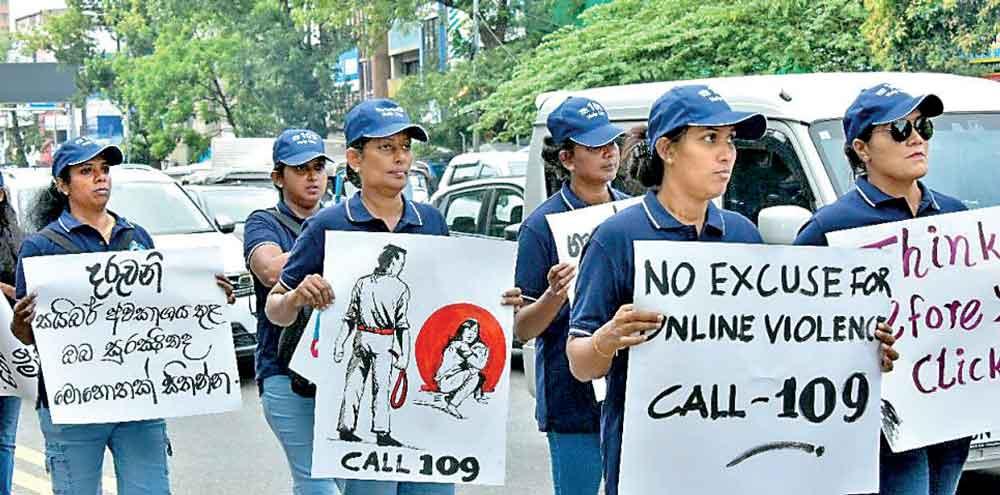
Protest march organised by Police Women and Children’s Bureau to raise awareness on online violence. Image courtesy - Sri Lanka Police
By Chamal Weerakkody
Digital platforms are now central to political campaigning in Sri Lanka. During the 2025 local elections, they offered a clearer view of how political engagement unfolds online, particularly for women in public life.
Drawing on Democracy Reporting International’s recent work on Sri Lanka’s 2025 local elections, analysis of Facebook and YouTube comments shared during the campaign period highlights how candidates were discussed on social media, the tone of those conversations, and the contrasting patterns of online responses directed at women and men in politics.
Social media is often viewed as a space that can broaden participation and diversify political debate. In practice, however, online engagement around women candidates frequently extends beyond policy positions, shifting instead toward personal and gendered lines of commentary.
A global pattern
Women who step into public political life face coordinated campaigns of online abuse designed to silence them. In Europe and Central Asia, a 2023 UN Women study across 13 countries found that 53 percent of women online had experienced technology-facilitated violence. Across the Asia-Pacific region, 60 percent of women parliamentarians report facing online gender-based violence. In Brazil, analysis of online content during the 2020 São Paulo mayoral election found that female candidates were targeted with substantially higher levels of abusive and sexist commentary on social media platforms than their male counterparts. This has documented persistent attacks on women candidates’ competence, appearance, and morality, while male candidates were more frequently discussed in relation to policies and political performance.
Similar findings emerged from another analysis conducted in the Middle East and North Africa. Analysing online political discourse across several countries, reveals that women politicians were disproportionately targeted with gendered insults, sexualised language, and threats of violence. The volume and nature of abuse contributed to self-censorship, with many women limiting their online engagement to avoid harassment.
Sri Lanka’s reality
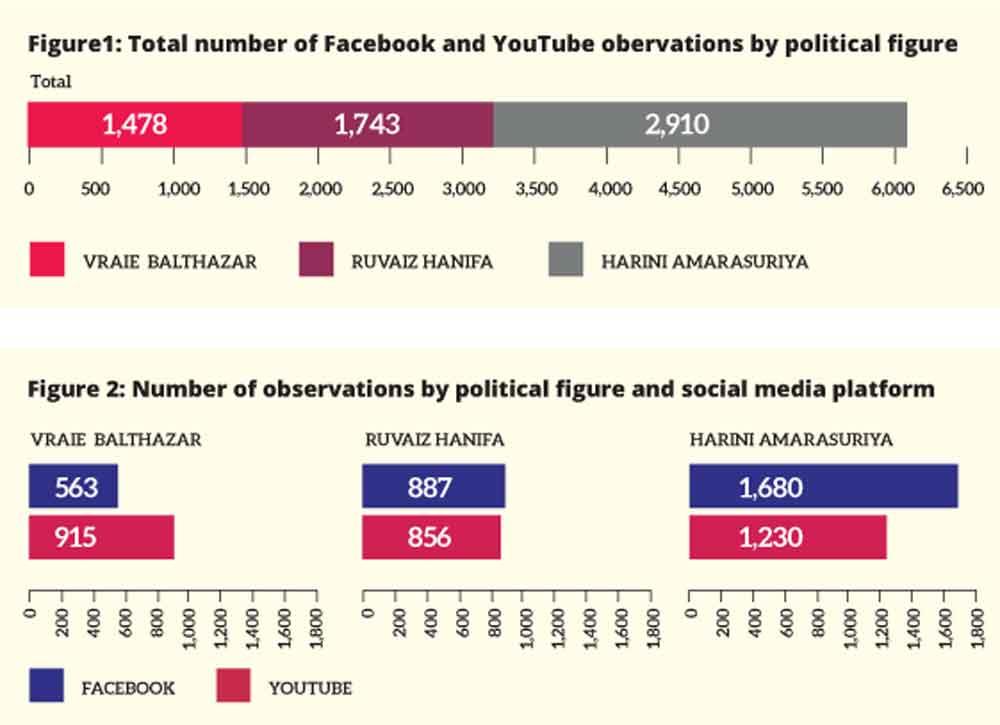
Sri Lanka’s 2025 local elections provide a clear picture of this issue. During the election period, over 6,000 comments observed on Facebook and YouTube referenced two then–Colombo mayoral candidates, Vraie Balthazar of the National People’s Power and Ruvaiz Hanifa of the Samagi Jana Balawegaya, alongside Prime Minister Harini Amarasuriya, whose prominence offered an important point of comparison in terms of visibility and exposure.
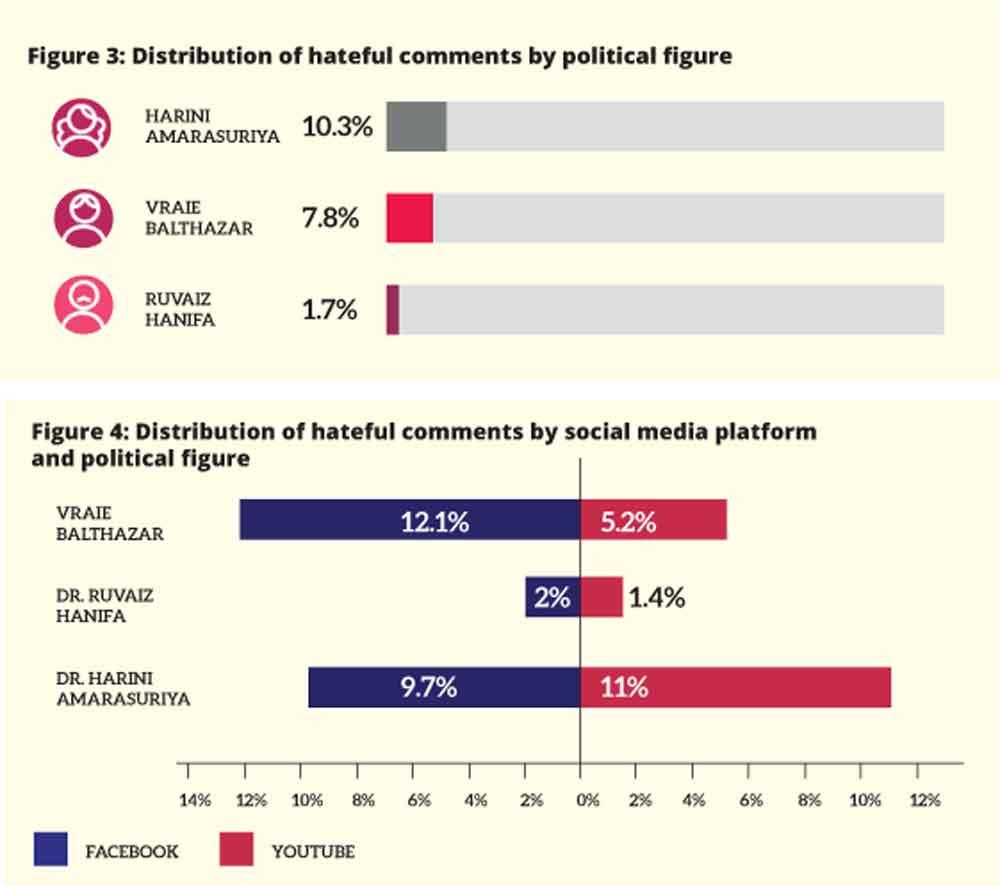
Among the mayoral candidates, a marked gender gap was evident in the tone of engagement. 7.8 percent of comments referring to Balthazar contained hate speech, compared to just 1.7 percent of comments targeting Hanifa. This disparity is held across platforms. On Facebook, 12.1 percent of comments about Balthazar were hateful, while only 2 percent of those referring to Hanifa fell into the same category. On YouTube, 5.2 percent of comments about Balthazar contained hate speech, compared to 1.4 percent for Hanifa.
Comparing these patterns with engagement around the Prime Minister highlights the scale of gendered targeting faced by women in highly visible leadership roles. Prime Minister Amarasuriya accounted for 47.5 percent of all comments observed. Of the comments about her, 10.3 percent contained gendered hate speech. This appeared across various platforms; 9.7 percent of Facebook comments and 11 percent of YouTube comments referring to the Prime Minister were hateful.
The nature of attacks was distinctly gendered and misogynistic. Online commentary frequently questioned their competence and suitability for leadership, drawing on long-standing gender stereotypes rather than political performance or policy positions. Women candidates were subjected to personal scrutiny extending into their appearance and private lives, including references to family roles, sexual orientation and parenting. In some instances, the abuse took a sexualised form, using derogatory language to undermine legitimacy and authority. By comparison, while the male candidate examined also attracted hostile comments, these were more closely linked to ethnic and religious identity.
Why this matters
Online gender-based violence (OGBV) has implications beyond individual candidates. In Sri Lanka, women make up just over 52 percent of the population, yet hold fewer than 10 percent of seats in Parliament, with similar gaps visible across other political spaces. When women reduce or withdraw their political participation in response to sustained online abuse, this imbalance deepens, and communities lose potential leaders as well as a diversity of perspectives and lived experiences that are essential to decision-making and policy formulation.
OGBV reshapes political debate. As online discussion shifts from policies and public issues to attacks on women’s legitimacy and right to lead, voters are left with less substantive information on which to make informed choices, weakening the quality of democratic decision-making.
The 2025 Media Guidelines issued by the Election Commission of Sri Lanka include provisions against content that promotes or incites hatred. Social media platforms’ own terms ban hate speech. Yet the DRI research shows that these protections are not always effective in online spaces.
What must change
These findings point to the need for concrete action. The Election Commission must move beyond guidelines to active enforcement, working with social media platforms to ensure the timely removal of hateful content and explicitly incorporating protections against online gender-based violence into electoral frameworks.
Social media platforms must strengthen content moderation for timely detection and removal of hateful content, with community guidelines available in Sinhala and Tamil. The current gap, where AI tools trained in English fail to detect hate speech in local languages, creates a threatening double standard.
Political parties help set the tone by making clear that OGBV has no place in electoral competition, while Civil society organisations and journalists play a role in documenting and examining patterns of OGBV. Media outlets shape public debate through editorial choices that prioritise policy over gendered narratives. Individual citizens also influence online spaces through what they choose to share, challenge, or report.
The choice before us
The 2025 elections revealed both promise and peril. Women are more visible in politics than ever, yet this increased visibility has come with a steep cost—systematic online attacks targeting their competence, appearance, and right to lead.
We face a choice. We can allow OGBV to roll back decades of progress toward political equality, or we can recognise that protecting women’s right to participate online is protecting democracy itself. The question is whether we have the collective courage to make it happen.
11 Jul 2026 12 minute ago
11 Jul 2026 31 minute ago
11 Jul 2026 51 minute ago
11 Jul 2026 1 hours ago
11 Jul 2026 1 hours ago