14 Mar 2025 - {{hitsCtrl.values.hits}}
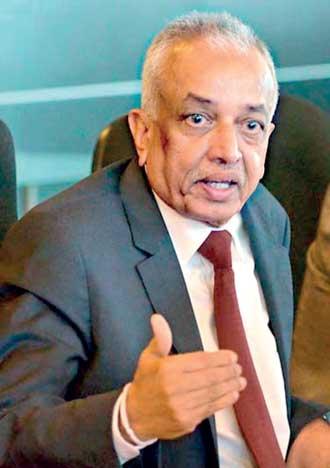
Former Minister of Development Strategies and International Trade Malik Samarawickrama, who has now retired from politics, remains optimistic about the current government. Samarawickrama, in an interview with the Daily Mirror, said that the Government’s actions show that they are on track and that the people shouldn’t expect the regime to deliver overnight. He also reiterated the fact that there are enough promising young people in the opposition from all parties and that they must get together and form an alliance. Excerpts of the interview:
“The fact is that it is now established that the current leadership- current President, the Prime Minister, the Ministers and MPs of the ruling party are not corrupt. That I think everybody knows. So now they have to ensure it goes down and gradually make sure that even at the lowest level, corruption is eliminated. I think they can do it if they set a good standard.
They’re looking at free trade agreements. They’re looking at the Economic Transformation Act with some amendments. I think the new economic commission and the zone management company is a step in the right direction. On the side of exports and investments, I think they have taken the right policies
QHow do you look at the phenomenal change in Sri Lankan politics as someone involved in politics with the United National party (UNP) and Samagi Jana Balawegaya (SJB)?
I was not really involved with SJB as such. I was involved with the UNP. That is true. So when the party split, that’s the time I also decided to quit politics.
 Q Is there a change in politics in Sri Lanka with a novel force in power?
I think the people had got fed up with the previous regimes, mainly because of corruption. Corruption has reached a very high level and unfortunately nothing was being done to eliminate or at least reduce corruption.
So, the people probably realised that they had to change the system. They had to bring in new people. President Anura Kumara Dissanayake really appealed to the people. He went around the country and said the right things. That’s probably why they elected him as the President.
QYou were in active politics for long. How rampant was corruption?
Well it certainly was pretty bad. It started a long time back.
Q When did it really start?
Well I think with the open market economy, there was a bit of corruption, but it wasn’t that much. Gradually it increased. With every regime it seemed to increase. Unfortunately some of the ministers were very corrupt and no action was taken against them by the leaders at that time. If a few of them were sacked then, the situation wouldn’t have been this bad.
Then, when the ministers at the top were corrupt, what happens is that the administrators, the senior public officers also tend to be corrupt, and it goes down the line. So it came to a stage where nothing could be done without bribing people even at the lowest level. Let’s say in the local councils, you can’t get anything done.
QNow there’s a change of government. There’s a change of leadership. Even if the leadership wants to change the situation, is it practically possible?
The fact is that it is now established that the current leadership- current President, the Prime Minister, the Ministers and MPs of the ruling party are not corrupt. That I think everybody knows. So now they have to ensure it goes down and gradually make sure that even at the lowest level, corruption is eliminated. I think they can do it if they set a good standard. The public must help. People need not bribe people to get things done. But it can be done now, it was done in Singapore. You ensure there’s zero corruption. I think it will take a little time, but I’m sure this government, this President will ensure corruption will be eliminated.
QHow hopeful are you of this government actually?
Well, so far, all the actions show that they are on right track. The budget is an extremely good one, particularly under the very difficult circumstances. They have inherited an economy which is still not out of the woods. Under the circumstances, they have done a very good job. But what is most encouraging is that they have conceived some of the initiatives of the previous regimes- good initiatives particularly on trade and investment, having a national export strategy, ensuring that export zones are expanded- some to be owned and managed by the private sector. They’re looking at free trade agreements. They’re looking at the Economic Transformation Act with some amendments. I think the new economic commission and the zone management company is a step in the right direction. On the side of exports and investments, I think they have taken the right policies.
Q But the execution?
Of course, execution is the key. If you don’t implement what has been put down in the budget, you’ll be at the same place. So to ensure that the implementation is done, I suggest that they have a regular monitoring mechanism with the President himself being involved.
At least, once a month or once a fortnight, they should meet and see where they are on track.
QHow important is it for Sri Lanka to tie up with the countries such as India and China, and also to join the Regional Comprehensive Economic Partnership (RCEP)?
Yes, that is also a good thing. RCEP has been discussed before. I think that is the only way we can move forward. India and China have developed so much. India is extremely developed on IT sector and digitalization. So the first thing we have to do is ensure that our country is digitalised. The President, I think, is very keen on that.
He’s focusing on digitalisation and innovation, so that we will be able to compete on the global stage. So he’s got the private sector people involved. There are good people from the private sector who are advising him and coming to work with him without even any salaries. That’s a good step. On the other hand, he only has a few experienced ministers. The others will take a little time. It’s a learning process. But if you are honest, you must give them some time to deliver.
You can’t expect them to deliver overnight. People are shouting about governance and so on. But they have inherited those problems.
QAt one point you were the Minister in charge of international trade. So for us to join this RCEP, it is challenging because India doesn’t like it. What is your view?
On the one hand, we want to join hands with India. On the other hand, we have to balance this out. Yes, I think initially we should complete the ETCA (Economic and Technology Cooperation Agreement) and the Free Trade Agreement with China. Then we can look at Indonesia. We already have two FTAs with Singapore and Thailand. Now they must look at Indonesia and countries like that.
QAre you willing to offer your expertise in this field to the government in case they reach out to you?
I think the government has enough expertise. But on and off, if they want to get some advice, there are people who will oblige.
I have no problem. It is our duty to help any government. We have to make sure our country is in a better position.
QThe main criticism against this government is that it is nothing but the IMF prescription. What is your view?
Well, not really. They have done their best. Of course, the IMF agreement is there. You can’t move away from that. Within that framework, they have done what they can do. They have increased the salaries of government servants. They have given a minimum wage to the private sector, the estate sector. But now they have to ensure that the government officers also deliver.
They must be more efficient. The services must be more efficient at the local council level, and government departments. So people must feel that government is delivering something.
Those officers are taking higher salaries. They must show more productivity. My concern is that the government, and also the President, in particular, have allayed the fears of some of the people who were saying that this government will take us to a closed economy. Now they have no reason to criticise. They are following some of the good initiatives of the previous governments, which is a good thing. You don’t have to go back every time a government changes.
QWhat do you think of future politics in Sri Lanka, especially the opposition?
I think it all depends on what this government does. I think over a period of time they will deliver. Actually, if you look at the rural people, the poor people, the people from the less affluent society, all their concerns are about cost of living, food prices and employment and education of their children.
The government has addressed the education issue. They have even increased the budget for that. They have to look at stabilising the cost of living. That also can come only through productivity. The yields must increase, the land must be properly used. As far as the future is concerned, it will be difficult to challenge this setup unless there is a change in the opposition as well. What I suggest is that there are enough good young people in the opposition from all parties. So they must get together and form some kind of alliance and put forward a team. But they must be people who are clean.
Q Do you see any prospective upcoming young leader?
There are good people, but unfortunately the leaders have not been developed. Nobody seems to be coming out as a leader.
QIs it possible for you to name a few?
I don’t think it’s fair for me to name anyone, but there are people from all parties who have shown that they are capable. So you have to ensure that they are also absolutely clean.
QWhen we talk about this IMF programme, we have to come out of it at one stage, don’t we?
India, for example, went with the IMF at one point, but later moved out of it. This is like a three-year programme. I think until 2028, things will be very difficult. The economy will gradually take off if you’re sticking to the right policies. But till then, the next three or four years are going to be very tough. And I think that if we want to really get out of this, our exports must go up to at least $30 billion. It is achievable over a three or four-year period. You must bring in a lot of FDIs. The FDIs are the key. And those are tradable FDIs, so that export-oriented industries must be brought here. So initially, we’ll have to work very closely with India and China, and probably look at the Middle East. India has developed so much, and we should take advantage of their development.
21 Jul 2026 4 hours ago
21 Jul 2026 5 hours ago
21 Jul 2026 6 hours ago
21 Jul 2026 6 hours ago
21 Jul 2026 7 hours ago