17 May 2025 - {{hitsCtrl.values.hits}}
The JVP’s transformation from radical to mainstream took decades
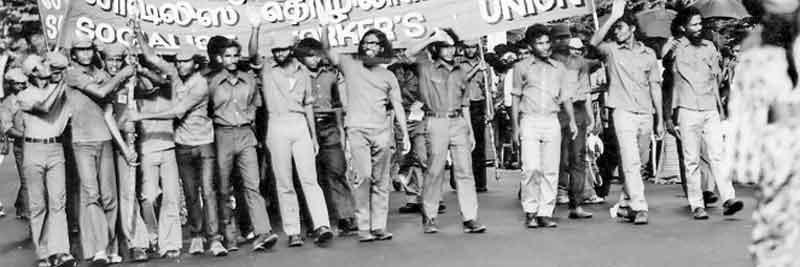
 In Sri Lanka also, there were several leftist parties like the LSSP and the CPSL then with considerable trade union support and different foreign affiliations. These parties launched a united trade union action in 1964 against the then Sirima Bandaranaike government presenting 21 demands
Unlike the other leftist political parties, the Janatha Vimukthi Peramuna (JVP) has been fortunate enough to rise to power, though under a coalition, the National People’s Power (NPP) within sixty years since its inception.
In fact, the only entity within the NPP that can be reckoned with is the JVP and it is singularly entitled to any credit or blame earned by the NPP. Hence, it is the JVP that has really come to power through the Presidential and Parliamentary elections held last year.
The JVP celebrated its 60th anniversary on Wednesday at the Vihara Maha Devi Open Air Theatre as the ruling party of the country while the old traditional leftist parties like the Lanka Sama Samaja Party (LSSP) and the Communist Party of Sri Lanka (CPSL) which are 90 years and 86 years old respectively – making a huge impact on Sri Lankan politics in the 1950s and 60s -- have been reduced to miniscule groups unknown to the present younger generation.
The JVP was initially launched by a group of 10 youths led by Rohana Wijeweera who hailed from a humble family in southern Sri Lanka. He described the birth of his party as a historical prerequisite rather than a creation of a power-hungry individual or a group.
During the JVP’s first national level education camp (a residential education programme) in Tangalla in 1979, Wijeweera explained the circumstances that led to the launching of the party. The 1950s and 60s was a time when there was a strong bloc of socialist countries led by the Union of Soviet Socialist Republics (USSR,) and their socialist ideology was making an enormous impact on youth all over the world. They accepted socialism as the remedy for all ills caused by the capitalist economic system.
In Sri Lanka also, there were several leftist parties like the LSSP and the CPSL then with considerable trade union support and different foreign affiliations. These parties launched a united trade union action in 1964 against the then Sirima Bandaranaike government presenting 21 demands. However, the leaders of the two main leftist parties the LSSP and the CPSL betrayed the struggle halfway and joined the government, accepting three cabinet portfolios and two deputy minister posts.
This happened at a time when leftist movements across the world were drawing inspiration and motivation from the Cuban Revolution that triumphed in 1959. This, according to Wijeweera, was the situation that pushed him and like-minded youths in the country to act seriously towards the formation of a new revolutionary political movement.
However, violent suppression of leftists claimed hundreds of thousands of lives in many countries, especially in Indonesia where over half a million people, mostly members of the Indonesian Communist Party, perished at the hands of the armed forces of that country in 1965. This indicated how difficult their journey would be and prompted these young followers of Wijewera to carry out their political activities secretly. The first meeting of this group was held on May 14, 1965 which happened to be a Vesak Poya Day at a house in Akmeemana.
Since then, it has been a long and hazardous journey for this group which grew fast to surpass all traditional leftist parties within five years, going on to defeat all other major parties in the country in sixty years after surviving two bloody suppressions in which tens of thousands of young men and women sacrificed their lives. They also underwent several splits as well including two major ones.
During the initial years after the launching of the party, they had to sacrifice over ten thousand lives at their first insurrection while over twenty thousand were incarcerated. This was followed by a peaceful period when the JVP contested by-elections, the first and the only District Development Council (DDC) elections in 1981 and a Presidential election in 1982, but only to be proscribed again by the United National Party (UNP) government of President J.R. Jayewardene under false allegations of inciting the 1983 anti-Tamil pogrom. The result was their second insurrection where over 60,000 people were killed by the armed forces and pro-government vigilante groups.
The general perception was that President Jayewardene banned the JVP in order to sabotage the legal action Wijeweera had taken against the results of the 1982 referendum held to extend the regular Parliamentary term. This referendum, the first and the last of its kind, has been documented as the most rigged poll in the country.
Even after encountering the most brutal suppression in the century the JVP sprang into action in 1994 like the legendary phoenix, the immortal bird in Greek mythology that is cyclically reborn. It has undergone so many ideological transformations according to the changing political situations in the country as well as internationally, inviting criticism. When they contested elections subsequent to their first insurrection, the leftists censured them claiming that the JVP had given up the revolutionary path.
Even now they are being criticised for changing their stance on the open economy, International Monetary Fund (IMF), relationship with India and socialism, the socioeconomic system the JVP stood for since its inception. In fact, adaptability has been the strength of the JVP in its survival through many political storms during the past sixty years and helped it to gain power last year, albeit as a coalition with another 20 smaller groups.
However, if not for the imprudent economic decisions taken by former president Gotabaya Rajapaksa, the NPP would not have come to power even this time. Rajapaksa created a hell on earth for the people, leaving them with no option but to reject all parties that had traditionally been in power. Voters sought an untainted fresh political force after an unprecedented uprising in 2022 which toppled Gotabhaya. Their choice was the NPP led by the JVP which they did not trust for six decades.
Nevertheless, the NPP has faced a drastic setback in numbers at the local government elections held on 6th of this month, despite being far ahead of all other parties. The prime reason seems to be the failure on the part of the NPP government to address the craving for change by the large majority of people who voted it into power.
A stagnation in the government machinery is being clearly witnessed, in spite of the members of the government apparently not being after perks and privileges as those of the past governments have been. People also might have been disillusioned over the amateurishness evident in the ministers and the MPs in handling the media. What the leaders of the government have to realise is that the people voted them into power not with a deep understanding but on an impulse following an unprecedented economic crisis.
10 Jul 2026 1 hours ago
10 Jul 2026 2 hours ago
10 Jul 2026 3 hours ago
10 Jul 2026 3 hours ago
10 Jul 2026 3 hours ago