26 Sep 2025 - {{hitsCtrl.values.hits}}
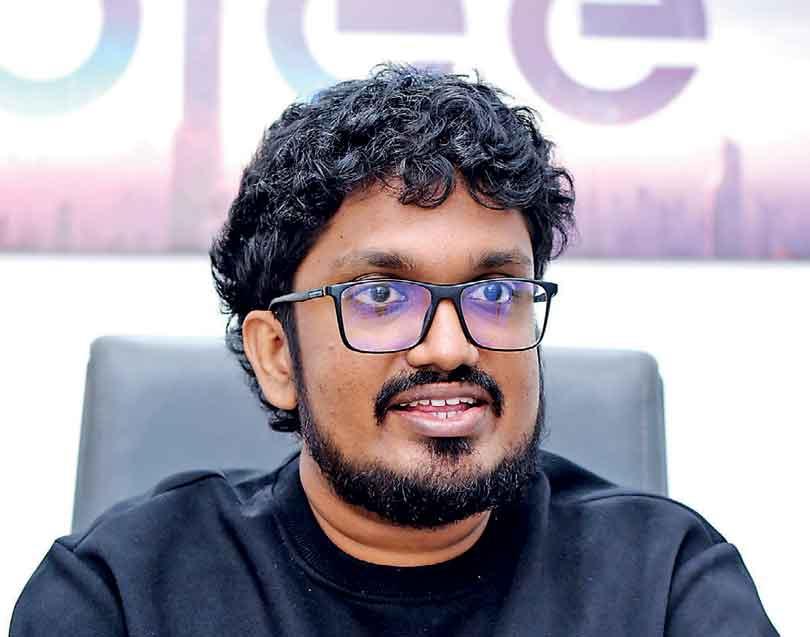
Dilshan- Always one step ahead: Dilshan Abeygunawardena at the Olee.AI offices in Malabe
(Pix by Nisal Baduge)
By Rashitha Dahanayaka
With digital education and Artificial Intelligence (AI) becoming increasingly relevant and reshaping our way of life, concerns are raised that Sri Lanka risks being left behind. One such person who shares these concerns is none other than Dilshan Abeygunawardena, an early adopter and at present an entrepreneur and a content creator, with over 650,000 followers across social media and a career that spans podcasting, gaming, investing in the crypto space and AI entrepreneurship. In conversation with the Daily Mirror, he spoke candidly about the future of AI, the gaps in government policy, and the challenges faced by Sri Lankan freelancers.
Excerpts:
Q. You’ve worn many hats, from early podcaster to AI entrepreneur. Can you briefly tell your story?
My journey began at age five, when I won consecutive bronze medals at the 28th and 29th International Children’s Art Exhibitions. A few years later, I convinced my grandfather, through a letter to my school counsellor, to buy me a laptop. That opened the door to creating video games, exploring YouTube, and eventually winning an e-Swabhimani award for my computer game Operation Wanni.
Of course, at home, it was always “Doctor! Doctor! Doctor!” That was the expectation. But my passion was elsewhere, and that’s what pushed me into experimenting with IT and media from a young age.
From there, I stepped into podcasting with Dilshan’s Thoughts, which became one of the highest-rated podcasts in Sri Lanka, recognised by USAID as influential and ranked in Spotify’s global top 10% most-followed shows. I didn’t just want to entertain; I wanted to make an impact.
My first business venture was with Dileepa Jayawardena, selling point-of-sale systems, and later I co-founded the myHub YouTube channel with him.
Q. You were an early adopter of many things, from podcasting to Fiverr. Today, you run Olee.ai, which develops and delivers AI solutions for businesses. Can you briefly explain what Olee.ai does?
Simply put, Olee.ai is an AI transformation company, which I co-founded with Dileepa. Think of it this way: the banking system used to be paper-based, then IT came in, and it became digital banking. We work on the same principle, but with AI. What we do is look at a business and find areas where AI can step in, whether it’s automating routine tasks, improving customer service, or streamlining operations and in turn, that increases efficiency and revenue.
Q. With the recent education reforms, there are discussions around bringing more digital education to the fore. How crucial do you think it is to include a subject like IT, AI and Digital Education in the national curriculum?
If we look at the younger generation, they’re already immersed in IT; their whole world is connected to it. But it wasn’t the same for us.
Sri Lanka has set a target of reaching $5 billion in IT exports by 2030, yet today we’re only hovering around the $1.2 billion figure. During the previous regime, about one billion rupees were pledged for artificial intelligence. But there’s been little follow-through. While some officials are enthusiastic, there isn’t a sustained push to move forward.
Now, if we are to progress, it has to happen immediately. Look at China: they made IT and AI compulsory from the very beginning of school. Meanwhile, in Sri Lanka, we visited a government institute for youth and found they were still teaching kids Adobe PageMaker and Illustrator. That’s outdated. Teaching those tools is not going to prepare students for the future, when skills like AI, coding, and other emerging technologies are becoming essential to daily life.
Q. Many young Sri Lankans are leaving school with skills that belong to yesterday, not tomorrow. If you were tasked with designing the country’s AI and digital skills strategy for the next 5-10 years, where would you start, and why?
I would start by loosening the tight regulations that were imposed years ago and haven’t been reviewed since. For example, there was an issue around crypto because of risks to our foreign reserves. Our suggestion was simple: either keep the markets completely closed, or at least allow a licensed framework with small allowances — say, the ability to convert up to $100.
Another problem is the lack of clear definitions in financial regulations. Terms like “cryptocurrency” or “pyramid scam” are not properly defined, which leads to confusion and uncertainty.
And then you have rules like this: income earners who bring in foreign currency cannot hold their earnings for more than three months without converting them into Sri Lankan rupees. Policies like that discourage freelancers and entrepreneurs, when what we actually need is flexibility.
Q. I’ve noticed in your days of Dilshan YouTube vlogs, you’ve sat on advisory boards to the government and youth committees, offering advice on digital policy. How much of that actually turns into action, and what’s one recommendation you made that you wish the government had acted on immediately?
We went to the Central Bank to discuss regulations that simply haven’t kept pace with the changing dynamics of our economy. When you really look at the regulations, it’s clear they make life unnecessarily difficult for freelancers who depend on foreign income. People are stuck.
What’s interesting, though, is the contrast. When we speak to secretaries and younger hires, there’s real enthusiasm, in fact, much more than what we saw under previous governments. But that energy doesn’t carry through at the top. Senior officials are far less willing to move, and that’s where progress stalls.
Q. How do strict regulations like the ones you mentioned impact our economy?
If the regulatory environment was right, we could have companies like OpenAI (the creators of ChatGPT) setting up servers here in Sri Lanka. That would mean direct investment, jobs, and a stronger place in the global AI economy. But because our policies aren’t aligned, those opportunities simply pass us by.
Q. Sri Lankans sometimes seem suspicious of business success. How do you personally tune out the noise, and how can young entrepreneurs keep going when the country isn’t cheering for them?
All I can say is: don’t care about that. If you’ve set up your operation at home, the best option is to rent an office outside and continue running your venture from there. This way, you don’t have to listen to anyone.
At the same time, young entrepreneurs need to ensure they register their business and know how to file personal taxes. Many rural folks are talented, but without these basic business skills, they will face challenges as they grow.
Q. To sign off, if you could speak directly to every youngster in Sri Lanka for one minute, what’s the single most important message you would give them?
Plan ahead. Often, two or three friends get together and decide, “Let’s start a software business,” and only learn things after the fact. Instead, plan every step: what clients you want to serve, which countries to target, and so on.
There’s nothing you can’t do in Sri Lanka. Yes, it’s challenging, but there are possibilities; you just have to keep trying.
The world isn’t always fair, especially for rural kids, but you do what you can with what you have.
21 Jul 2026 5 hours ago
21 Jul 2026 5 hours ago
21 Jul 2026 6 hours ago
21 Jul 2026 6 hours ago
21 Jul 2026 7 hours ago