22 Dec 2017 - {{hitsCtrl.values.hits}}
The three member delegation from the UN working group on arbitrary detention was in Sri Lanka for a 10 day visit.
 During their stay they visited the LTTE detainees only but not the servicemen who were in remand prison on suspicion. They were not allowed to, by the local UN staff, at least to accept a letter written by the daughter of Commodore D.K.P. Dasanayaka, who is in remand for more than 5 months.
All she wanted to ask this team was to visit her father too in prison. The Tamil female employer has first asked her whether it was a LTTE complain and when Miss Dasanayaka answered in the negative, she was practically sent out and was never allowed to meet the team. They kept the UN team inside the room until the Dasanayaka family left the location. This happened at the BMICH in Colombo.
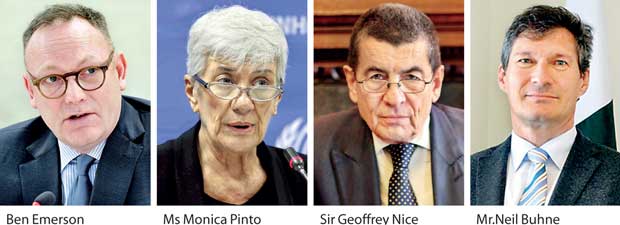
Ben Emerson, the UN representative on Human Rights and Counter terrorism, who came on a 4 day visit to Sri Lanka, threatened the government saying “ Implement the Geneva Resolution or face consequence”. He further had the audacity to tell that Sri Lanka should not test the patience of the International Community!! Emerson in his report also said that there was very little evidence that perpetrators of war crimes committed by members of Sri Lankan Armed Forces were being brought
to justice.
The special rapporteur on the Independence of judges and lawyers in Sri Lanka, Ms Monica Pinto, came to Sri Lanka, spent 8 days in the country, and concluded that Sri Lanka’s judiciary is highly politicized, and judges give verdicts favouring the government, hoping to obtain good positions after retirement! She also mentioned that the judges in Sri Lanka are incompetent, incapable, poorly selected, corrupted, cowardly, partial and the Attorney General’s Department is rather lethargic and defends the interest of only the government and not the public and the Bar Association is strongly divided on political lines? None of the legal luminaries in the country objected!.
It is very obvious that all these were pre-conceived/pre-determined observations, influenced by separatist elements to justify foreign judges, lawyers and prosecutors in special courts in Sri Lanka to try our soldiers. Apart from government officials she has spoken only to pro LTTE lawyers and LTTE detainees in the country.
The war against LTTE was won on 19th May 2009 and the first resolution passed in Geneva was a positive one praising the Sri Lankan government for bringing peace and condemning the LTTE for using human shields
On 26th March 2014, the UNHRC by resolution A/HRC/25/1 requested the High Commissioner to undertake a comprehensive investigation into “serious violations and abuses of human rights and related crimes” allegedly committed during the period 2002 February to 2011 November, in
Sri Lanka.
The final report of the investigation, widely known as OISL (Office of the United Nations High Commission in Human Rights) report, was released on 16th September, 2015. On 29th September, 2015 the UNHRC by resolution A/HRC/30/1 endorsed without reservation the conclusions and the recommendations of the OISL report. The said resolution was sponsored by USA and co-sponsored by the Government of Sri Lanka and adopted by the council by consensus, without a vote.
The OISL report was seriously flawed and full of contradictions, omissions, and obfuscations. A team from the Global Sri Lankan Forum prepared a rebuttal to all the charges mentioned and handed it over to the HC of the UNHRC in Geneva in March this year. One of the charges was that the government had pursued a policy of deliberately denying humanitarian assistance to the civilians trapped in the conflict zone. Mr.Neil Buhne, the UN Resident Coordinator who was a member of the Consultative Committee on Humanitarian Assistance had commented that the Sri Lankan government should be given a Gold Medal for her commitment in providing aid. Mr. Amin Award, the representative of UNHRC, had expressed the view that Sri Lanka was a Role Model to the rest of the world in the manner in which the government of SL had handled the humanitarian crisis caused by the LTTE using civilians as a human shield in the theatre of war. Ms Emelda Sugumaran, the District Secretary to Mulliativu, had confirmed that they had three months stock of food and medicine at any given time. With all these available information Zeid Al Hussein, in his OISL report, had thought it fit to accuse the government of denying humanitarian assistance to the North and the present government had accepted the report with appreciation and co-sponsored the resolution based on that!
The purpose of the OISL report is to make a case for war crimes against the State. This report was never properly assessed by any professional agency of the UN and it is asserted that the report is deeply flawed and biased against Sri Lanka. Hence UNHRC, in allowing resolution 30/1 to be adopted without a vote and without a debate has been negligent in its duties and obligations under the UN charter and hence illegal.
The investigation against Sri Lanka, authorized by UNHRC in March 2014 itself is again illegal. The council’s authorization of the investigation was based purely on a recommendation for such an investigation made by the High Commissioner where she had no rational basis to make the said recommendation at the time she did.
The war against LTTE was won on 19th May 2009 and the first resolution passed in Geneva was a positive one praising the Sri Lankan government for bringing peace and condemning the LTTE for using human shields. This was after 17 nations led by Germany called for a special session, 8 days after the conclusion of the war, and charged the government of committing war crimes and demanding that the perpetrators be punished. But majority of countries in the council, specially the nations in the South, rejected it and adopted a positive counter resolution as mentioned above.
That resolution welcomed the conclusion of hostilities, the liberation of tens of thousands of its citizens that were kept by the terrorists and bringing permanent peace to the country. It was obviously a set back to the separatist Tamil diaspora and other critics, who attempted to recover through
other means.
The then Secretary General Mr. Ban Ki Moon came to Sri Lanka just four days after the defeat of LTTE to look into “ accountability” . When the LTTE held 350,000 civilians as a human shield in January 2009, Ban Ki Moon never came here to prevail on LTTE to release them. When UNICEF was confirming that LTTE were recruiting child soldiers in large scale he did sweet nothing. But he visited Sri Lanka soon after the war, and wanted the government to initiate an accountability process.
Mr. Ban Ki Moon then appointed the Panel of Experts known as Darusman Committee to appraise him whether war crimes were committed in Sri Lanka. This action of the Secretary General was highly illegitimate and in fact illegal under the UN charter. The Secretary General had appointed three outsiders to the POE committee. But article 100 of the UN charter categorically says that the Secretary General should not receive instructions from any other authority external to the Organization.
As per article 97 and 98 ,the Secretary General is the Chief Admin Officer of UN and should perform tasks entrusted to him by the Security Council or the General Assembly or the Trusteeship Council. None of these organs had given instructions to the Secretary General in this regard but yet he appointed the POE on his own.
The Secretary Geeneral also violated Article 2 (7) of the UN charter which says that, “Nothing contained in the present charter shall authorize the UN to intervene in matters which are essentially within the domestic jurisdiction of any state or shall require the members to submit such matters to settlement under the present charter.”
Hence by appointing the POE the Secretary General had violated his own rules!!
The Panel of Experts then concluded that there were credible allegations that violations of International Humanitarian Law and International Human Rights Law did occur and recommended an international investigation. The POE then became the basis for the demand for an international investigation in subsequent UNHRC resolutions against Sri Lanka.
The POE report charged the government of war crimes on false evidence from biased and separatist elements. Referring to the POE report of the UNSG, the International legal luminaries, Sir Geoffrey Nice QC and Rodney Dixon QC , who have both worked in international tribunals and worked for ICC in Hague, say that the findings in respect of the alleged criminal violations fall well short of the legal standards and all the evidence virtually unsourced. Darusman report very clearly mentions, without any reliable evidence, that 40,000 Tamil civilians were killed by the Army during the last stages of war.
The Darusman or the POE report was never placed officially at the HRC and hence the Sri Lankan government never got a chance to officially respond to it. When the Sec Gen first announced that he would commission the report, senior diplomats in a number of prominent countries expressed grave concerns about the dangerous precedence the Sec Gen was about to set. Russia, through its UN ambassador, even raised objections in the Security Council. The Russian Ambassador Vladimir Mikaylov, when asked on what grounds the objections made said “ On the grounds that it was not a UN report. On the grounds that it was not done in accordance of the regulations and procedures of UN. From the very beginning it was told that the report was purely for the Sec Gen. So if it was for the Sec Gen why did they have to publish it? “
So based on this illegal Darusman report there were resolutions in 2012 and 2013 and it should be noted that just prior to the March 2013 resolution, a group of 14 nations including Russia, China, Venezuela and Iran made a joint statement expressing their dismay and frustration at what was being done to this country. Referring to mandating the UNHRC to provide advice and technical assistance to Sri Lanka they said such recommendations are arbitrary, intrusive and of a political nature!!.
Finally the resolution 25/1 passed in 2014 , requesting the present High Commissioner to undertake a comprehensive investigation into alleged war crimes. It was hardly a unanimous decision where 23 countries voted in favour, 12 against and 12 abstained. The OISL report of the present High Commissioner is the result of that investigation.
28 Jun 2026 3 hours ago
28 Jun 2026 6 hours ago
28 Jun 2026 6 hours ago
28 Jun 2026 6 hours ago