 Kamanthi Wickramasinghe
 Reply To:
Name - Reply Comment
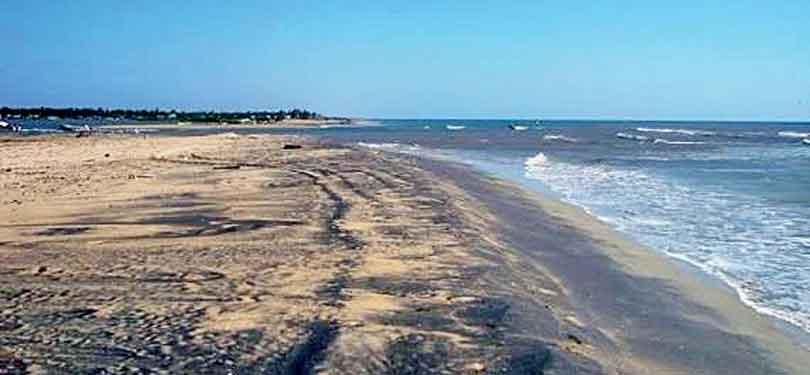
Mineral rich Pulmoddai beach. File photo
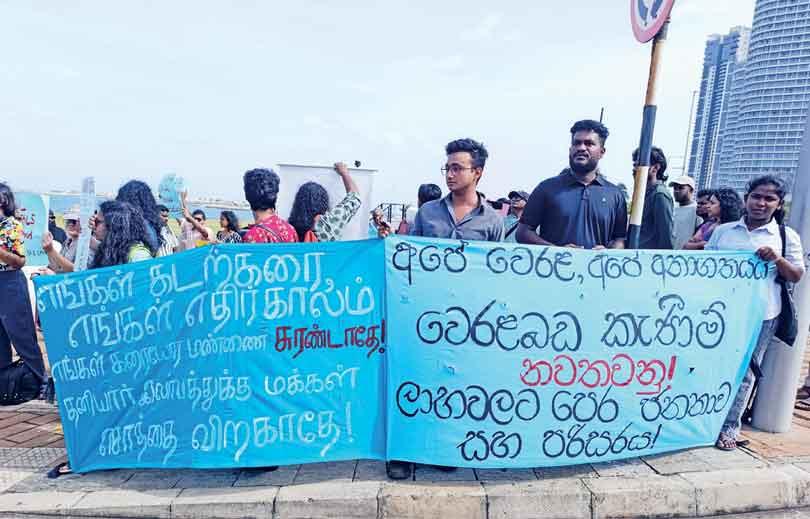
Recent protest at Galle Face Green against heavy mineral sand mining
- Many multinational companies are currently aiming at extracting these resources from Sri Lanka. There’s a growing discourse about why Sri Lanka should utilise its resources to add value to the economy
Sri Lanka’s mineral-rich coastline comprises of an abundance of heavy mineral sands including Ilmenite, Rutile, Zircon, Monazite and Garnet. The mineral sand sector is now gaining momentum due to the global demand for mineral sand, driven by increasing construction, automobile industry and the transition to green energy. In this backdrop, the Sri Lankan government recently announced its National Mineral Policy with a primary focus of doing value addition to raw materials prior to exports. However, the unsustainable demand for mineral sands by certain multinational companies has been scrutinised by environmental groups and civil society organisations as they claim that it would pose detrimental impacts on people as well as the environment.
Recently, several interest groups staged a ‘teach-out’ at the Galle Face Green to educate the public about why Sri Lanka’s mineral sand deposits need to be preserved for future generations. According to environmental activist Sajeewa Chamikara, attempts were made to carry out large scale mineral sand extraction in areas such as Magama and Kirinda in 2006/2007. However, due to interventions made by farmers, environmentalists and civil society activists, these attempts proved futile.
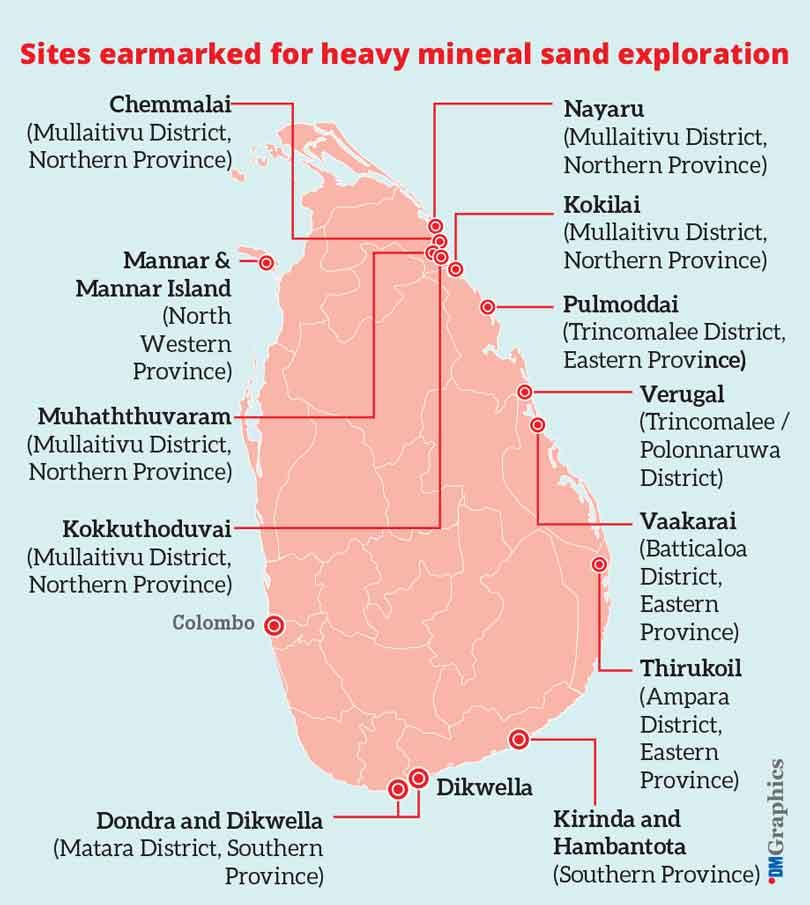
“But today, 12 sites have been earmarked for mineral sand extraction,” he said addressing the crowd. “What has been mentioned in most reports is the fact that there’s 17% productivity in areas that these mineral sands are being extracted when compared to other countries. This shows the growing demand by multinational companies to take over mineral sand deposits located along the coastline. However, these projects are being implemented sans a proper evaluation of studies conducted on mineral sand extraction. No studies have been done on the impact on fisheries communities, and comments from people in these communities have been excluded from Environmental Impact Assessments (EIAs). So when these companies bypass certain fundamental criteria in EIAs, it shows that there’s a vested agenda behind these operations,” he claimed.
Chamikara further said that influential personalities have been absorbed into the boards of these companies and they try to carry out these activities in the guise of investment projects.
“With the newly announced National Mineral Policy, the focus has now been shifted to do value addition to raw materials such as mineral sands prior to being exported. A huge amount of chemicals is required to do value addition, and some of them are extremely toxic. On the other hand, large quantities of marine groundwater is used to purify these mineral deposits. This affects the availability of water for drinking, agriculture and other purposes, depriving people of a basic need,” he added.
In addition to wind turbines, Mannar Island fell victim to mineral sand extraction projects over the recent past. Due to coastal erosion and other vulnerabilities, people in Mannar Island worry about the future of their homeland.
In his comments, Selvaratnam Dilaxan from Mannar Island said that people living on Mannar Island are challenged with abject poverty.
“In this backdrop, our coastline has been earmarked for mineral sand extraction projects. So we cannot imagine what our future holds. The fishermen and people in the area are not aware of what’s going on with these projects. When the tsunami occurred, some of these mineral sand deposits acted as a defense to minimise the impact of rough waves. But we don’t see these deposits today,” he said.
“Heavy mineral sand extraction will pose serious threats to our marine environment,” said Pearl Protectors Founder Muditha Katuwawala. “Already, Sri Lanka is challenged by coastal erosion. 103 rivers push out a lot of sediment out into the sea, which in turn nourishes our beaches. But some multinational companies are coming into Sri Lanka, deceiving people in these communities as well as the government to start extracting these minerals, and they say that it would add value to our economy,” he said.
He said that Kirinda is one of the most significant coastal environments where all five sea turtles come including Hawksbill, Leatherback, Green sea turtle, Olive Ridley and the Loggerhead come to lay eggs. “There’s no other country where these sea turtles come to nest in one location. Kirinda is also one of the oldest harbours in the world. If heavy mineral sand is being extracted, it would lead to sedimental loosening of our beaches, resulting in many beaches being eroded back into the sea. Our beaches are at risk of being permanently destroyed,” he warned.
Katuwawala further said that similar extractions have been carried out in Tamil Nadu and Kerala where radioactive chemicals were used to extract mineral sands. “In Mozambique, large scale sand dunes were destroyed for mineral extraction. At Richard’s Bay in South Africa, large areas of coastal dune forests and a globally significant and highly bio diverse ecosystem have been destroyed due to heavy mineral sand extraction. In the East, we have a lot of lagoons and these extractions will destroy our sensitive ecosystems. In Indonesia, the heavy use of chemicals to extract heavy mineral sands have caused damage to coral reefs. Coastal vegetation that feeds coastal communities and aquatic animals will be destroyed. We are a vulnerable country following the economic crisis and we have to be smart about these unsustainable practices.
Many multinational companies are currently aiming at extracting these resources from Sri Lanka. There’s a growing discourse about why Sri Lanka should utilise its resources to add value to the economy. The revenue generated by the government from certain mineral sand exports is around USD 30 million which is a very nominal amount, said researcher and feminist political economist Dr. Amali Wedagedara. She said that around 300 job opportunities have been created for people in these areas, but that these are not skill-based jobs.
“Mineral sand extraction is a hazardous industry; these are hazardous jobs and labourers have a tendency to fall ill,” she added.
Wedagedara further said that Sri Lanka is bracing for an El Niño and a possible scarcity of water. “The country has already become vulnerable to natural disasters due to shortsighted development. Such projects would add more burden to the government and the economy,” she underscored.
Addressing a recent conference on mineral sands, Minister of Industries and Entrepreneurship Development Sunil Handunneththi said that the new National Mineral Policy introduced by the government clearly reinforces strict adherence to environmental legislation including NEA and other relevant regulatory frameworks. He said that responsible and environmentally sustainable mining practices will remain the guiding principles of the future development of Sri Lanka’s mineral sand industry.
According to him, a major focus of the new policy is the strengthening of exploration, mining, and processing and value addition as key pillars of sectoral growth.
“Unfortunately in previous decades Sri Lanka was unable to fully realise the maximum benefits of its mineral resources due to limited long-term strategic development and insufficient value added industrial expansion. Responsible mining practices, scientific environmental assessments, rehabilitation programmes, biodiversity protection and effective monitoring systems are essential to safeguard sensitive ecosystems for future generations. Responsible investment requires transparency, policy consistency, efficient administration and good governance. The new policy also strengthens governance frameworks, institutional coordination, investor friendly regulatory mechanisms,” he said.