Reply To:
Name - Reply Comment
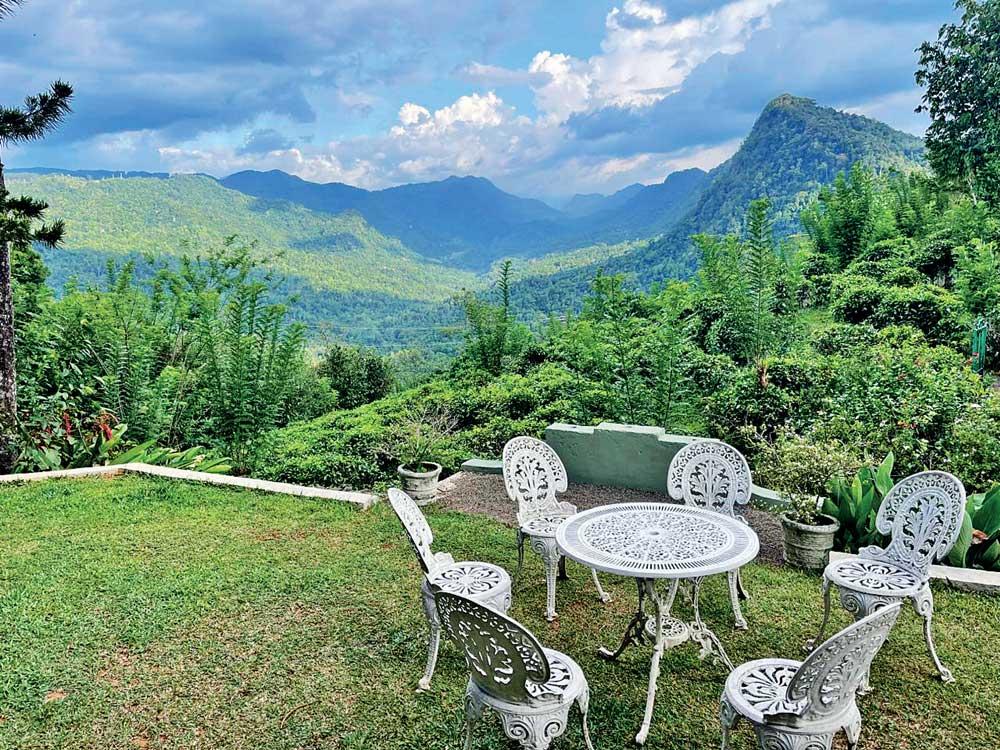
Though tourists had made reservations at hotels they have had to cancel them due to the absence of train services. As a result, the number of tourists coming to Nuwara Eliya has decreased (Photos: Hatton Ranjith Rajapaksa)
By Prageeth Sampath Karunathilaka
Many people predict that Sri Lanka’s tourism industry, which is one of the country’s main sources of income, is successful at present. This perception is based on the quarterly count of tourist arrivals. However, it is doubtful whether Sri Lanka’s tourism industry has actually developed in proportion to the number of tourists arriving in the country. During the period from January 1 to May 24 of this year, the number of tourists who arrived in Sri Lanka was 990,032. This is clearly reflected in the data made available by the Sri Lanka Tourism Development Authority (SLTDA).
Among the tourists who arrived in the country, the highest number came from India, amounting to 236,916. In addition, a significant number of tourists arrived from the United Kingdom, Russia, Germany, and China. During the period from May 1 to May 24 alone, the number of tourist arrivals was 113,755. Although such a large number of tourists have arrived, it is important to examine how this affects the country’s economy. Although tourists arrive from countries such as India and China, the extent of their travel within the country and their expenditure are relatively low. In particular, many of these visitors often come to Sri Lanka to fulfill personal needs. According SLTDA data, the number of tourists arriving in Sri Lanka had exceeded 1.8 million by October 2025. During the first 15 days of that month alone, 75,657 tourists arrived in Sri Lanka. As a result, the total number of tourist arrivals up to that point had increased to 1,801,151.
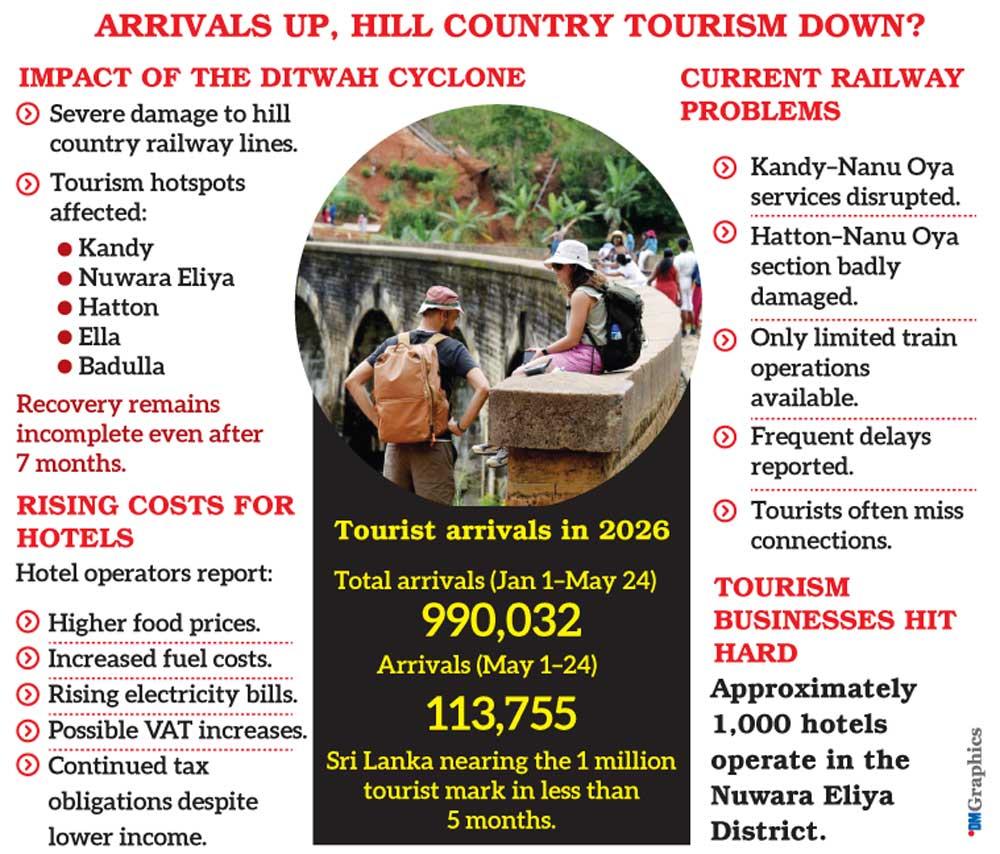
Although tourist arrivals have increased, tourists who visited Sri Lanka after the Ditwah cyclone were unable to travel as they wished. This was due to the severe damage caused to the areas of Kandy, Nuwara Eliya, and Badulla. Even though nearly seven months have passed since the Ditwah cyclone struck, the tourism industry in those areas has still not returned to normal. This was also evident to this scribe during a visit to the Nuwara Eliya District.
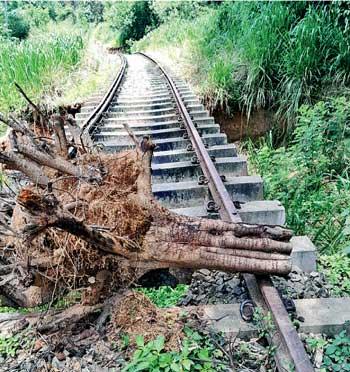 |
| If the railway line is repaired, there can be hope for the future of the tourism industry in Nuwara Eliya |
During the Sri Pada pilgrimage season, a large number of tourists usually travel to the area by train. In particular, tourists travelling from Kandy to Nawalapitiya visit Ginigathhena and its surrounding areas, enjoying the beauty of the natural environment while making their pilgrimage to Sri Pada. From there, they travel to Nanu Oya, visit Nuwara Eliya, and later travel to Badulla.
The railway had been the main mode of transport for these tourists. However, after the Ditwah cyclone, train services from Kandy to Nanu Oya were disrupted because the railway line had suffered extensive damage.
Train service resumes
Passenger train services between Nanu Oya and Badulla have officially resumed on Saturday (June 20) following a seven-month suspension due to track damage from Cyclone Ditwah. According to railway officials four daily train trips operate on this restored upcountry route.
The train service between Nanuoya and Badulla resumed following a suspension due to adverse weather and track damage left in the wake of the cyclone. Railway authorities confirmed that the tracks have been cleared and safety inspections are complete.
However, following the Ditwah cyclone, the destruction of railway routes led to a decline in tourist travel. Due to the lack of proper transportation facilities, many tourists have even cancelled their trips to Sri Lanka.
As a result, they are required to leave well in advance. Although four trains operate from Ambewela to Badulla and break journey for approximately two hours. Hotel owners in the area pointed out that these trains also do not arrive on schedule.
In the Nuwara Eliya District, there are approximately 1,000 hotels operating on both large and small scales. The primary target market of these hotels is foreign tourists. Due to the lack of proper transportation facilities, the number of tourists staying in hotels starting Ginigathhena to Nuwara Eliya has declined. As a result, their expected income targets have been disrupted. Against the backdrop of stalled expected revenue streams, the hotel industry is also facing the risk of collapse.
The decline in the arrival of foreign tourists has caused a severe blow to the tourism industry. Hotel owners engaged in the sector are continuing their businesses amid serious financial difficulties. In such a context, the increase in the prices of food and essential goods has also severely impacted hotel operators . Hotel owners added that rising fuel prices and increased electricity charges have severely affected their businesses.
Commenting on this matter, Ajith Kumara Bandara, a hotel businessman from the Ginigathhena area, said the following: “Through our hotel website and other hotel booking websites, tourists from Germany, the United Kingdom, Israel, and other countries reserve rooms at our hotel. Some stay here for two to three days, while others remain for up to a week and travel around the surrounding areas. The main waterfalls nearby and Sri Pada are among their key destinations. These tourists usually travel from Colombo to Nawalapitiya, after which we pick them up and bring them to the hotel.
“Steps already taken to assist hotel owners”- SLTDA
Since there has been a downturn in the tourism sector, this newspaper inquired from the SLTDA whether any relief measures had been taken to help those engaged in tourism-related businesses in Nuwara Eliya. Although attempts were made to contact its Chairman, Buddhika Hewawasam, he wasn’t available. However, an officer from the Authority’s research division stated that steps had already been taken to provide assistance to hotel owners affected by the Ditwah Cyclone. She further stated that a survey and study are currently being conducted regarding those involved in the tourism industry and hotel owners whose livelihoods and businesses were economically affected following the Ditwah cyclone. She added that information is still being collected, and once the process is completed, relief measures would also be provided to those affected.

No replies to Daily Mirror inquiries
The Daily Mirror sent Emails to the General Manager of Sri Lanka Railways and officials of the Sri Lanka Tourist Board to check what efforts are being made to boost the tourism industry in Nuwara Eliya and repair the destroyed railway line. However there were no responses from both these institutes. Only the Tourist Police Division had sent a message confirming receipt of the email mail sent by this newspaper.
Some of them come specifically to pluck tea leaves, bathe in waterfalls, and go on forest walks. Due to these tourists, local people in the surrounding areas also earn a good income by selling their handmade products and other goods. However, after the upcountry railway line was damaged by the Ditwah cyclone, fewer tourists have been coming to the Ginigathhena area. Many tourists who had booked rooms at our hotel cancelled their reservations because there were no train services. As a result, the number of tourists coming to Nuwara Eliya has decreased, which has severely affected the hotel industry.
“Since there are fewer tourists, it is difficult for us to achieve our expected income targets. Nevertheless, we still have to pay all government taxes, staff salaries, and other employee benefits. Now, the prices of goods have increased, and there are plans to increase VAT as well. On the other hand, fuel prices and electricity bills have increased. With insufficient income, we are suffering greatly. Under these circumstances, it has become difficult to continue operating in the hotel industry. Recently, two foreign tourists staying at our hotel wanted to travel to Badulla by train. They hired a private vehicle from Ginigathhena to Ambewela to catch the train, but by the time they had arrived, they missed it. They wasted more than two hours. If the railway line had been repaired, they could have gone to Nawalapitiya and caught the train on time. Situations like these discourage tourists from coming, and it has a major impact on our industry.
“If electricity consumption exceeds 180 units, the electricity bill increases by 18 percent. Even when there are no tourists, the hotel uses around 8 to 10 electricity units per day. That means we consume between 240 and 300 units per month. Along with food, beverages, and other expenses, we have to bear a very high cost. Yet, there is no sufficient income. We do not know when this situation would improve. As a result, the hotel industry in the Nuwara Eliya District is facing a serious risk. To recover from this situation, tourists must return. For tourists to return, the railway line must be repaired. Work has begun on the section from Ambewela to Nanu Oya. Nothing has been done in the other areas. At the very least, if work had started elsewhere, we would have some idea of how long it would take and could harbour hope that things might improve by then. There are a few signs that the railway line is being repaired, and even after six to seven months since Ditwah, hardly any restoration work has taken place. If this situation continues, the hotel industry in Nuwara Eliya will be in serious trouble.” said Bandara.
Commenting on this matter, Helapriya Nandaraja, a member of the Ambagamuwa Pradeshiya Sabha, pointed out the following:
“The people of Nuwara Eliya have continued to suffer in the aftermath of the Ditwah cyclone due to the loss of their sources of income. This has had a severe impact on the economy. The main source of income for the people of Nuwara Eliya is the tourism industry. The local people survive by selling whatever products they produce to foreign visitors. People in the area had become accustomed to earning their daily income by supplying these products to trains or hotels. However, after the Ditwah cyclone, that economic system collapsed due to the decline in tourist arrivals. Vegetables from Nuwara Eliya were transported to other provinces by train. Hence those transport goods largely depended on the railway. Fuel for Nuwara Eliya is distributed from the Kotapola storage facility, and the fuel is transported there by train. Work is currently underway to repair the railway line from Ambewela to Nanu Oya, but progress has been delayed due to disagreements among the authorities. The railway line must be repaired as quickly as possible from there up to Kandy. Otherwise, all sources of income for these people will be destroyed. The government continues to impose tax after tax on the public, yet it does not seem committed to repairing the railway line, which is essential for restoring livelihoods. If the railway line is repaired, there can be hope for the future of the tourism industry in Nuwara Eliya. If this is done, tourist guides to others who depend on this industry for their income, will benefit. At present, all of these people have been left helpless. At the very least, this government does not appear to have any real intention of repairing these damaged routes. If this situation continues, the tourism industry in Nuwara Eliya will face severe consequences by the end of this year,” said Nandaraja.
The upcountry railway line has still not been restored to normal operations, and it may take another two to three years for it to return to its previous condition. According to reliable sources, delays in this process appear to stem from inefficiencies within both the railway administration and the political framework. This issue deserves separate discussion in the future. The upcountry region remains one of the most preferred destinations for tourists visiting Sri Lanka. Areas such as Kandy, Nuwara Eliya, Badulla, Bandarawela and Ella are among them. The most attractive means of transport to these destinations is the upcountry train service. Although much is said about the country’s future, development and generating revenue, the necessary infrastructure has still not been provided. Even after seven months since the Ditwah Cyclone, the upcountry railway line has not been restored. Yet no one appears to be calculating the amount of foreign exchange the country continues to lose as a result.
While we talk about an economy based on commercial crops such as tea, coconut and rubber, the authorities show little interest in developing the tourism industry, which is one of the country’s main sources of income. This is also why the reconstruction of the railway line has been delayed. If Sri Lanka lacked the technical expertise to rebuild the railway line, assistance and technical knowledge could have been sought from another country. Despite political promises that trains would return to Kandy within three months, the authorities have failed to rebuild the railway line even after seven months. Any worthwhile progress is still not visible.
Therefore, this issue has both direct and indirect effects on the country’s economy. At present, it has severely impacted the tourism industry. If the authorities fail to find alternative solutions quickly, tourism zones centered around Nuwara Eliya will face serious risks. Just as people say that trains once operated to areas such as Ratnapura and Yatiyantota, but those railway lines have now disappeared. People might one day have to say that trains once traveled to the hill country as well, until the Ditwah Cyclone destroyed those routes. They will not forget to add that the authorities at the time lacked the interest to restore them. At the same time, attention must also be paid to how this issue is affecting the country’s economy. While the authorities continue to boast about the economy, the country’s tourism industry is gradually moving toward destruction.
This newspaper also made inquiries with the Sri Lanka Railways (SLR) regarding how long it would take to reconstruct the damaged railway line. However, although attempts were made to contact SLR by phone no response was received.
Due to these tourists, local people in the surrounding areas also earn a good income by selling their handmade products and other goods. However, after the upcountry railway line was damaged by the Ditwah cyclone, fewer tourists have been coming to the Ginigathhena area”- Ajith Kumara Bandara, Hotel Businessman from the Ginigathhena