Reply To:
Name - Reply Comment
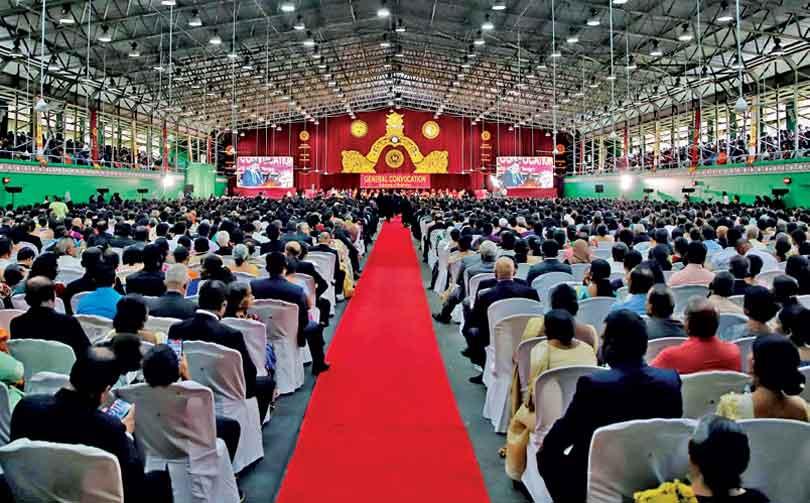
A session of the Peradeniya University Convocation
 Like the shopkeepers of London, the Duke of Gloucester said while laying the Foundation Stone for a Convocation Hall at the University of Peradeniya: “More Open than Usual.” Way back on 12 August 1948, the then Minister of Transport and Works Sir John Kotalawela invited the Duke to lay the foundation stone at the Convocation Hall of the University of Peradeniya. Today the Foundation stone stands there like the ruins of Polonnaruwa.
When a University is open, it stays open, said the then Chancellor of University Lord Soulbury. But today the foundation stone and the other ancillaries stays like neglected ruins.
But there seems to be a “Hoodoo” as to why such a massive Institution such as Peradeniya cannot construct a Convocation Hall on their sprawling 1,1910 acres of land, though 74 years ago had gone by without a Convocation Hall. The original earmarked Building designed by Sir Patrick Abercrombie who arrived in Sri Lanka at the invitation of the Government to design and lay out the buildings for this University at Peradeniya has not seen the light of day.
Why that’s so is a question, when so much construction work has been carried out within the University costing trillions of rupees since the establishment of the University.
On June 24 2026, 3339 men and women received their Degrees from a make-shift “ Convocation Hall,” a Gymnasium turned into a Convocation Hall at great cost (with one Honorary Doctorate to Professor Nimal Senanayake. June 25 would be the second day of the Convocation as it has been divided into four sessions. Degrees were conferred on Post Graduate of Medicine, Post Graduate Arts, and Degrees on medicine and Science).
In recent times the former Minister of Higher Education and Member of Parliament Lakshman Kiriella earmarked a plot of land close to Getambe, out of land belonging to the University, for a dual Convocation Hall that even schools could use for their prize givings or other educational agenda’s -- long before the construction of the Mahinda Rajapaksa building at Polgolla. But somehow it did not see the light of day, and the country’s premier Education Institution is still without a Convocation Hall.
The first Doctorate was presented to the Late Prime Minister D.S. Senanayake at the very first Convocation on Convocation Hill, in a thatch building in an area earmarked for the Convocation Hall. He had left his certificate on the table and it was lost until around five years ago when it was found at the administrative office of the University, and now it hangs at the main Library of the University.
In the sprawling, beautiful Campus, many new buildings, worth trillions are been constructed or have been completed, but nobody seems to be thinking of a Convocation Hall.
This writer has questioned a number of Vice-Chancellors as to why this hoodoo remains, when so much money comes into the University locally and internationally. There is no answer and the question is avoided.
A Convocation Hall of any University is a chapel where graduates receive their certificates from the Head of the Institution with his blessings. In Oxford University or Cambridge, the word “convocation” comes from the Latin convocare, meaning “to call together.” It is a Ritual. It is the physical space where students transition from candidates to graduates. The hall symbolically represents the academic heart, history, and prestige of a university.
Could the State answer this question as it is the government of the Day who elects the university’s Chancellor and the Vice Chancellor.