28 Feb 2025 - {{hitsCtrl.values.hits}}
The United States Agency for International Development (USAID) is a humanitarian organization known for vicariously projecting the U.S’ soft power across the globe
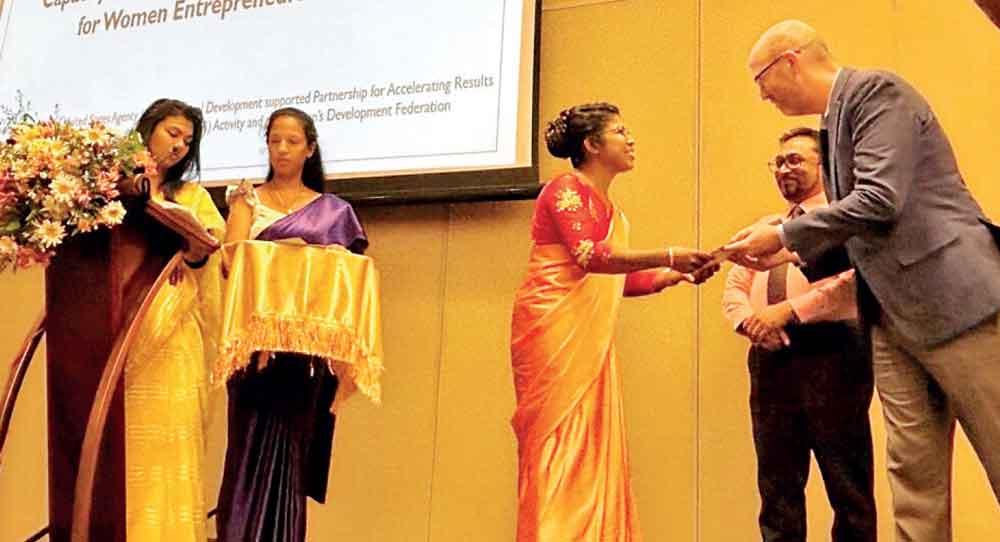
One of the forty women entrepreneurs who completed the year long USAID and WDF training and mentorship program receives her certificate from Dennis Wesner, Deputy Director, USAID Sri Lanka and Maldives Economic Growth (photo credit US Embassy)

An entrepreneur smiles following a certificate award ceremony upon completion of a year long USAID and WDF training and mentorship program (photo credit US Embassy)
|
USAID has frequently been criticized on the grounds of efficiency, transparency and the effectiveness of its initiatives Critics state that the USAID serves as a political instrument instead of a humanitarian organization The U.S.-Sri Lanka relationship has been historically complex, with USAID playing a significant role in the country’s development for decades |
USAID has also been a major funder of Sri Lanka’s civil society organizations, particularly those focused on governance, human rights, and inclusivity. With Trump’s stringent policies in place, concerns have emerged over the future of ongoing projects. Moreover, several initiatives have come under intense scrutiny, with allegations that USAID has sought to influence local governance in Sri Lanka
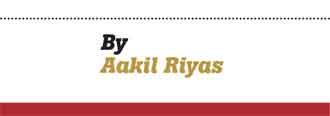 Two weeks ago, the Trump administration announced that it would be making sweeping budgetary cuts to the United States Agency for International Development’s (USAID) programme. This is not the first time President Trump has sought to prune government expenditure, nor will it be his last. In the wake of a 90 day freeze of the agency’s funds, the scales have tipped against the favour of many of its partner countries, including Sri Lanka.
Although the organization formally came into being under the Kennedy administration in 1961, the USAID website states that the agency has been deeply entrenched in crucial developmental affairs of Sri Lanka since 1958. This begs the question ‘how damaging is this blow to the country?’ And the answer is something you quite might not like.
The sudden freeze in funding has placed several local communities and ongoing projects within the country in serious jeopardy, this has also been coupled with widespread confusion causing severe disarray. Moreover, the lack of access to sufficient information on the cancellation of these disbursed funds, is another cause for concern.
With a network spanning 5 continents, the USAID is undeniably a humanitarian behemoth of its own. For a country such as Sri Lanka, the inexplicable lack of funding has dealt a debilitating blow to many an NGO within the country, but this is simply the prelude to the worst of it.
A considerable swathe of USAID employees from Sri Lanka are at risk of losing their jobs. This is part of Trump’s larger scheme of plans to cut down USAID employees from 10,000 to 300 personnel across the globe. It is almost derisive to even fathom the idea of a humanitarian organization so engrossed in development projects to have its work cut down for it in the eleventh hour. The agency has functioned as a set of crutches to many a civil society over the years, propping them on seemingly higher ground to achieve their initiatives. Then again, something to note is that this problem isn’t simply a ‘Sri Lankan’ problem per se, but one escalating rapidly across the globe.
The United States Agency for International Development (USAID) is a humanitarian organization known for vicariously projecting the U.S’ soft power across the globe.
Two weeks ago, the Trump administration issued an executive order announcing sweeping budgetary cuts to the U.S. Agency for International Development (USAID) programme. This decision has left many developing countries uncertain about the plight of their ongoing projects, most of which rely heavily on USAID funding. The consequences of such a decision extend beyond financial reticence, thereby raising elemental questions about the role of U.S foreign aid and its broader implications for global stability.
Criticism
The USAID was established in 1961under President John F. Kennedy, during the height of the Cold War, via the Foreign Assistance Act. Since its inception six decades ago, the agency has functioned as a vicarious tool of American soft power, across the globe. The organization’s humanitarian efforts have encompassed both man-made and natural disasters, spanning disaster relief, democracy building, economic development and medical aid. In 2023 alone, the agency disbursed a sum of approximately $44 billion in aid to over 160 nations across the globe.
Despite the agency’s consistent contributions, USAID has frequently been criticised on the grounds of efficiency, transparency and the effectiveness of its initiatives. Critics also argue that a lack of accountability had led to a mismanagement in funds, while others state that the USAID serves as a political instrument instead of a humanitarian organization.
Under fire
President Trump has sought to reassert his ‘American First’ doctrine to the world. While rooted in bolstering and prioritizing U.S. interests, this move has both alienated allies and antagonised adversaries of the nation. In the context of the USAID, during his initial tenure in office, Trump sough to curtail the agency’s budget under the pretext that overseas spending was unnecessary. His administration followed suit, consistently prioritizing domestic interests over foreign assistance. Trump has also continuously asserted that foreign aid is an unnecessary burden on American taxpayers.
Since his return to the oval office on January 7th 2025, the Trump administration has doubled down on its stance, by enforcing a 90-day freeze on U.S foreign development assistance, along with initiating a stringent review of all foreign aid programs. To quote article 01 of the executive order, “The United States foreign aid industry and bureaucracy are not aligned with American interests and, in many cases, antithetical to American values. They serve to destabilize world peace by promoting ideas in foreign countries that are directly inverse to harmonious and stable relations internal to and among countries.”
This move has sparked considerable controversy from various USAID stakeholders. Critics argue that the mobilization of aid funding is not temporary but a precursor to permanently defunding various foreign aid programs.
Proponents of these budgetary cuts argue that the USAID has long been riddled with inefficiencies and that foreign aid should be reassessed to ensure it serves national interests. However, opponents warn that such measures could weaken American influence abroad and may create a vacuum that rival nations, such as China and Russia, may seek to exploit. Billionaire Elon Musk, whom Trump appointed to lead the Department of Government Efficiency (DOGE), fueled further debate by stating on the social media platform X that USAID is “beyond repair.”
His comments have intensified public discourse, with some questioning whether the agency should continue or simply cease to exist. Musk’s involvement in government affairs, particularly in bureaucratic efficiency, has raised eyebrows, with critics arguing that his corporate-driven approach may not align with the complexities of foreign aid and diplomacy. However, Musk and Trump—both staunch capitalists—view curbing government expenditure as a key priority, framing USAID’s budget as a potential area for cuts.
Impacts on Sri Lanka
Then again, one might ask how this policy shift affects development projects in Sri Lanka, and there is no succinct way to explain this. The U.S.-Sri Lanka relationship has been historically complex, with USAID playing a significant role in the country’s development for decades.
Over the years, the agency has provided assistance for the tsunami reconstruction programme, post-civil war recovery efforts, and digital transformation programs. USAID has also been a major funder of Sri Lanka’s civil society organizations, particularly those focused on governance, human rights, and inclusivity. With Trump’s stringent policies in place, concerns have emerged over the future of ongoing projects. Moreover, several initiatives have come under intense scrutiny, with allegations that USAID has sought to influence local governance in Sri Lanka.
Dr. Prathiba Mahanamahewa, Former Commissioner: Sri Lanka Human Rights Commission & Attorney-at-law notes that, ‘the allegations Sri Lanka has made about the USAID seeking to influence local governance, is something that should be determined via forensic investigations and review reports.
Given Sri Lanka’s delicate political landscape, the potential reduction of USAID support raises concerns about the sustainability of crucial initiatives, particularly those aimed at democratic reforms and economic resilience.
Meanwhile, Dr. Paikiasothy Saravanamuttu, Founder & Executive Director of the Center for Policy Alternatives (CPA), emphasises that USAID has been the largest donor to Sri Lanka’s civil society and is having a devastating effect on smaller organizations focused on diversity and inclusivity. He also acknowledges that the renewal of funds after the 90 day suspension, presents a considerable challenge, as Trump’s administration continues its push for financial austerity. The maelstrom of controversy regarding USAID’s initiatives in Sri Lanka, rose from a statement circulating on social media claiming that $7.9 million was allocated to training journalists on gendered language usage. While such initiatives have merit in promoting inclusivity and media ethics, they have also become a focal point of criticism regarding USAID’s spending priorities in Sri Lanka.
The Trump administration’s argument that such expenditures do not serve core American interests has fueled further debate on whether USAID funding should be reevaluated. The controversy underscores a broader ideological divide over the purpose of foreign aid whether it should primarily serve humanitarian goals or align strictly with national strategic interests.
On shaky ground
The uncertainty surrounding USAID’s future extends beyond Sri Lanka. As Trump’s administration continues to push its hardline stance on foreign aid, recipient nations worldwide must reassess their development strategies. Many countries that have traditionally relied on U.S. assistance now face the prospect of seeking alternative funding sources.
This leaves ample room for China to navigate the chessboard as a competitor for international development. China’s Belt and Road initiative (BRI), for instance, has emerged as a competing model for viable international development. With the capacity to provide infrastructure financing with fewer political constraints, China is perfectly poised to foray into the world if the opportunity permits. Moreover, the rapidly shifting geopolitical landscape raises questions about whether U.S withdrawal from foreign aid, would inadvertently strengthen Beijing’s influence in developing nations.
The broader implications of USAID budget cuts extend to global diplomacy. Foreign aid has long been a key instrument of U.S. soft power, fostering alliances and vicariously promoting American values abroad. By reducing its humanitarian footprint around the world, the U.S. risks diminishing its global leadership role, potentially allowing authoritarian regimes to expand their influence. Critics argue that such a shift not only weakens America’s moral standing but also undermines long-term strategic interests. There is much to be seen on whether this pivot would affect the United States stance as a great power in the world.
In conclusion, the Trump administration’s decision to suspend USAID funding is a reflection of its broader policy approach—prioritizing domestic interests while reexamining America’s role in global affairs. While some view this move as a necessary step to curb government spending and reassess the efficiency of foreign aid, others warn of its far-reaching consequences.
In Sri Lanka’s case, USAID has played a pivotal role in supporting civil society, governance, and economic recovery. The prospect of losing this assistance presents significant challenges for ongoing initiatives. As the debate over foreign aid continues, the fundamental question remains: is the restructuring of USAID a step towards better efficiency, or does it signify a retreat from America’s longstanding commitment to global humanitarian efforts?
13 Jun 2026 5 hours ago
13 Jun 2026 5 hours ago
13 Jun 2026 7 hours ago
13 Jun 2026 7 hours ago
13 Jun 2026 8 hours ago