11 Jul 2025 - {{hitsCtrl.values.hits}}
Israel- Iran conflict
Third-party triggers, Thucydides traps, and the illusion of strategic control in an entangled world
By J.S.K. Senevirathne
& Chaminda Priyadarshana
The genius of diplomacy is not in its mastery of force, but in its restraint from using it. Yet history, like a deaf sovereign, often favours the loudest actors. The 12-day war between Israel and Iran in June 2025, overshadowed by media spectacles and spun as a “strategic victory” by its instigators, demands more serious attention. Beneath its tactical brevity lies a tectonic disturbance in international relations. It was not merely a regional skirmish, but a near-fatal rehearsal of a world war in miniature, with the U.S., Russia, and China all dancing near the brink.
The article explores how the 12-day war echoed the Cuban Missile Crisis, mimicked the miscalculations of World War I and exposed the modern vulnerabilities of global powers to small allies and third-party spoilers. Central to the argument is that far from being in control, major powers are now more exposed than ever to “accidental war by proxy” a phenomenon both feared and predicted by strategic theorists like Graham Allison and ancient observers like Thucydides.
A Flammable Landscape: Revisiting the 12-Day War
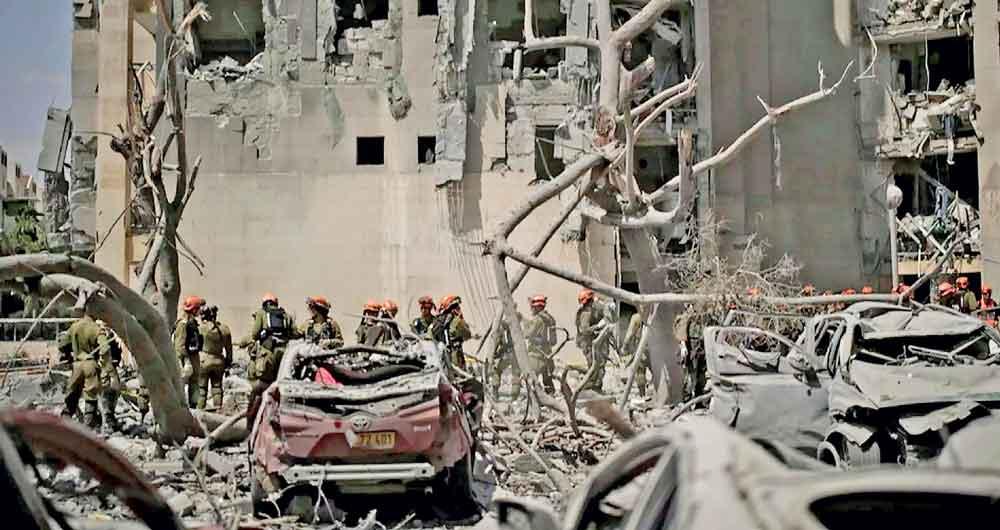
The Israeli air assault on Iranian nuclear and IRGC assets on 12th June, codenamed Operation Rising Lion, was launched with surgical precision and diplomatic audacity. Israel’s justification; Iran’s probable nuclear weapons programme, plus Hezbollah’s expanded operations in southern Syria. Tel Aviv acted unilaterally, with no formal U.S. green light and no consultation with the UN or NATO.
But in doing so, Israel detonated a geopolitical tripwire.
Iran retaliated with drone swarms, missiles and possibly cyber operations targeting Haifa and Dimona. The U.S under Donald Trump’s return to office responded with targeted bombings in Iran’s western military zones, under the guise of defending “regional stability.” Russia activated war games in the Caspian and China issued thinly veiled warnings to Washington about “further escalation in sovereign spaces.” NATO’s Article 5 was dusted off in backroom talks. The world stood at the edge.
As expected India went on high alert and tip toed a ‘balancing cum partisan act’. The South Asian power is known for ‘strategic perplexity’ under the Modi regime.
The Shadow of Sarajevo: Historical Parallels to 1914 and 1939
This confrontation mirrors the original ignition of World War I (28th June 1914), when a minor state (Serbia) drew great powers (Austria-Hungary, Germany, USSR, Britain) into total war through alliance entanglements and nationalist escalation. Netanyahu, in this analogy, is the modern Princip—a smaller actor with disproportionate power to provoke global calamity.
Similarly, in 1939 (01st September), ideological rigidity and assumptions of swift victory emboldened risk-takers. Netanyahu believed in a rapid strike. Iran misread U.S. intent. The United States assumed that an overwhelming force would contain the problem. It nearly didn’t.
The lesson: strategic certainty is the most dangerous illusion.
Trump, Brinkmanship, and the Illusion of Deterrence
President Trump’s role in this crisis is paradoxical. He escalated quickly but pivoted faster. His authorisation of limited strikes on Iranian infrastructure may have prevented a protracted regional war, but only after taking the world to the edge of nuclear confrontation.
This pattern is not new. In the Cuban Missile Crisis, President J.F Kennedy threatened war, then brokered peace by privately conceding to remove Jupiter missiles from Turkey. Trump’s pivot was similarly transactional; bomb first, then mediate.
Yet the Trump doctrine reveals something deeper; a personalised diplomacy built on spectacle and gamble, not institutional foresight. His decisions bypassed the State Department, rattled NATO, and revealed how one leader’s instincts, unchecked, can both make and unmake peace in a hyper-connected age.
The Thucydides Trap Reloaded: When the Old Order Clashes with the New
China and the United States, long circling each other like anxious giants, were pulled closer to direct confrontation. Not by their own choice, but by regional actors (spoilers) operating on narrower goals. Israel, fearing Iranian ascent. Iran, emboldened by strategic depth. Each played the rising power card, daring the old guard to respond.
This is the modern Thucydides Trap; not a great power challenging another, but a smaller one triggering the clash by daring the established order to defend its credibility. This makes the world far more volatile than in Thucydides’ original formulation.
Where Athens and Sparta once sized each other with open contempt, today Washington and Beijing find themselves one missile away from war because of Tehran or Tel Aviv.
Netanyahu as Catalyst: Mastermind or Madman?
Critics of Prime Minister Netanyahu argue that his legacy is one of permanent escalation. Having lost political ground after Gaza, he needed a grand narrative, an existential threat to national survival, to cement power. The Iran strike offered that, even as it gambled with the future of millions.
Netanyahu’s strategies reveal the emerging power of “spoiler states”, those who can leverage larger alliances and nuclear ambiguity to reshape regional dynamics. Their danger lies in their confidence that great powers will clean up the mess they start.
This pattern is evident in other theatres: Ukraine’s delusion of continuous Western military aid, Taiwan’s assertiveness, Pakistan’s tactical brinkmanship, and North Korea’s theatrical threats. Each knows that the more dangerous they seem, the more attention and leverage they gain.
Lessons for Strategic Thinkers: Deterrence in the Age of Third-Party Chaos
We are no longer in the age of binary deterrence. Cold War-era stability, for all its flaws, operated on rational actor models and mutual assured destruction. Today, strategic control is diluted by:
The greatest threat to world peace today is not rivalry, but misalignment—the fact that local actors operate with regional goals, while their patrons bear global consequences. As an emerging IR theory, ‘Dual Utility of Collectivism’ provides a tool to understand this complexity.
Toward a New Doctrine: Containment of Allies, Not Just Enemies
The final and perhaps most controversial insight is this, to avoid a world war, the U.S., China, and Russia must not only deter each other, they must contain their own allies.
Preventive diplomacy must include the threat of sanctioning allies who act without consultation. It must shift from “mutual defence” to “mutual restraint.” Failure to do so leaves the great powers exposed, dragged, not marching, into war.
Conclusion: Strategic Sobriety in a Hall of Mirrors
What the 12-day war teaches us is not simply that nuclear catastrophe is still possible, but that it now arrives through accidental entanglement, personal politics and third-party adventurism. As Thucydides might warn, the future will not belong to the strongest or most virtuous—but to the most careful.
It is time international relations graduates stop romanticising statecraft and begin studying chaos theory and experimenting with the theory of ‘Dual Utility of Collectivism’.
In a tangled world, it is not our enemies who endanger us most, it is our friends. And how true!
Let this chapter serve as a lens, not of alarmism, but of vigilance. In this age, the master strategist is not the boldest, but the one who knows when not to act.
09 Jun 2026 15 minute ago
08 Jun 2026 08 Jun 2026
08 Jun 2026 08 Jun 2026
08 Jun 2026 08 Jun 2026
08 Jun 2026 08 Jun 2026