10 Jun 2025 - {{hitsCtrl.values.hits}}
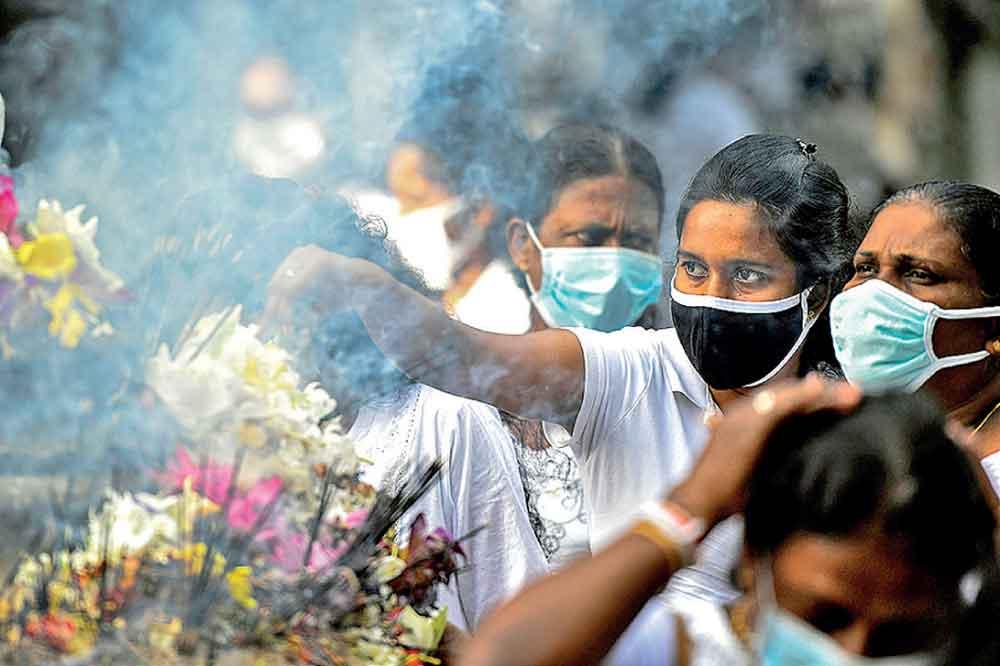
In Buddhism, flowers hold profound symbolic meaning to the nature of existence, beauty, and impermanence, serving as a powerful reminder of life’s transient nature
 Impermanence refers to the temporary and uncertain nature of much of what people perceive as reality. People often cling to the illusion of stability and permanence in their lives. Still, a deeper examination reveals that everything is constantly changing—even those things they perceive as solid and unchanging. This assumption of certainty sharply contrasts with one of the fundamental insights of Buddhism. Despite the reality of continuous change, people often mistakenly invest in multiple aspects of life as if they are fixed and certain, as modern life has insulated them from this basic truth. They build stupendous structures that seem eternal and enduring institutions meant to outlast generations, and technological systems that promise to solve all problems.
Transience is the universal law of all phenomenal things, and it teaches us that nothing remains the same for two consecutive moments. Buddha observed, “Impermanent are all things. They arise and cease, that is nature; They come into being and pass away. Release from them is bliss supreme” (D 157). “Everything that the nature of arising has the nature of ceasing.”
Impermanence is a fundamental concept in Buddhism and many other spiritual traditions. This idea is not solely religious or exclusive to Buddhism; it can also be found in Christianity. For example, James, the brother of Jesus, writes in the New Testament, “Why, you do not even know what will happen tomorrow. What is your life? You are but a mist that appears for a little while and then vanishes” (James 4:14). Additionally, in the Gospel of Mary Magdalene, Jesus states, “All that is born, all that is created, all that is composed, shall be decomposed.”
The concept of impermanence is, therefore, something that is empirically verifiable and observable throughout the entire universe. No other religious teacher or philosopher has articulated the reality of impermanence as profoundly as the Buddha. It is a sublime truth and the crux of Buddhist philosophy. Everything in this world transforms and ultimately perishes. Nothing remains constant, even for a single moment.
What is built eventually crumbles and falls, whoever is born will eventually die, and what comes together will ultimately separate and fall apart. All things change, nothing ever stays the same. Change is the essence of life and the essence of existence. It is the inescapable reality. In other words, nothing—divine or human, animate or inanimate, organic or inorganic is permanent, stable, unchanging, or everlasting.
We can visualise four areas of impermanence: physical, emotional, mental, and social. We can see how the physical world is changing and by the periodic changes of the seasons, ageing, sickness and death. In the emotional world, we can see impermanence through the constant changes of feelings and emotions, as one moment we might be euphoric, happy and elated next moment feeling sad and melancholy. Mentally, our ideas, thoughts and concepts change occasionally, and new ideas and concepts come into being. Lastly, from the social perspective, we form new relationships, we meet new people, we separate from our dear loved ones, we change our employment and get into new jobs, and eventually, we lose our loved and dear ones.
King Pasenadi of Kosala at Savatthi once asked Lord Buddha, “Venerable Sir, is there anyone who is born free from ageing and death?” Then Gautama Buddha replied, “Oh, great King, no one who is born is free from ageing and death. Even those affluent, rich, with great wealth and property, with abundant gold and silver, and abundant treasures, because they are born, are not free from ageing and death.”
In Buddhism, flowers hold profound symbolic meaning to the nature of existence, beauty, and impermanence, serving as a powerful reminder of life’s transient nature, the uncertainties of our lives and the pursuit of spiritual growth. The practice of offering flowers to Buddha, reciting “Pujemi buddham kusmenena, punnena metana labami mokham puppham milayati yatha yatha idam me kayo thathyati vinasa bhavacvam”, holds profound significance in Buddhism.
According to Dr. Deepak Chopra, an influential American physician and author, embracing impermanence can lead to personal transformation and a greater sense of freedom from attachments to material possessions and external validation. Everything, including our experiences, emotions, and even life itself, is impermanent. Recognition of impermanence leads to greater mindfulness, acceptance of change and richer appreciation for the moment. Understanding impermanence can foster a deeper connection with others and reduce anxiety.
The renowned Greek Philosopher Heraclitus once declared, “No man ever steps in the same river twice, for it is not the same river and he is not the same man”.
There is no static being, no unchanging substratum. In his notes to the novel “Chance”, one of the greatest Polish British novelists, Joseph Conrad, stated thus: “The history of men on this earth may be summarised in one phrase of infinite poignancy: ‘They were born, they suffered, they died
In a society filled with unrealistic pursuits, many individuals attempt to express their identities through the accumulation of material possessions. They often go to great lengths to achieve this. The desire for social acceptance and the need to conform to societal norms lead them to justify their acquisitions. They depend on such temporary items as luxurious cars, jewellery, expensive clothing, cosmetic products that enhance their appearance, grand houses, and countless other products to define their identity and self-worth. They buy more than they need to attain social status through these worldly possessions and keep up Joneses, completely oblivious to the fact that they are temporary and transient. The impermanence of earthly things should serve as a call to prioritise spiritual growth, community and service over the pursuit of material wealth or temporal achievements.
Buddhism teaches that all things are interconnected, impermanent, and governed by cause and effect. Grasping these truths empowers us to let go of our clinging tendencies, paving the way for relief from suffering. The Dhamma—encompassing teachings like the Four Noble Truths and the Eightfold Path—provides us with practical guidance through mindfulness meditation and ethical living. These practices help us navigate the complexities of life and steer us away from the pain that arises from attachment.
Interestingly, Buddhism presents a paradox: acknowledging life’s uncertainty and the potential for everything to fall apart at any moment can lead to peace of mind and genuine happiness. Yet, according to Buddhism, accepting the all-pervading nature of impermanence can also be liberating because it opens us up to a world of endless possibility.
Impermanence and suffering
Man has achieved great marvellous things throughout the centuries; his ingenuity and strength have enabled him to conquer space and subdue matter to his will. Today, it is possible to save and prolong life through the use of wonder drugs and other medical and surgical techniques that were unavailable a few years ago. Heart and lungs, and other artificially created organs, are transplanted into people suffering from many diseases to prolong their lives. The world can offer a person anything he fancies except permanence. Even with the most brilliant application of modern science and technology, man has not yet seen the possibility of outlawing the ephemeral nature of human life and his ultimate enemy: death. Yet for all his capabilities and ingenuity, he remains fragile and vulnerable in the face of impermanence.
Non-attachment or detachment does not mean we stop caring; instead, it signifies that we care without holding expectations or demanding specific outcomes. The fleeting nature of our existence should not lead us to act with indifference; rather, it should inspire us to act with wisdom and compassion.
Today, people are living in uncertain times, and no one knows exactly what will happen to our lives and the lives of our loved ones, as the pandemic we are going through is unprecedented and unpredictable.
Impermanence brings us face to face with our mortality, in the face of the ravaging covid-19 pandemic. The way things are turning out, we may not live through the day. When we look around at our people, relations, possessions, all will one day be gone. Lord Buddha’s last admonition to his disciples was “all conditioned things are impermanent, subject to change and strive on with diligence”.
In other words, we cannot think of any object in this conditioned world that is not annicca. When we comprehend the basic truth of Impermanence (annicca), the tendency to cling to our attachment to worldly things is bound to diminish, and our lives become enriched with great equanimity so that we are in a better position to let go of our belief of permanence and stability of our life.
Impermanence continually presents challenges and people are faced with various life obstacles that are often out of their control. Recognising the reality of Impermanence not only will help us to live in the present moment but also increase our ability to overcome difficulties in life.
Although Buddhism emphasizes the universality of suffering it cannot be characterised as a pessimistic religion. It is neither totally pessimistic nor optimistic but realistic as it not only emphasizes the truth of suffering but also suggests a means to end the suffering and gain eternal happiness.
13 Jun 2026 1 hours ago
13 Jun 2026 1 hours ago
13 Jun 2026 4 hours ago
13 Jun 2026 4 hours ago
13 Jun 2026 4 hours ago