18 Jul 2018 - {{hitsCtrl.values.hits}}
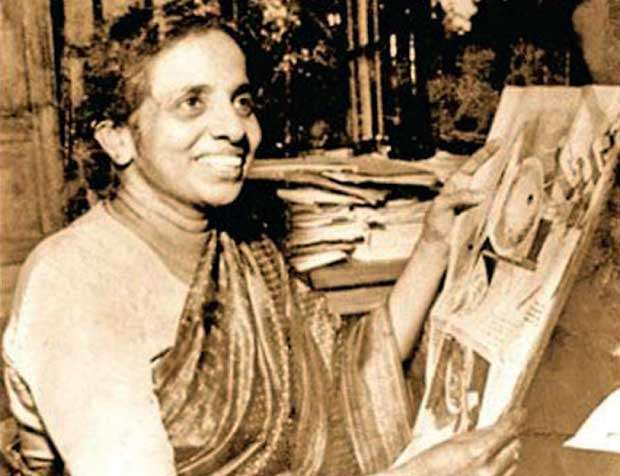
An annual feature in the Old Girls Association (OGA) calendar is the Susan George Pulimood Memorial Oration held every year on the 23rd of July to commemorate the birthday of Mrs. Pulimood who served Visakha Vidyalaya as Principal for 22 long years – laid the visionary foundations and her dedication led to Visakha being established as a ‘Super Grade’ school. She opened new doors for young Buddhist women hitherto restricted to the home sciences, by introducing the Science section.
An eminent past Visakhian who has distinguished herself in her chosen profession, is selected each year to deliver the oration.
This year the oration will be delivered by Prof. Niranjanie Ratnayake (nee Kodikara ) (BSc Eng (Hons) (Cey), MEng (Wales), Chartered Engineer FIESL., Member IEPSL, Emeritus Professor, Department of Civil Engineering, University of Moratuwa President, Institution of Engineers Sri Lanka, President Elect, Institute of Environmental Professionals Sri Lanka) The oration under the theme ‘Breaking Barriers and Changing the World – Women in Engineering’ will be delivered at the Jeremias Dias Hall, at Visakha Vidyalaya. The Trust also awards scholarships annually to students achieving academic excellence based on their performance at the GCE A/L examination in the Science (Bio & Physical), Arts and Commerce streams. The Pulimood Trust is sustained by the generous contributions made by the old girls and with their support the event had been continued uninterrupted for the past 27 years.
Synopsis of the Oration to be delivered by Prof. Niranjanie Ratnayake. ‘Breaking Barriers and Changing the World – Women in Engineering’ Gender stereotyping has been an ongoing practice in both the developed as well as developing world since time immemorial. Whilst some conservative cultures strictly enforce a differentiation between males and females in education, employment, and social freedom; even in the more liberal cultures, stereotyping is still apparent from the day a child is born. Girls are dressed in pink dresses with bows and ribbons, expected to play with dolls, and are seen to be timid and weak; whereas boys are dressed in blue, expected to play with trucks and trains, and often complimented for being tough and rough. Boys should fix things while girls need things fixed. As girls grow up, they are expected to be beautiful, graceful, soft spoken, and cultured, whereas boys will be handsome, outspoken, and strong. Boys are expected to be strong in science and mathematics and girls strong in the Arts. Even if the girls do get into science, they may study medicine or biological sciences, but rarely engineering. Boys will become Surgeons, Engineers, and Pilots, whereas girls will stay at home as housewives or take up jobs like nurses, primary teachers or secretaries. This is the typical stereotyping of roles given to boys and girls by society.
Since my childhood days, I have always challenged these stereotypes. Looking back at my time spent at this prestigious institution, I can see how my own views and attitudes were formed and influenced by strong female role models who also challenged society’s lazy stereotyping of how a woman should live her life. Our school’s founder, Mrs. Jeremias Dias, after whom this hall I address you incidentally is named, and Susan George Pulimood who I honour with my oration, were not only pioneers in the advancement of girls’ education in Sri Lanka, but were in their own right tremendously successful bonafide specialists in their fields of running a top class educational institution for girls, helping them to break the barriers imposed by a patriarchal society.
I speak to you today as a Professor Emeritus in Civil Engineering of the University of Moratuwa, as well as the current President of the Institution of Engineers Sri Lanka. I was the first female to achieve this combination, but I am hopeful I am merely the start of a long line of many more to come. To become an Engineer, as women, we have to break these social barriers I mentioned previously. Female Engineers have been coined ‘double stereotype breakers’; the stereotype for a ‘good woman’ as well as that for a ‘good engineer.’ Family and school support is extremely important for any girl taking this step. Visakha Vidyalaya has always empowered girls to take on challenges and do what they are best at, not being confined to stereotypes. This foundation helps a girl to confidently enter a male dominated field and still be a ‘good woman’; beautiful, graceful, eloquent, and cultured.
We become engineers because we get excited about solving problems and making things happen, by design. Engineers change the world – We improve human life by catering to the needs of society, providing solutions to facilitate everything from basic human necessities such as shelter, food, and water to transportation, clothing, and medical equipment to fancy extravaganzas like Trevitas and Lamborghinis. We help advance cultures through providing platforms for entertainment and communication. We conceptualize solutions, design them, and implement them. We also design and implement others’ concepts, collaborating with architects, doctors, and scientists to create buildings, medical equipment, and laboratories. Engineers at NASA are working hand in hand with astronauts right now, designing and implementing their concepts for space travel to another planet! This list is endless. Without engineers, these concepts would remain merely as ideas. It is the engineer’s role to design safe and functional solutions to all kinds of problems faced by others, and bring them to life. That is how Engineers are changing the world. I do not see being a woman as a handicap for being an engineer. Gaining the right skills and having the passion for what you are doing are the important factors to be successful as a female in engineering.
“I wish people would stop being impressed by the fact that I’m a Woman Engineer. We want it to be normal to see beautiful, social, intelligent women out there that are engineers”
This statement by Stacey DelVecchio, Past President, Society of Women Engineers, USA, nicely sums up the sentiment most of us women engineers feel at work as well as when we meet people socially.
To all the parents and teachers in the audience, I urge you to help your daughter and pupil to find her passion, be it Engineering, Business, Surgery, or anything in between, encourage her to break all barriers she comes across, and not let stereotyping stop her from changing the world into a better, more beautiful, peaceful and happy place to live in.
18 Jun 2026 13 minute ago
18 Jun 2026 54 minute ago
18 Jun 2026 2 hours ago
18 Jun 2026 2 hours ago
18 Jun 2026 2 hours ago