06 Feb 2017 - {{hitsCtrl.values.hits}}

Speaking about the misuse of plastic, Dr. M.A.B. Prashantha, a senior lecturer at the Department of Chemistry of the University of Sri Jayawardenepura said cultural practices were mainly responsible for the misuse and the consequent damage. “We are highly dependent and addicted to consumerism. So our social dynamics have changed from simplicity to a more complex context. Therefore we tend  to buy more than our needs while consumerists produce different products to cater to this need. Thus there is an inflow of plastics in various shapes,’ he said.
“Often, we see people buying oil in shopping bags. Chemicals can leach into the oil. Garden hoses should not be used to provide water for drinking. Toxic chemicals are used to make this rubber. We don’t know how much of them leach into the water. But we often see, especially at funerals, how drinking water is provided through the hose,” he added.
“There is no practice among our people to carry a bag to purchase goods”, he said. “When we buy something from the market, it is also given in a polythene bag. We use plastic shopping bags unnecessarily,” he added.
Polyvinyl chloride (PVC) is one of the most used plastics in the world, though the use of PVC is phasing out in certain countries. “PVC is a lethal plastic because it is fairly unstable. Manufacturers use additives to improve the stability of PVC. The additives can leach into the water and the soil. Ultimately, additives used can pollute the groundwater. It can enter the human body through food chains,” said Dr. Prashantha.
He said PVC plastic could affect the endocrine system (hormone system). “Additives can accumulate in our fatty tissues and the additives can mimic the effect of hormones. This affects our endocrine system and central nervous system. Research shows that hormonal change can cause infertility,” he added.

Research has also established links between endocrine disrupting chemicals and diseases such as cardiovascular diseases, diabetes, cancers, neurological effects and obesity. Bisphenol A (BPA), an endocrine disrupting chemical, leaches from polycarbonates (PC) such as plastic baby bottles at high temperatures and when reusing. “Plastic bottles containing BPA (bisphenol A) are not used in the United Kingdom. In certain countries it is mandatory to include whether the plastic includes BPA or if it is BPA free,” said Dr. Waruna Gunathilaka, the Head of the Toxicology Department of the National Poison Centre.
“PET (polyethylene terephthalate) bottles contain phthalates, which is a known cause for various cancers including prostate cancers. If the surface is indented, crushed or faded, one must refrain from buying them. It is not advisable to buy water bottles exposed to direct sunlight as certain chemicals can leach into the water due to the heat. This is why we need to recycle water bottles and not reuse them,” said Dr. Ruwan Wijeyamuni, the Colombo Chief Medical Officer.
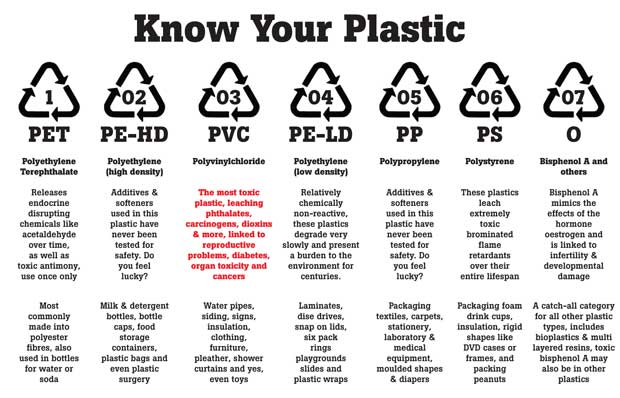
“Similarly, we have problems with polystyrene (Styrofoam lunch boxes). It is bad when hot oily food is directly served onto the polystyrene, because the styrene can leak into the food,” said Dr. Wijeyamuni. He added that this could cause allergic reactions and skin problems in the short term, while in the long run various alimentary tract problems and indigestion could be caused while it could trigger the growth of cancer cells.
“When you look at the death pattern of Sri Lanka about two decades ago, the main cause of hospitalized death was infectious and parasitic diseases. Now we have started to mimic the death pattern of the developed world where heart attacks, strokes and cancers dominate,” he said, implying that plastics had a role to play in this.
Commenting on polystyrenes, Dr. Gunathilake said there was no culture of using a lunch sheet over Styrofoam to serve food in the developed world. “They usually use cardboard because it is safer,’ he said.
 Dr.M.A.B.Prashantha, a senior lecturer at the Department of Chemistry of the University of Sri Jayawardenepura
“We have to be careful about plastic contact with food items. Food can be contaminated because of the leaching effect. Food grade plastic is relatively safe, but in our country, we are not assured as to whether the plastic used is food grade or not,” said Dr. Gunathilake.
Citing an example of day-to-day misuse of plastic, he explained how kirihodi is often given in a red sili sili bag when buying string hoppers. “Red and green are also chemicals. So with the heat of the gravy, chemicals can seep out of the polythene,” he said.
He noted how in other countries the quality of plastic products were regularly checked. The International symbol for food grade plastic is a wine glass and fork. The plastic should be able to maintain its composition and not affect the quality of the content it is used to protect, for instance, medicines.
“Straws are also plastic. But we don’t know if they are food grade. We don’t know what chemicals they use. We don’t know the ingredients of lunch sheets either,” he said.
Plastics should be recycled. However Dr. Gunathilake pointed out that certain provincial councils did not collect plastic waste which compelled people to burn them in their garden. “Plastic should not be burned as it causes air pollution and pollutes groundwater. It emits dioxin and furan which are very toxic and act as a Persistent Organic polluter (POP),” he said. Dioxin is carcinogenic and can cause throat, nasal cavity and lung cancers.
“Plastic is fat soluble, can enter food and can persist for a long time- for about 25 to 30 years. There should be a recycling procedure in this country,” he added.
When asked about the negative effects of plastic recycling, as chemicals could be emitted when melting them for the purpose of recycling he said, “In the developed world plastic is incinerated in a controlled temperature plant where the damage can be minimized.”
Adding that there was neither a proper plastic reuse plan nor proper recycling taking place, Dr. Wijeyamuni quizzed as to whether people handed over used plastic bottles to recycling centres. “PET bottles are recycled to a certain extent but how many of us are really returning PET bottles to these centres and how many centres do we have?”
Shedding further light on this, Dr. Prashantha said that even if plastic was recycled at the end, it was dumped into the environment. “When you recycle plastic over and over again, the grade decreases and its properties weaken. Ultimately it becomes waste,” he said.
“Plastic is incinerated to produce energy. But when you burn plastic it emits carbon dioxide which contributes to global warming,” he added.
 Dr.Ruwan Wijeyamuni, the Colombo Chief Medical Officer
The use of plastic should be minimized. Ceramic-ware, glassware and stainless-steel ware could be used instead of plastic for storing and carrying goods.
Dr. Gunathilake said that the developed world, especially the European Union, was attempting to minimize the usage of plastic through legislature. “They are discouraging the use of plastic, whereas we are trying to popularize it. In the United Kingdom, 5 pence is charged for every plastic carrier bag, though it was free initially. After this legislation, the use of plastic bags has dropped,” he said.
When asked about the laws and regulations with regards to the use of plastic, Ajith Wijesundara, the Director of Waste Management at the Central Environment Authority (CEA) said there were Local Authority Acts and ordinances stating that they should manage plastic waste. “In addition, there are provisions in the National Environment Act to not pollute the environment. Then there is a regulation banning the use, manufacture and sale of plastic and polythene below 20 microns. There are provisions in the Food Act of the Health Ministry regarding the ingredients of the polythene for medicines and food,” he said. He added that though plastic should be disposed into landfills there were not many landfills in Sri Lanka.
03 Jul 2026 7 hours ago
03 Jul 2026 7 hours ago
03 Jul 2026 7 hours ago
03 Jul 2026 8 hours ago
03 Jul 2026 8 hours ago