23 Jan 2017 - {{hitsCtrl.values.hits}}
When history began to turn against Hitler, he issued an infamous secret directive known by its codename: “Night and Fog”. It allowed the Nazis to abduct anyone by night, so that they effectively vanished without trace.
Under cover of “Night and Fog”, Hitler’s forces set about “the immediate, effective and enduring intimidation of the population.” It was spearheaded by Field Marshal Wilhelm Keitel. He told his forces: “Efficient intimidation can only be achieved either by capital punishment or by measures by which the relatives of the criminal and the population do not know [the prisoner’s] fate.”
“Silenced Shadows”, just published, is a deeply troubling testament to the Night and Fog of our times. It’s a chilling reality revealed by the statistical evidence from dozens of countries around the world. 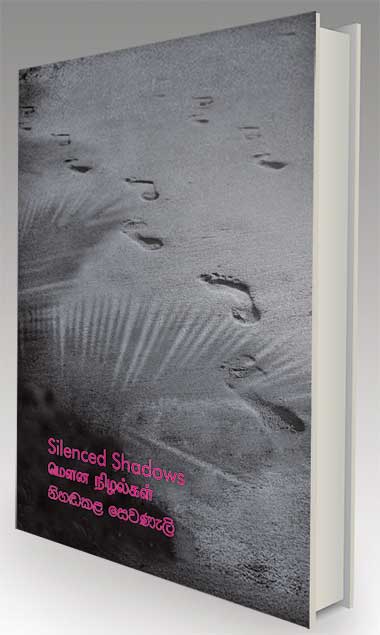 What the facts show is that the poison of this cancer has now entered the blood stream of contemporary nations under democratically elected governments.
This slender volume of poetry is filled – in Sinhala, Tamil and English – with the voices of those whose loved ones have been abducted and made to vanish without trace over the decades of violent conflict in Sri Lanka.
In her poem “Still Waiting”, Radhia Rameez watches a mother sitting “outside the skeleton of her house, weaving palm baskets with her dead fingers, and waiting”:
‘’her eyes are a story
and in them I read
of stolen people,
vanished off the earth
like shadows in the night,
of war and carnage and burning palm trees,
the torture of uncertainty...’’
This mother is not alone in her agony and bewilderment. The numbers affected are staggering: the United Nations Working Group on Enforced or Involuntary Disappearances ranks Sri Lanka second in the world in the total number of cases reported to that body (some 12,000). Amnesty International says the number is a mere fraction of tens of thousands of complaints made to local commissions throughout the country.
The Chilean poet and author Ariel Dorfman, himself a survivor of the brutal coup that brought General Pinochet to power, continues to speak out worldwide in protest against these crimes. He also asks us to honour the courage and tenacity of those who – like the poets of “Silenced Shadows”— have refused to let their loved ones be forgotten.
“We have grown strangely used to them over the last 25 years,” Dorfman told an Amnesty International conference in Edinburgh, “the women with a small photo of a man pinned to their dark dress, the extended tribe of those whose loved ones, from Chile to Kurdistan, from Argentina to Ethiopia, from Guatemala to Guinea, have been abducted in the night and never heard of again. Mothers and daughters, wives and sisters, demanding to know the true fate of their men, demanding that they be returned to their families alive. They have become a habitual presence, these faraway women on the television screen asking at least for a body to bury, that they be allowed to start mourning their dead.”
But it is not only the cases of menfolk that fill the grim dossiers of the disappeared. The lethal cocktail of illegal detention, torture, sexual violence and extrajudicial killing has claimed the lives of countless women. Children have also been seized, tortured and killed. The legions of the disappeared have been dragged into seeming oblivion not only by agents of the state, but also by armed opposition groups – all acting lawlessly and in violation of the most fundamental standards of humanity.
Nor is it only the wish for closure and for the final rituals of mourning that rise from the pages of “Silenced Shadows”. Society, power and justice are laid out like corpses in a mortuary for examination. “I believed in rules and the law,” writes the author of “Looking for Raju”:
“What is the rule, the law that allows
stealing of the young,
And then making them disappear...
This volume comes hard on the heels of the comprehensive report of the Consultation Task Force set up by Sri Lanka’s president as part of the country’s truth, justice, reconciliation, and non-recurrence process. The Task Force received more than 7,000 submissions, many of them expressing outrage at the huge backlog of unresolved disappearance cases.
“There will be over 100,000 complaints to the Office of Missing Persons,” the Organization of Families of the Disappeared told the Task Force. Lest anyone think the problem is somehow limited to one ethnic group alone, or only to terrorist suspects and the war, the Task Force report presents what it calls “a sobering catalogue” of no fewer than 15 different categories of disappearances spanning all communities.
The decades of Night and Fog stretch from the 1970s through to June 2016. “It was heart-breaking,” says Manouri Muttetuwegama, chair of the Task Force, “to see people coming from the South, still looking for answers for those who had disappeared during the 1971 JVP insurrection.”
Despite three previous disappearance commissions, including an All IslandDisappearances Commission, there is still a population within the country looking for answers, and for justice - evoked in the verses of “Looking for Raju”:
“Tens of thousands of such men,
Such women, walk this country.
In the South, the North and the East,
Everywhere, every day, asking the same questions.”
“They are most probably dead,” the country’s Prime inister told a British journalist in January 2016 when asked about the disappeared last seen alive in government custody:
Jon Snow (Channel 4): “We have specific cases in which people are recorded as having surrendered. They were seen in detention one year on, but they cannot now be seen. You’re saying they’re dead.”
Prime Minister: “They are most probably dead.”
It is an answer as chilling as the sleepless nights that haunt the aching verses of these poems.
Every year hundreds of thousands of Amnesty International supporters send personal letters to families of the disappeared, or appeals to governments on their behalf.
“At a time in history where it is all too easy to feel defenceless and passive and irrelevant,” says Ariel Dorfman, “it is heartening to see how some of the least powerful people on this earth can score a victory of the imagination against their enemies, can prove that it is possible for the modernity of human rights to defeat the modernity of inhuman authoritarianism. Indeed, the relatives of the disappeared are handing us a model for how other humans can make use of the forces of globalization to make this world a less threatening home for us all.”
“Every time I come home and see all the cards and letters it reminds me that people are working on this. [It] gives me strength to keep going,’ says Sandya Eknaligoda whose tireless campaign has been an inspiration to many. Her husband, Prageeth Eknaligoda, one of Sri Lanka’s leading investigative journalists, was reported missing two days before the country’s 2010 Presidential Election. He was working for a pro-opposition website.
She went to the police. Her words, if printed as poetry, would slip seamlessly into “Silenced Shadows”:
03 Jul 2026 7 hours ago
03 Jul 2026 7 hours ago
03 Jul 2026 7 hours ago
03 Jul 2026 7 hours ago
03 Jul 2026 8 hours ago